
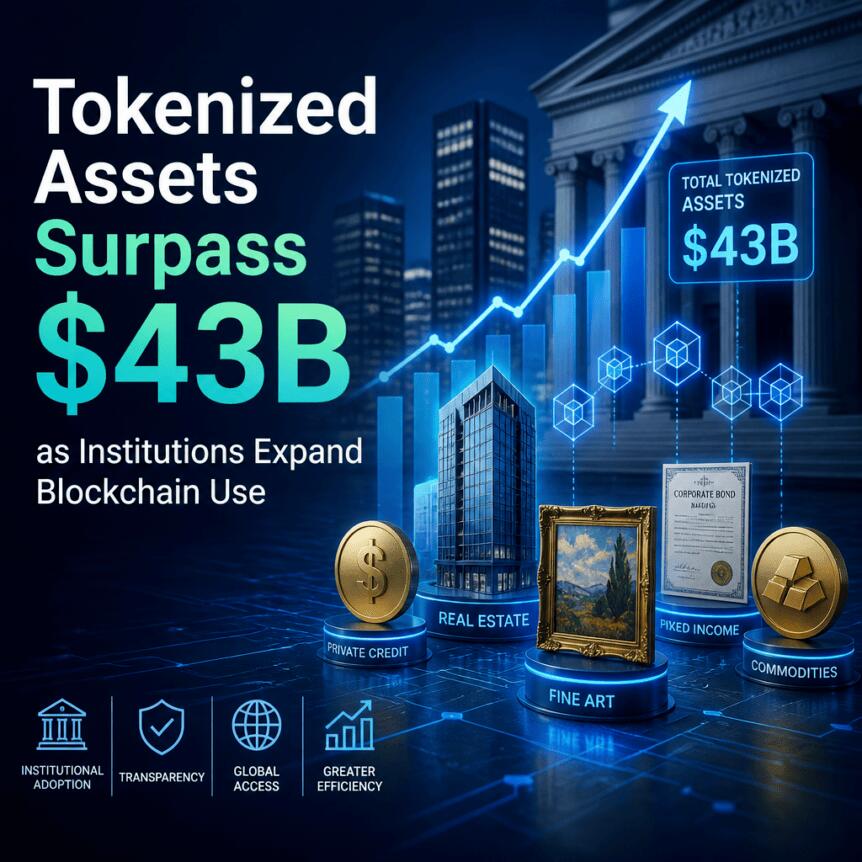
Tokenized real-world assets (RWAs) are continuing to gain ground even as broader crypto markets show softness. Data compiled from onchain metrics points to a sharp increase in the value of tokenized financial products over the past six months, underscoring how incremental adoption by issuers and infrastructure providers is gradually expanding beyond a narrow “tokenized Treasuries” narrative.
According to Token Terminal, the market for tokenized financial assets has surpassed $43 billion, representing an increase of about 37% over the last 180 days. The same figures also show that tokenized funds remain the largest slice of the sector, while other categories—commodities and tokenized stocks—still trail by a wide margin.
Key takeaways
- Token Terminal estimates tokenized onchain financial assets now exceed $43 billion, up ~37% in 180 days.
- Other trackers, including RWA.xyz, report a lower combined market value (below $33 billion), likely due to methodology differences.
- Tokenized funds account for nearly 80% of the sector’s capitalization, with commodities at 16.6% and tokenized stocks at 3.8%.
- Ethereum is still the dominant network for tokenized assets at 57.8%, but several chains collectively account for meaningful share.
- Major institutions are increasingly framing tokenization as a shift from pilots toward regulated, mainstream issuance—though many market metrics exclude stablecoins.
Why tokenized asset totals differ across trackers
The headline growth in tokenized RWAs becomes even more notable when compared with alternative market estimates. Token Terminal’s reported market size is larger than figures compiled by RWA.xyz, which puts the combined RWA market at less than $33 billion. The gap appears rooted in how each dataset defines and counts tokenized financial products.
Token Terminal’s broader inclusion criteria likely help explain the higher total, especially given how tokenized ecosystems can blend categories such as funds, credit products, and other structured yield instruments. For investors and builders, this matters: differing scopes can change how quickly the “market cap” appears to expand and can influence how readily people compare performance across dashboards.
Tokenized funds lead; the sector’s asset mix is still concentrated
While tokenized RWAs are widening in attention, Token Terminal data suggests the sector’s capitalization remains heavily concentrated. Tokenized funds make up nearly 80% of the overall market value. Commodities rank second at 16.6%, while tokenized stocks account for about 3.8%.
That ranking highlights where demand and issuance infrastructure are currently strongest. Funds, by design, can package exposure into a standardized structure, making them easier to deploy across multiple investor bases. Meanwhile, stocks and other equity-like instruments generally require more complex regulatory, custody, and operational alignment—helping explain their smaller share today even as adoption progresses.
Networks: Ethereum stays on top, but momentum is spreading
Ethereum continues to be the central settlement and issuance chain for tokenized assets, with Token Terminal putting its share at 57.8%. Other networks contribute additional—if smaller—parts of the pie: BNB Chain at 8.5%, zkSync Era at 7.5%, XRP Ledger at 5.8%, and Stellar at 5.4%.
For market participants, the multi-chain distribution is an important signal. Tokenized RWAs are not only scaling in value; they are also extending across different technical ecosystems. That can affect liquidity venues, compliance tooling, and even investor accessibility, since different networks often come with distinct integration partners and user journeys.
Issuance concentration is also visible in the top providers. Token Terminal lists Sky as the largest issuer at $6.1 billion in tokenized assets, followed by Securitize and Ondo Finance, each at $3.6 billion.
From “Treasuries first” to a broader yield ecosystem
Institutional interest in tokenization continues to move beyond academic or pilot-era discussions. Earlier this week, Standard Chartered initiated coverage of Uniswap, arguing that the UNI token could appreciate significantly by 2030 as tokenized assets increasingly move onto blockchain rails. The bank also projected that decentralized finance could reach $2.7 trillion over the same period, with growth largely driven by the expansion of tokenized financial products. (See earlier coverage: Cointelegraph’s report on Standard Chartered’s thesis.)
Meanwhile, Citigroup has framed tokenization as an industry poised to scale with improving regulatory clarity. In a base-case outlook, Citi projected tokenization reaching $5.5 trillion by 2030, and in a bull scenario up to $8.2 trillion. Citi pointed to a shift from pilots toward integration into core issuance infrastructure, identifying potential catalysts including efforts around the Depository Trust & Clearing Corporation and major market operators such as the NYSE and Nasdaq incorporating tokenization into issuance processes. (For the report referenced in the original coverage, see Citi’s Tokenization 2030 PDF.)
Stablecoins are also expected to play a major role in sector growth, even though many tokenization-focused market dashboards exclude them. That creates an analytical blind spot for readers relying solely on RWA market-cap figures: the onchain settlement layer can be expanding even if specific token categories are measured differently.
Beyond funds and credit, tokenized equities are beginning to show clearer momentum through platforms such as Ondo Markets and xStocks, reflecting a diversification trend. Binance Research previously concluded that RWA growth is becoming more diversified, with its report noting that 2026 could represent maturation from a “Treasury-dominated narrative” into a more varied yield ecosystem (as described in Cointelegraph’s earlier coverage).
For investors, the practical takeaway is that tokenized RWAs are still dominated by a small number of asset types and issuers, but the direction of travel is widening. The sector is also increasingly tied to mainstream financial infrastructure and regulated processes—an evolution that could reshape how capital moves onchain over the next cycle.
Going forward, readers should watch whether tokenization metrics continue to converge across data providers as methodologies tighten, and whether more issuance pipelines and trading venues broaden access to non-fund products like equities and commodities—areas that currently account for smaller shares but may determine the next phase of growth.
https://www.cryptobreaking.com/tokenized-assets-surpass-43b-as/?utm_source=blogger%20&utm_medium=social_auto&utm_campaign=Tokenized%20Assets%20Surpass%20$43B%20as%20Institutions%20Expand%20Blockchain%20Use%20
Comments
Post a Comment