
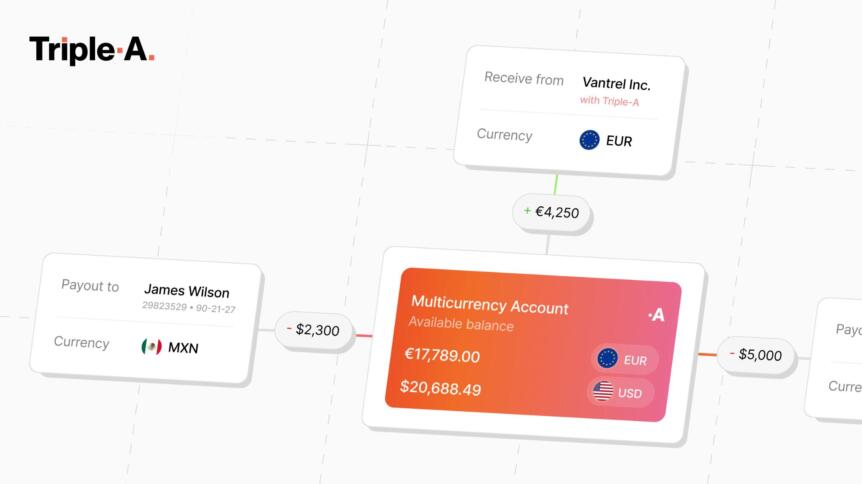
Triple-A, a licensed global payments firm, has begun a European rollout of Multicurrency Accounts that link local euro collections to stablecoin rails and global payout options. The product gives businesses a named EUR IBAN without needing an EU legal entity and consolidates collection, conversion and payout into a single platform that supports payouts to more than 70 countries.
What the product does
The Multicurrency Accounts offer customers a named euro International Bank Account Number, enabling firms to receive SEPA and SEPA Instant transfers as if they had a local euro account. From there, funds can be routed to a traditional bank account, converted and sent into a stablecoin, or distributed as local-currency payouts across Triple-A’s supported markets.
Key capabilities include:
- Collection of euro payments via SEPA rails without establishing an EU entity or separate local bank account.
- Integrated conversion and settlement into stablecoins alongside traditional fiat payouts.
- Global payout coverage exceeding 70 jurisdictions, intended to simplify reconciliation and lower transaction predictability.
Why this matters to businesses
For companies that sell into Europe or run platforms with EU-based users, collecting euros typically requires either opening a local subsidiary and bank account or relying on intermediary providers, which can add cost, time and reconciliation complexity. Triple-A’s offering aims to remove that onboarding hurdle by providing named euro accounts without a local entity, while keeping collection and payout flows connected in the same infrastructure.
That unified approach is significant because it collapses what are often separate steps in cross-border workflows: collection, conversion and payout. By linking SEPA collection directly to stablecoin rails and local-currency payouts, payouts can be executed faster and with fewer handoffs. For B2B sellers, marketplaces, and platforms that manage many payees across multiple jurisdictions, this reduces operational friction and can improve cash flow timing.
Regulatory and market context
Triple-A positions the product as bridging traditional banking rails with cryptocurrency settlement options. The company is registered with the U.S. Financial Crimes Enforcement Network and holds licences across jurisdictions including Singapore and Europe, an important point given the heightened regulatory attention on stablecoins and cross-border transfers.
Stablecoins have been promoted as a way to speed settlement and reduce foreign exchange overheads, but widespread commercial adoption depends on robust on- and off-ramps to fiat. Providers that focus narrowly on stablecoin rails can struggle to offer local collection capabilities; conversely, traditional payment providers often lack direct access to digital-asset settlement. Triple-A’s pitch is that combining both capabilities in one system addresses a practical market gap.
Industry implications and risks
In practice, the impact of products like Multicurrency Accounts will hinge on several factors. First, bank and regulator acceptance of named IBAN flows routed through non-EU entities will determine how broadly firms can rely on these accounts. Second, counterparty, custody and AML controls around stablecoin conversions remain a focus for regulators and corporate treasurers, affecting how quickly large enterprises will shift liquidity into tokenised rails.
Operationally, bringing collection and payout into a single ledger can simplify reconciliation and lower per-transaction costs, which matters for platforms with many small payouts. It also creates a clearer technical path for firms that want optionality between fiat and token settlement depending on corridor economics.
How it fits into the competitive landscape
Triple-A’s announcement highlights a broader industry trend: providers seeking to stitch together fiat rails, banking relationships and tokenised settlement to offer end-to-end cross-border payment services. While some market participants specialise in stablecoin settlement and others in local-rail collection, the value proposition here rests on integration and coverage.
The company says the offering is intended for a range of customers, including B2B merchants selling into Europe, exporters, platforms that collect and disburse funds for users and other payment service providers or electronic money institutions seeking to add euro collections to their stacks. Triple-A also indicates plans to expand collection capabilities to include U.S. dollar and Singapore dollar accounts in the future.
Takeaway
Triple-A’s Multicurrency Accounts represent a practical step toward reducing friction in euro collections and global payouts by combining SEPA access with stablecoin rails. The product could ease market entry for non-EU firms selling into Europe and provide platforms with a unified path from collection to payout. However, the broader adoption will depend on regulatory acceptance, counterparty controls and how cost savings compare with traditional banking and payment-provider alternatives.
For corporates and fintechs evaluating cross-border architectures, the announcement underscores the growing focus on hybrid solutions that marry established banking rails with digital-asset settlement to deliver faster, more predictable global payments.
https://www.cryptobreaking.com/triple-a-multicurrency-accounts-stablecoin/?utm_source=blogger%20&utm_medium=social_auto&utm_campaign=Triple-A%20launches%20EU%20multicity%20accounts%20with%20stablecoin%20rails%20
Comments
Post a Comment