
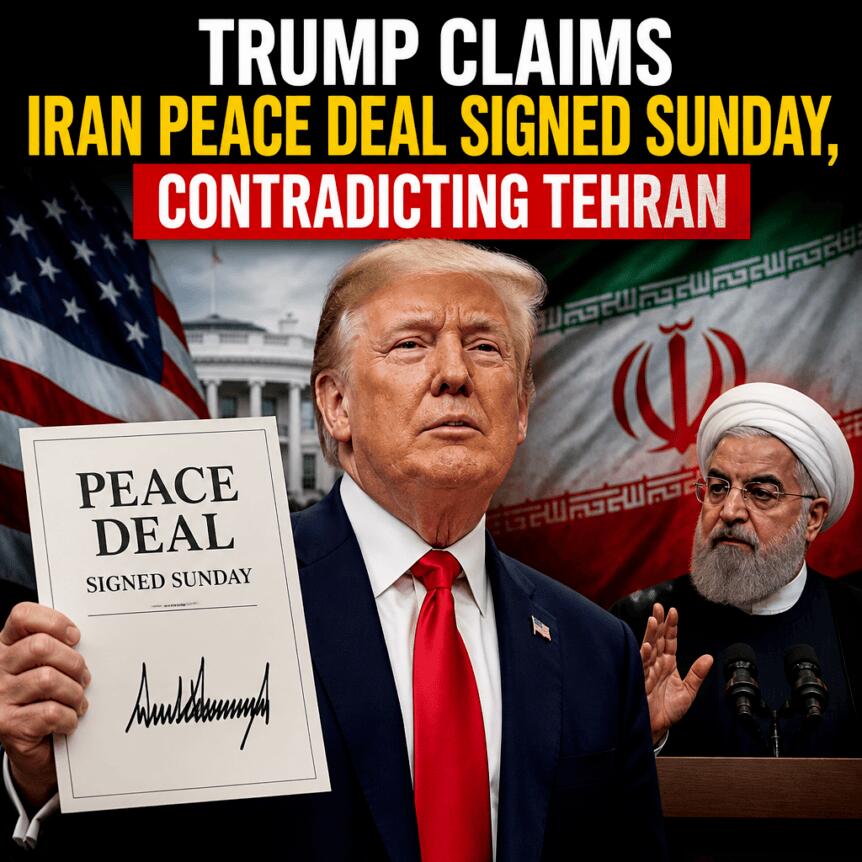
US President Donald Trump says a memorandum of understanding aimed at ending the US–Iran conflict is slated to be signed on Sunday, even though Iranian officials have previously questioned the timing. Trump also claimed that the “Hormuz Strait” would be opened to all immediately after the signing.
The proposed agreement—mediated by Pakistan—would extend a ceasefire and reopen the Strait of Hormuz. While Pakistan’s prime minister said finalization could occur within 24 hours, Iran has not confirmed Sunday as the signing date, leaving traders to weigh the prospect of de-escalation against the risk of further delays.
Key takeaways
- Trump says the US–Iran memorandum is scheduled for Sunday signing and that shipping access through the Strait of Hormuz would follow immediately after.
- Pakistan’s Prime Minister Shehbaz Sharif said the agreement could be finalized within 24 hours, with electronic signing likely shortly afterward.
- Iran has indicated the memorandum would not be signed “tomorrow,” pointing instead to “coming days,” creating near-term timeline uncertainty.
- Analysts expect a peace-related improvement in risk sentiment to benefit crypto—particularly Bitcoin—after months of geopolitics-driven pressure.
- Spot Bitcoin ETF flows have been negative for five straight weeks, with CoinShares research previously linking recent digital asset outflows to geopolitics and interest-rate uncertainty.
Sunday signing claim vs. Iran’s timeline uncertainty
In a Saturday post on Truth Social, Trump said: “The Deal is scheduled to get signed tomorrow,” adding that once signed, “the Hormuz Strait is OPEN TO ALL.” The statement places the signing squarely on Sunday, setting a clear expectation for immediate follow-on steps that could affect shipping and energy markets.
Pakistan, which has been mediating between the US and Iran, also indicated progress. According to remarks attributed to Pakistani leadership on X, an agreement could be reached within 24 hours.
However, Iran has not confirmed Trump’s timeline. An Iranian foreign ministry spokesperson, Esmaeil Baghaei, told state media earlier that the memorandum would not be signed on Sunday and could instead occur “in the coming days.” That clarification matters because it suggests the ceasefire-extension and Strait-of-Hormuz reopenings may depend on a final date agreed by all parties—not just on public statements from Washington and intermediaries.
The deal in question is described as a memorandum of understanding. It is expected to extend the ceasefire between the US and Iran for 60 days and reopen the Strait of Hormuz. Still, until Iran confirms the signing date and details, markets may treat Sunday as a scenario rather than a certainty.
Why the Strait of Hormuz matters for crypto risk appetite
During the conflict, the naval blockade has reportedly choked around 20% of the world’s oil and liquefied natural gas supply, according to the article’s summary. That kind of disruption can spill into macro conditions—raising energy costs, influencing inflation expectations, and amplifying risk premiums across asset classes.
Crypto has not been immune. The same disruption has been linked to a sentiment shock that “pressed crypto markets for months,” reflecting how geopolitical escalation can tighten financial conditions and reduce appetite for volatile assets.
If de-escalation proceeds as envisioned—particularly reopening the Strait of Hormuz—investors may look for improved macro visibility and a broader shift back toward “risk-on” behavior. In practice, that can translate into increased demand for high-beta assets like Bitcoin, especially when market participants believe liquidity constraints may ease.
What analysts are watching for Bitcoin and ETF flows
Crypto analyst Michaël van de Poppe said a peace deal between Iran and the US could trigger a “surge in Bitcoin,” alongside positive ETF flows. His thesis is tied to liquidity returning to risk assets once uncertainty fades.
Van de Poppe’s view also comes alongside ongoing data on Bitcoin ETF performance. According to the referenced SoSoValue tracking, spot Bitcoin exchange-traded funds recorded about $315.84 million in net outflows for the week ended Friday—marking the fifth consecutive week of outflows for Bitcoin-linked crypto funds. Persistent redemptions are important because they can offset spot buying from other parts of the market, dampening upside momentum even if headlines improve.
Separately, CoinShares head of research James Butterfill told Cointelegraph earlier that recent outflows from digital asset investment products were driven primarily by geopolitics. In that account, uncertainty around the Iran conflict was seen as weighing on expectations for interest rates—an interaction that can influence the valuation and risk appetite of crypto assets.
At the time of writing, Bitcoin was trading around $64,491, up roughly 1.5% over 24 hours. While that immediate move suggests some buyers respond to improving headlines, the broader ETF trend indicates the market’s positioning remains cautious.
De-escalation is likely beneficial—but the deal still has execution risk
The clearest tension in the story is the gap between declared signing timing and Iran’s stated uncertainty. Trump’s “tomorrow” claim and Pakistan’s expectation of near-term finalization set a near-term catalyst in motion. Yet Iran’s messaging that the memorandum would not be signed Sunday implies that execution risk remains.
For traders and long-horizon investors, this is more than diplomatic theater. If the signing is delayed, markets that priced a rapid reduction in geopolitical risk could reverse quickly—particularly in a market already contending with ongoing ETF outflows. On the other hand, if the memorandum is signed and implementation steps begin, the energy and macro channel that has weighed on sentiment could start to unwind.
Even in optimistic scenarios, investors will likely track whether reopening steps for the Strait of Hormuz are actually operational, not just announced. That practical follow-through is what determines whether the conflict’s macro impacts—energy disruption and related inflation fears—turn into a relief factor rather than another unresolved headline.
Going forward, the key question is whether Iran ultimately confirms Sunday signing—or whether the memorandum shifts further into “coming days.” Readers should also watch for whether any post-signing commitments translate into measurable changes for shipping and energy-market expectations, since that is where crypto sentiment has been most sensitive so far.
https://www.cryptobreaking.com/trump-claims-iran-peace-deal/?utm_source=blogger%20&utm_medium=social_auto&utm_campaign=Trump%20Claims%20Iran%20Peace%20Deal%20Signed%20Sunday,%20Contradicting%20Tehran%20
Comments
Post a Comment