
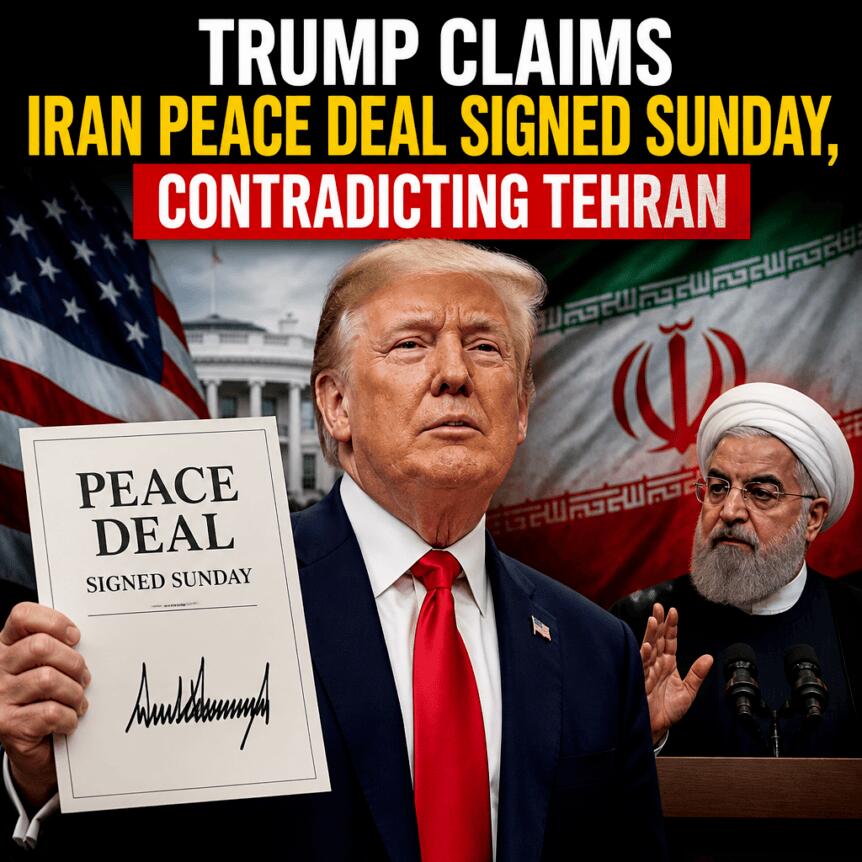
U.S. President Donald Trump says a deal to end hostilities between the United States and Iran is scheduled to be signed on Sunday, and that immediately afterward the Strait of Hormuz would be “OPEN TO ALL.” The announcement comes despite earlier caution from Iranian officials about the timing, underscoring how closely markets are watching the next steps in a geopolitical standoff that has already roiled energy flows.
Pakistan, which has been mediating the talks, indicated that an agreement could be reached within 24 hours and that preparations are underway for electronic signing following the finalization. Analysts argue that any credible de-escalation—especially one tied to reopened shipping lanes—could feed into improved sentiment for broader risk assets, including Bitcoin and exchange-traded products.
Key takeaways
- Trump claims Sunday will be the signing date and says the Strait of Hormuz would reopen to all immediately afterward.
- Iranian officials have not confirmed the Sunday timeline, with the foreign ministry spokesperson saying it would not be “tomorrow” and could occur “in the coming days.”
- Pakistan’s mediation role suggests a 24-hour window and preparation for electronic signing, followed by technical discussions next week.
- The conflict has already disrupted global energy supply estimates, a development that has contributed to market-wide risk aversion affecting crypto for months.
- Crypto strategists link expectations of a peace breakthrough with potential relief in Bitcoin and ETF-related demand, contrasting with recent ETF outflows.
Trump’s Sunday signing claim meets uncertainty from Tehran
On Saturday, Trump posted on Truth Social that the memorandum of understanding is “scheduled to get signed tomorrow,” adding that “immediately after it is signed, the Hormuz Strait is OPEN TO ALL.” His statement indicates a rapid pivot from ceasefire management toward a broader reopening of one of the world’s most strategically important shipping corridors.
However, the timeline is not uniformly accepted across the negotiations. Iran has not confirmed the Sunday signing. Earlier statements from Iran’s Foreign Ministry spokesperson Esmaeil Baghaei, carried by state media, suggested the memorandum would not be signed on Sunday and instead could happen “in the coming days.” In those remarks, Baghaei indicated that an exact date would need to be clarified, explicitly pushing back against “tomorrow” as the signing day.
For markets, the disagreement itself matters. When a diplomatic timeline is disputed—particularly one that implies potential easing in energy risk—traders often remain cautious, pricing in both the possibility of a quick resolution and the chance of further delay.
Pakistan signals a 24-hour path to agreement
Pakistan’s Prime Minister Shehbaz Sharif also weighed in, saying on X that the region is “closer to a peace deal than ever before.” Sharif stated that finalisation is likely within the next 24 hours and that Pakistan is preparing for electronic signing immediately afterward, followed by technical-level talks next week.
That message is consistent with the mediation posture Pakistan has reportedly taken in the process: offering a near-term cadence for decision-making while keeping the next round of talks in view. Still, with Iran signaling that Sunday might not be accurate, investors have reason to watch whether the signing occurs on schedule—or whether the parties move the date further into the “coming days” window referenced by Baghaei.
Why Hormuz and ceasefire terms matter to crypto sentiment
The anticipated memorandum is expected to extend the ceasefire between the United States and Iran for 60 days and reopen the Strait of Hormuz. While the immediate subject is maritime access and de-escalation, the market impact is broader: disruptions related to the conflict have been widely described as constraining energy supply.
According to the article’s framing, the naval blockade has choked around 20% of the world’s oil and liquefied natural gas supply, contributing to higher global asset prices and a sentiment shock that has pressured crypto markets for months. Even if crypto’s move is not a direct function of shipping lanes alone, the linkage typically works through risk appetite—higher uncertainty can translate into lower willingness to hold volatile assets, while credible de-escalation can do the opposite.
In that sense, a signing date is more than a diplomatic milestone. It serves as an observable signal that the conflict risk premium may begin to unwind, potentially affecting liquidity conditions across financial markets.
Analysts eye relief in Bitcoin and ETF flows after de-escalation
Crypto analyst Michaël van de Poppe said a peace deal between Iran and the U.S. would likely trigger a surge in Bitcoin, along with positive ETF flows. He suggested that liquidity would rotate back toward “risk-on” assets, adding that a portion of that renewed liquidity could flow toward crypto following other major market events.
At the same time, recent Bitcoin fund flow data points to caution. Spot Bitcoin ETFs recorded about $315.84 million in net outflows for the week ended Friday, according to SoSoValue’s ETF tracking. That week’s results also marked the fifth consecutive week of outflows for Bitcoin-linked crypto funds mentioned in the source.
CoinShares head of research James Butterfill previously told Cointelegraph that pressure on digital asset investment products was being driven largely by geopolitics. He linked the uncertainty around the Iran conflict to pressure on interest-rate expectations—an important bridge between macro conditions and investor behavior in risk assets, including crypto.
As of the time of writing, Bitcoin was trading at $64,491 and up 1.5% over the prior 24 hours, according to the provided snapshot.
Taken together, the current setup is a familiar pattern: traders look for catalysts that can shift global risk sentiment, while recent ETF outflows highlight that positioning has been cautious. If the Sunday signing happens as Trump says—and if subsequent steps confirm Hormuz reopening—market narratives could shift quickly. If the signing is delayed again, expectations may reset and the relief bid could stall.
Readers should focus on the key next milestones: whether the memorandum is actually signed on Sunday, whether Iran further clarifies the date, and what follow-through signals emerge regarding Hormuz access. Those specifics will determine whether “de-escalation” becomes a sustained market theme—or remains a headline-driven hope.
https://www.cryptobreaking.com/trump-claims-iran-peace-deal-2/?utm_source=blogger%20&utm_medium=social_auto&utm_campaign=Trump%20Claims%20Iran%20Peace%20Deal%20Signed%20Sunday,%20Contradicting%20Tehran%20
Comments
Post a Comment