
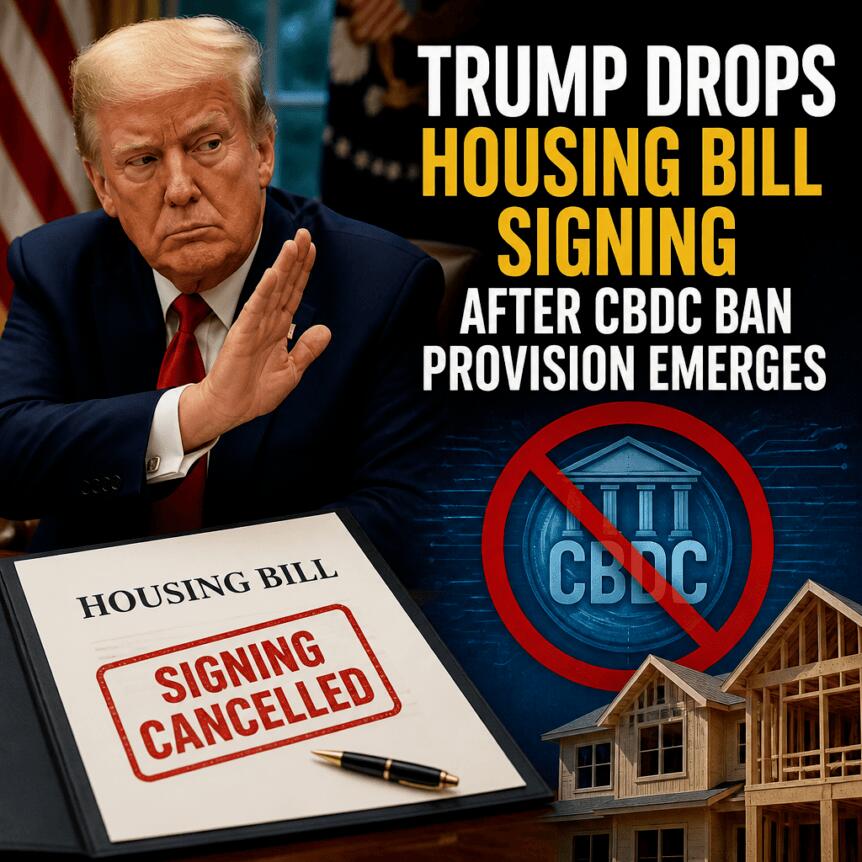
U.S. President Donald Trump has halted the signing of a housing bill that includes a temporary ban on central bank digital currencies (CBDCs), citing a need to prioritize another piece of legislation he is pushing in Congress. The development adds uncertainty to the near-term U.S. regulatory path for digital assets, even as lawmakers move forward on separate crypto bills.
Trump said on Wednesday that he would cancel the signing ceremony for the “21st Century ROAD to Housing Act” and hold it “until such time as we pass the desperately needed SAVE America Act,” according to a post on Truth Social. The housing measure—already passed by both chambers—contains a CBDC restriction through the end of 2030, but also includes a carve-out for certain stablecoins.
Key takeaways
- Trump has delayed signing the 21st Century ROAD to Housing Act due to his insistence that Congress pass the SAVE America Act first.
- The housing bill bans the Federal Reserve from issuing or creating a CBDC (or a substantially similar digital asset) until the end of 2030, while allowing “dollar-denominated” stablecoins that are open, permissionless, and private.
- Trump’s stance raises uncertainty over how (and whether) he will handle other digital-asset legislation pending in the Senate.
- The Digital Asset Market Clarity (CLARITY) Act remains awaiting a potential Senate vote, and Trump has previously signaled support for codifying a “future-proof” market structure.
- If Trump vetoes related legislation, Congress could potentially override with a two-thirds vote in both chambers.
Housing bill stalled despite approval from both chambers
The “21st Century ROAD to Housing Act” passed the U.S. House on Tuesday and had previously cleared the Senate. While many observers expected Trump to sign the bill without delay, his Wednesday announcement suggests he may treat the SAVE America Act as a prerequisite for other legislation.
In his Truth Social post, Trump linked the cancellation directly to the need to pass the SAVE America Act. The bill he referred to is associated with changes to voting procedures, including a requirement that voters provide proof of U.S. citizenship in person to register—an approach that critics have argued could disenfranchise eligible voters.
This is not the first time Trump has floated a broader “no other bills” condition. Earlier this year, he said he would not sign other measures until the SAVE America Act is enacted, a position that now appears to be affecting the timeline for the housing package as well.
What the housing bill does on CBDCs—and where stablecoins fit
Supporters of the housing bill included a CBDC-limiting provision that would restrict U.S. central bank digital currency issuance. As reported in earlier coverage by Cointelegraph, the legislation bars the Federal Reserve from issuing or creating a CBDC or “any digital asset that is substantially similar” until the end of 2030.
At the same time, the bill includes a narrow exception for stablecoins. The text described in Cointelegraph’s coverage allows “dollar-denominated currency that is open, permissionless and private,” a carve-out designed to permit certain stablecoin models even under the broader CBDC restriction.
For crypto market participants, the carve-out matters because it frames how Congress could draw a line between CBDC-style instruments and private stablecoin systems. However, with Trump delaying signing, that legal boundary is not yet locked in—meaning the practical effect of the CBDC timeline could remain uncertain until the housing bill becomes law.
Regulatory ripple effects: CLARITY and the broader “market structure” debate
Trump’s insistence on prioritizing the SAVE America Act has also introduced questions about how he might act on crypto-related legislation that is still moving through Congress. As of Wednesday, the U.S. Senate was reportedly awaiting a potential vote on the Digital Asset Market Clarity (CLARITY) Act, a bill intended to reshape how regulators handle and enforce digital asset-related rules.
Cointelegraph previously reported that Trump said in May he intended to codify a “future-proof digital asset market structure,” which was widely understood as aligning with proposals like CLARITY. While the housing bill’s CBDC provision reflects Congress carving out limitations on central bank-backed digital currency efforts, CLARITY is aimed at defining regulatory roles and enforcement frameworks for the broader digital asset ecosystem.
Given the president’s stated approach of linking bill signings to passage of the SAVE America Act, the immediate risk for crypto policy timelines is straightforward: even if Congress passes measures, final enactment may still depend on executive scheduling and broader political leverage.
Lawmakers may still be able to override a veto
If Trump ultimately vetoes the housing bill or any other digital-asset-related legislation, Congress has a constitutional route to respond. As noted in the source coverage, lawmakers could override a veto by securing a two-thirds majority in both chambers.
That possibility means the outcome is not solely dependent on presidential action. Still, the delay itself can be meaningful for the market: regulatory certainty affects compliance planning, investment decisions, and how institutions allocate resources toward particular product or infrastructure strategies.
For now, investors and builders should watch whether the Senate brings CLARITY to a vote and, crucially, whether Trump’s SAVE America Act condition changes execution timelines for bills affecting the digital asset sector.
https://www.cryptobreaking.com/trump-drops-housing-bill-signing/?utm_source=blogger%20&utm_medium=social_auto&utm_campaign=Trump%20Drops%20Housing%20Bill%20Signing%20After%20CBDC%20Ban%20Provision%20Emerges%20
Comments
Post a Comment