
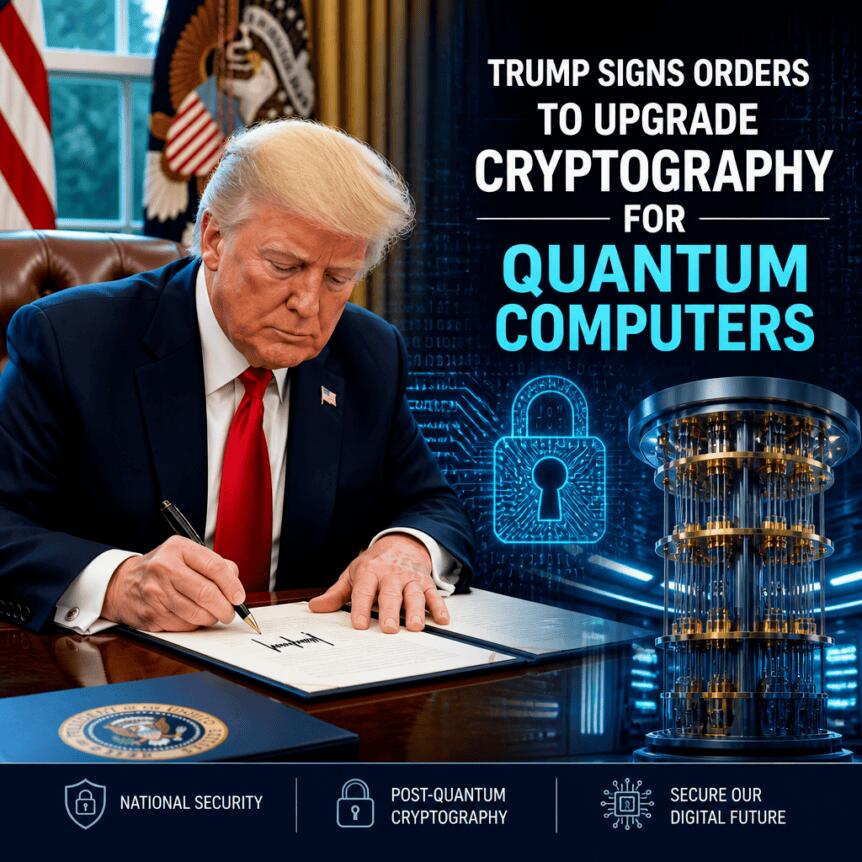
US President Donald Trump signed two executive orders on Monday aimed at accelerating quantum computing while preparing US systems for the cryptographic risks posed by large-scale quantum machines. The orders also emphasize working with allies to reduce the chances that quantum information science and technology (QIST) could be used to undermine national security.
One order focuses on building and commercializing quantum computing capabilities, while the other concentrates on upgrading US cryptography to post-quantum standards. Together, the moves signal that the quantum transition—both in hardware and in security practices—is becoming a mainstream national policy priority rather than a niche research track.
Key takeaways
- The executive orders direct agencies to update the National Quantum Strategy within 180 days to support commercialization and industry partnerships.
- US agencies are instructed to assess how scaling commercial quantum computers could affect the migration to post-quantum cryptography.
- A separate order calls for an accelerated nationwide migration toward post-quantum cryptography led by the Office of Management and Budget and the National Cyber Director.
- The policy emphasis comes as China expands its own quantum roadmap, including investments in scalable quantum computing and quantum communication networks.
US pushes quantum computing from lab to industry
The first executive order, published on the White House website, outlines a “cohesive, whole-of-government approach” to accelerate the deployment and commercialization of quantum computing. It frames the effort as both an innovation agenda and a national security imperative, including a stated goal to ensure adversaries cannot use QIST to threaten sensitive technologies.
Importantly for developers and businesses, the order requires agencies to update the National Quantum Strategy within 180 days. That update is intended to better support commercialization and partnerships with industry—an explicit acknowledgment that translating quantum progress into real products and services will depend on coordination across government and the private sector.
The order also assigns agencies the task of identifying implications of rising scale and performance in commercial quantum systems. The focal concern is not quantum computers as a theoretical breakthrough, but their potential effects on widely used cryptographic systems—specifically the practical transition to post-quantum cryptography.
As context, the US action arrives while China is intensifying its quantum push. Earlier coverage referenced China’s March “Five-Year Plan,” which aims to expand investment in scalable quantum computers and develop an integrated space-earth quantum communication network. The contrast matters: when one major power accelerates quantum capabilities, other states typically face stronger pressure to tighten both technical development and security readiness.
A new US initiative for quantum development at application scale
The executive order also establishes a national initiative called Quantum Computer for Application Development and Discovery Science (QC-ADDS). The description of QC-ADDS points to a specific strategic direction: pursuing quantum computing “at a scale” intended to help “initiate the era of quantum-enabled scientific discovery.”
For investors and builders watching the sector, the significance lies in the order’s framing. Rather than treating quantum progress solely as incremental improvements in qubits or error rates, the policy language emphasizes application readiness and discovery outcomes. That can influence funding priorities and procurement-style collaborations that connect research institutions to industrial partners.
Still, key technical questions remain beyond what policy documents can resolve. Even if the roadmap is clear, timelines for meaningful, reliable advantage in real-world use cases depend on engineering milestones that are hard to standardize across vendors and architectures.
Post-quantum cryptography becomes a nationwide migration priority
The second executive order, also available via the White House, shifts from quantum computing development to the security transition that quantum could force. Its stated purpose is to secure the United States against “quantum-assisted cryptographic attacks,” with a more direct emphasis on migrating to post-quantum cryptography.
The order directs the Office of Management and Budget (OMB) and the National Cyber Director to lead an accelerated, nationwide migration to post-quantum cryptography. The underlying rationale is spelled out in the order: large-scale quantum computers—particularly if held by adversaries—could create a significant threat to encryption systems that are currently trusted at global scale.
While quantum hardware timelines are debated, post-quantum migration is often treated differently because cryptographic planning can be slow and complex. Systems must be inventoried, algorithms tested, compatibility maintained, and operational processes updated. In that sense, policy pressure may accelerate planning cycles even before quantum machines capable of breaking current schemes are widely available.
In the executive order’s framing, this is not simply an IT upgrade—it’s an effort to ensure that sensitive data remains secure as quantum capabilities evolve. That logic is particularly relevant to organizations that must protect information over long retention periods, where “harvest now, decrypt later” style risks can become salient.
How the crypto industry fits into the shift
Crypto networks are already responding to the quantum threat, but not all communities share the same approach. The executive order’s focus on post-quantum cryptography highlights why those design and governance choices matter beyond academia.
According to the article’s referenced reporting, major blockchains such as Ethereum and Solana have already started working on post-quantum roadmaps. That suggests at least some ecosystems are preparing for a longer-term transition in cryptographic primitives as they build toward future network resilience.
By contrast, the Bitcoin community is described as divided on how to secure “old coins” against quantum vulnerability, including proposals discussed among developers and researchers about how (or whether) to address coins already in circulation. That tension reflects a broader asymmetry: migrating security for legacy states can be far harder than designing upgrades for new deployments, especially when systems need strong guarantees about backward compatibility and consensus stability.
The executive orders may not directly dictate protocol-level changes for public blockchains, but they can still influence the environment. When national governments move toward post-quantum standards, compliance expectations, risk assessments, and procurement requirements tend to ripple outward. For crypto developers, that may translate into stronger demand for clearer migration paths and better documentation around quantum resistance.
Earlier discussions in crypto have also noted that the path to quantum-safe cryptography is not only an implementation challenge, but a systems problem involving performance, interoperability, and—crucially—confidence that proposed schemes will work as intended under real adversarial conditions. The cited related coverage underscores that uncertainty remains an industry-wide concern.
What to watch next
The immediate next step is procedural: agencies must update the National Quantum Strategy within 180 days and produce assessments tied to commercial quantum scaling and post-quantum migration. After that, the most important developments to track will be how quickly real security standards and migration guidance follow—and whether crypto ecosystems accelerate their post-quantum roadmaps in response to the policy momentum.
https://www.cryptobreaking.com/trump-signs-orders-to-upgrade/?utm_source=blogger%20&utm_medium=social_auto&utm_campaign=Trump%20Signs%20Orders%20to%20Upgrade%20Cryptography%20for%20Quantum%20Computers%20
Comments
Post a Comment