
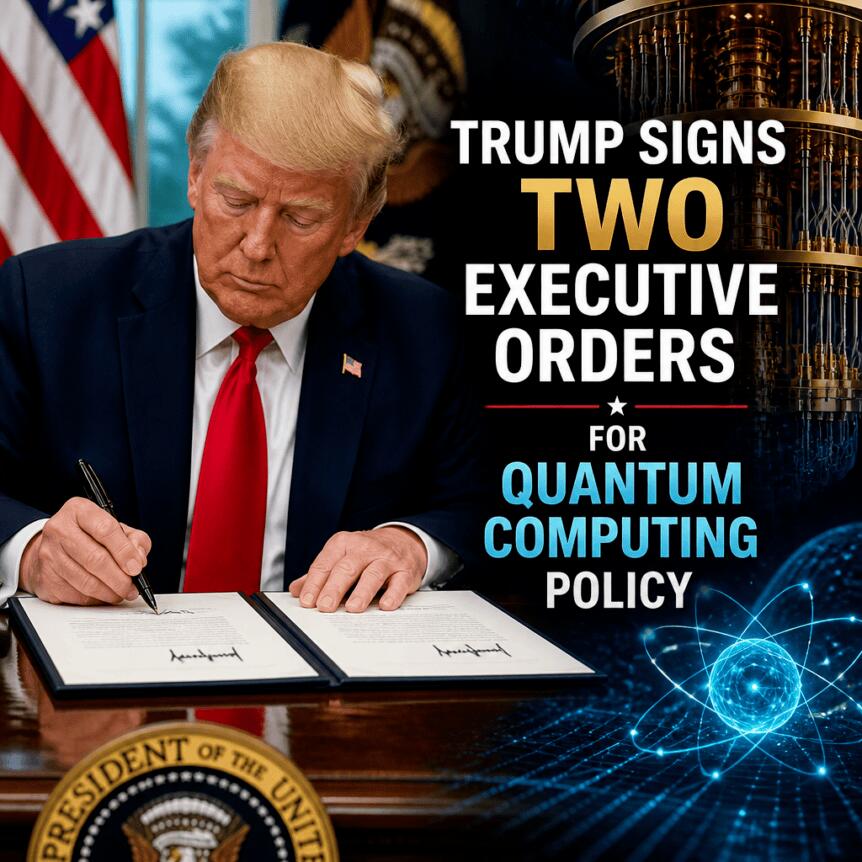
US President Donald Trump signed two executive orders Monday aimed at accelerating quantum computing research and, just as importantly, pushing the country toward cryptography that can withstand quantum attacks. The actions combine a push for faster commercialization of quantum systems with a government-led effort to migrate sensitive data to post-quantum cryptography (PQC).
According to the White House, the orders call for a “cohesive, whole-of-government approach” to support deployment and commercialization of quantum computing, while also coordinating with allies to ensure adversaries cannot use Quantum Information Science and Technology (QIST) to undermine national security.
Key takeaways
- Two executive orders focus on both building quantum computing capacity and reducing quantum-related cryptographic risk through PQC.
- Within 180 days, agencies are directed to update the National Quantum Strategy to better support commercialization and partnerships.
- The government tasks multiple agencies with assessing what scaling commercial quantum computers could mean—particularly for migrating to post-quantum cryptography.
- A new national program, QC-ADDS, is established to pursue quantum computing “at scale” for scientific discovery and development.
- The second order directs OMB and the National Cyber Director to lead an accelerated nationwide PQC migration.
Quantum computing push comes with a commercialization mandate
One of the executive orders, detailed in a posting on the White House website, is designed to speed up how quantum technologies move from research into real-world use. It sets a clear operational target: within 180 days, relevant US agencies must update the National Quantum Strategy to reflect commercialization goals and new industry partnerships.
The order also frames quantum progress as a national-security issue. It emphasizes protecting sensitive technologies and working with allies so adversaries cannot exploit QIST to weaken US security.
That timing matters in the context of global competition. The executive orders arrive as China expands its own quantum ambitions following its March “Five-Year Plan” announcement, which the source describes as targeting scalable quantum computers and the development of an integrated space-earth quantum communication network (reported by The Quantum Insider). The US move signals Washington is aiming to keep pace not only in hardware development, but also in the practical integration of quantum systems.
A new program targets quantum systems “at scale”
Beyond strategy updates, the quantum-focused order creates a new initiative: Quantum Computer for Application Development and Discovery Science (QC-ADDS). The program is described as a national effort intended to pursue a quantum computer at a scale meant to “initiate the era of quantum-enabled scientific discovery.”
For investors and builders, this kind of government-backed push can shape demand signals across the quantum ecosystem—especially for research infrastructure, talent pipelines, and enabling technologies needed to move beyond lab experiments. While the order does not lay out technical milestones in the excerpt provided, the emphasis on scale and discovery suggests the US is treating quantum computing not just as an R&D topic, but as a track with commercialization implications.
Post-quantum cryptography becomes the central security priority
The second executive order shifts from building quantum computers to defending communications and systems against them. Its goal is to “secure the nation against quantum-assisted cryptographic attacks,” with a primary focus on accelerating migration to post-quantum cryptography.
In the White House coverage, the order directs the Office of Management and Budget and the National Cyber Director to lead an accelerated, nationwide PQC migration—framing it as necessary to ensure data remains secure as quantum capabilities advance.
The order also stresses the threat model behind the policy push. It states that large-scale quantum computers, particularly if used by adversaries, will pose a significant risk to widely deployed cryptographic security systems. In practical terms, this reinforces a key point for crypto and cybersecurity communities: even if quantum breakthroughs take time, the migration window for cryptography is long because systems need updating across infrastructure, software, and long-lived data archives.
What this means for crypto ecosystems and “quantum-safe” roadmaps
Crypto networks are already grappling with the question of how to remain secure as cryptography transitions. The article’s source notes that major crypto blockchains such as Ethereum and Solana have begun working on post-quantum roadmaps, referencing earlier Cointelegraph reporting on these efforts. Separately, it notes the Bitcoin community remains divided on how to secure older coins against a quantum threat, pointing to Cointelegraph coverage of proposed approaches (including references to BIP-361 in the source material).
The new US executive order adds weight to the broader industry direction: governments are explicitly treating PQC migration as a time-sensitive national effort, not a speculative future concern. That can increase pressure for standards work, implementations, and security reviews—particularly where blockchain systems rely on long-term cryptographic assumptions.
One tension worth watching is that quantum-resistant security is not a single switch. Networks may need to balance backward compatibility, wallet and key-management practices, signature verification changes, and the operational complexity of rolling upgrades. If PQC migration accelerates at the national level, it may also influence what tooling and standards become widely available, which in turn can affect how quickly crypto projects converge on approaches.
At the same time, the source material references broader uncertainty in the industry about whether “quantum secure” cryptography will function exactly as expected in real conditions, pointing to earlier Cointelegraph Magazine coverage. While that perspective is not detailed here, it aligns with the practical risk behind any migration effort: cryptographic transitions require both correctness and interoperability, and timelines can be harder than they look on paper.
Timeline and next steps for readers
The most immediate operational signals in the orders are the 180-day requirement to update the National Quantum Strategy and the direction to accelerate PQC migration through OMB and the National Cyber Director. In the coming months, US agencies may refine how they assess the implications of scaling commercial quantum computing and what “migration” looks like in practice for different classes of systems and data.
For crypto participants, the key thing to monitor next is whether these executive actions translate into clearer guidance, standards alignment, or procurement and policy levers that reinforce PQC adoption—and how that pressure interacts with blockchain-specific debates over securing existing assets and keys.
https://www.cryptobreaking.com/trump-signs-two-executive-orders/?utm_source=blogger%20&utm_medium=social_auto&utm_campaign=Trump%20Signs%20Two%20Executive%20Orders%20for%20Quantum%20Computing%20Policy%20
Comments
Post a Comment