
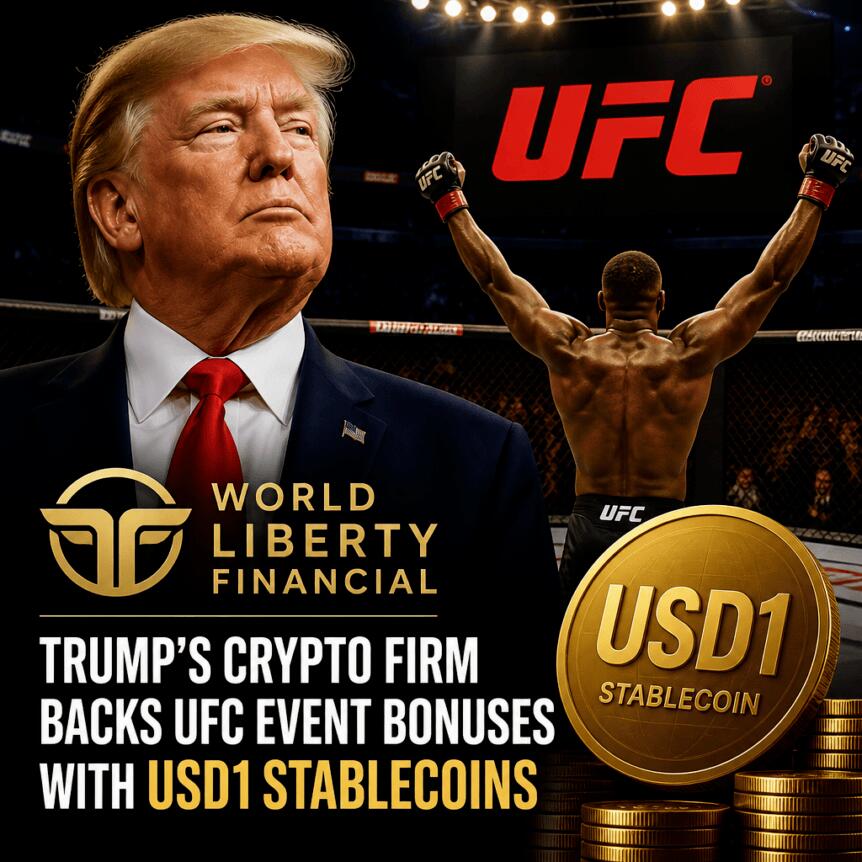
World Liberty Financial has confirmed that some fighters at the UFC’s “UFC Freedom 250” event on the White House lawn will receive performance bonuses paid in its USD1 stablecoin, a U.S. dollar-pegged token issued by the Trump family crypto firm.
According to a Business Wire announcement released Monday, UFC will pay up to $250,000 in bonuses denominated in USD1. CoinMarketCap data shows USD1 traded slightly above its $1 peg on June 12, remaining above $1 at the time of the report, with 24-hour trading volume up more than 93% to $2.38 billion.
Key takeaways
- UFC says it will pay up to $250,000 in bonuses using World Liberty Financial’s USD1 stablecoin for the White House lawn event.
- USD1 briefly traded above its $1 peg around June 12, alongside a sharp increase in reported trading volume.
- “UFC Freedom 250” drew significant congressional criticism over its reported $60 million price tag and political implications.
- World Liberty’s role in US regulatory filings and ongoing legal disputes has kept the project at the center of broader crypto policy debate.
Stablecoins become part of UFC’s White House event
World Liberty Financial’s confirmation ties the UFC Freedom 250 weekend to the stablecoin payment strategy the company has been promoting in public. UFC previously signaled a similar plan ahead of the event, and Monday’s update formalizes that fighter bonuses may be distributed in USD1.
Stablecoin-based payouts matter for more than headline optics. For investors and traders, they can increase near-term demand for the specific asset being used in settlement and may shift liquidity flows toward the issuer’s on-chain rails or trading venues. In this case, CoinMarketCap’s figures show USD1’s market activity expanded markedly around the announcement period.
USD1 trades above the peg as activity spikes
CoinMarketCap data cited in the report indicates USD1 jumped above $1 on June 12 and held above that level at last look. The same snapshot put USD1’s past-24-hour trading volume at $2.38 billion, up more than 93%.
The article also notes that USD1 had spent most of the previous month trading below $1, underscoring that the stablecoin’s behavior has not been uniformly close to the peg. That matters to users who rely on predictable dollar value for payments, custody, or arbitrage: even small deviations—especially if they persist—can affect who benefits from stablecoin-based settlement and at what effective rates.
For market participants, the key watchpoint is whether the brief above-peg move reflects temporary liquidity effects tied to the UFC-linked demand, broader conditions affecting dollar-pegged assets, or a continued pattern in USD1’s pricing around major news cycles.
Broader controversy surrounds the event and its sponsors
The UFC Freedom 250 event was held on the White House’s south lawn as part of activities tied to the country’s semiquincentennial. The report highlights that many members of Congress criticized the event, including attention to its reported $60 million price tag.
Sponsorship for the UFC event included World Liberty Financial, prediction markets company Polymarket, and crypto exchange Crypto.com. Crypto.com said it would offer $1 million in bonuses to fighters using its Cronos (CRO) token, adding to the sense that digital assets were being leveraged across multiple bonus structures.
The situation sits at the intersection of sport, politics, and finance—where stablecoin settlement can quickly become a proxy for larger debates over influence and conflicts of interest in the crypto industry.
World Liberty’s regulatory and legal turbulence
World Liberty Financial was launched in 2024 by members of the Trump family and others later linked to his administration. The project has been repeatedly cited in connection with corruption and conflicts-of-interest claims targeting the president.
The report points to regulatory momentum as well as controversy. World Liberty has an application pending with the US Office of the Comptroller of the Currency for a national trust charter, a move that—if approved—could shape how the firm operates within the US financial system.
At the same time, legal disputes have continued to escalate. In April, Tron founder Justin Sun—described in the report as a Trump supporter and one of the largest holders of the president’s TRUMP memecoin—filed a lawsuit against World Liberty alleging that the company froze his tokens and threatened to destroy them without proper justification. The report also notes that World Liberty countersued Sun weeks later.
These disputes and regulatory questions provide context for why UFC-linked USD1 payouts are likely to be closely scrutinized, not only by crypto market participants but also by lawmakers and advocates concerned about how US political power overlaps with private digital-asset ventures.
Political responses and questions of conflicts
The report includes a quoted response from a Democratic National Committee spokesperson, Jaelin O’Halloran, who characterized UFC’s stablecoin bonuses as self-dealing. A White House spokesperson, Davis Ingle, told Cointelegraph there are no conflicts of interest, arguing that President Trump’s assets are held in a trust managed by his children.
Whether observers view USD1 usage as a normal business arrangement or as evidence of improper entanglement may hinge on how regulators and courts interpret World Liberty’s corporate structure, charter application progress, and the outcomes of its ongoing litigation.
What to watch next
Investors and users should monitor whether USD1’s peg stability improves after the UFC announcement and whether trading-volume spikes fade or recur during future politically prominent events. In parallel, readers will likely want updates on World Liberty’s OCC charter process and the status of the Tron founder lawsuit, since those developments could materially affect how confidently market participants treat USD1 and World Liberty’s broader footprint in the US.
https://www.cryptobreaking.com/trumps-crypto-firm-backs-ufc/?utm_source=blogger%20&utm_medium=social_auto&utm_campaign=Trump’s%20crypto%20firm%20backs%20UFC%20event%20bonuses%20with%20USD1%20stablecoins%20
Comments
Post a Comment