
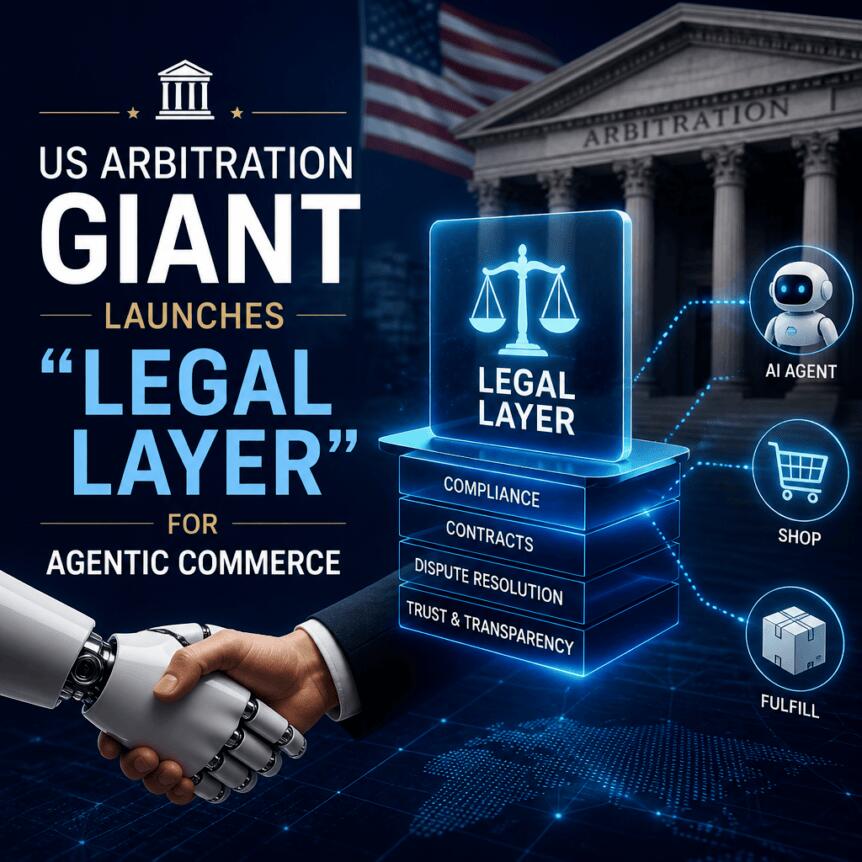
The American Arbitration Association (AAA) has joined forces with Integra Ledger and a coalition of major technology and crypto stakeholders to launch the Legal Context Protocol (LCP), an open standard aimed at bringing clearer legal terms to “agentic” AI transactions.
Announced Wednesday by the AAA, the initiative focuses on a gap that becomes more visible as AI systems increasingly negotiate, consent, and transact on behalf of people and organizations: unlike human-to-human or traditional e-commerce flows, agent-to-agent interactions do not automatically carry the same legal context about what was agreed, under what governing rules, and how disputes should be handled.
Key takeaways
- The Legal Context Protocol (LCP) is designed to make the legal “wrapper” of agentic AI transactions discoverable and verifiable, including consent and dispute resolution terms.
- AAA and Integra Ledger position LCP as a non-blockchain legal layer that complements existing payment and identity protocols.
- LCP targets a core operational question for agentic commerce: what terms applied, which law governs, and what recourse exists if something goes wrong.
- The protocol is backed by a wide founder cohort spanning large tech and crypto organizations, including Google, IBM, Circle, and multiple blockchain ecosystems.
Why a “legal layer” is becoming part of agentic commerce
AAA described LCP as a response to the mismatch between the legal infrastructure that shaped modern online commerce and the realities of agent-driven interactions. In remarks referenced by the announcement, Bridget McCormack, AAA’s president and CEO, said the legal mechanisms familiar to consumers—such as click-through consent and terms of service—do not translate cleanly to scenarios where AI agents negotiate with other agents.
That matters because agentic AI is moving from prototypes to enterprise and financial applications where automated systems may transact with minimal human involvement. The protocol’s goal is to help ensure that when agents transact, the relevant legal context can be attached to the activity in a way that can be checked later.
Gartner’s research, as cited in the announcement, projects that an “agentic payment economy” could reach $15 trillion in spending by 2028—an indicator of how quickly transactional automation could scale beyond conventional consumer web flows.
How LCP is meant to work alongside existing infrastructure
According to AAA, LCP does not require a blockchain. Instead, it is designed to work with the broader stack of protocols already being built for AI agent payments and identity.
AAA specifically framed LCP as complementary to payment and identity approaches—such as x402 and Machine Payments Protocol—while addressing a different question set. Rather than focusing on how value moves or how agents are authenticated, LCP is intended to cover under what terms and governance a transaction took place, and what dispute-resolution pathway applies.
David Fisher, CEO of Integra Ledger and a co-founding partner in the project, summarized the motivation by contrasting active development of payment infrastructure with an underbuilt legal layer. In his view, as the infrastructure for agent payments advances, the mechanisms that clarify what was agreed and what happens in an adverse scenario have not kept pace.
Hedera co-founder Mance Harmon echoed the same urgency, saying that as AI agents make decisions and transact on someone’s behalf, there must be a clear answer to what occurs when something goes wrong.
Dispute resolution and consent become technical requirements
A recurring challenge in automated contracting is that legal recourse is not simply a matter of jurisdiction; it also depends on what was actually communicated, agreed to, and recorded at the moment a transaction was initiated. LCP’s emphasis on making legal terms, consent, and dispute resolution “discoverable and verifiable” suggests the protocol is meant to translate those legal concepts into something more reliably legible in automated systems.
This direction also reflects a broader pattern in crypto and decentralized systems: as automation increases, the industry tends to formalize previously human-heavy processes (identity, permissions, access controls, and settlement rules) into verifiable primitives. In this case, LCP aims to bring a comparable level of structure to the legal side of agentic transactions.
For investors, traders, and builders watching agentic AI adoption, the timing is notable. Market forecasts cited in the announcement point to rapid growth expectations for agentic applications, including payments and token-linked activity. While those projections vary significantly, they reinforce a practical takeaway: standards that clarify terms and remedies can become increasingly important as more transactions shift from manual authorization to autonomous execution.
Who is backing the standard
The AAA, founded in 1926 and described as the largest private provider of alternative dispute resolution services in the world, is partnering with Integra Ledger, a company working on open protocols and middleware intended to give AI agents verifiable identity.
Founding contributors named in the announcement span both mainstream and crypto sectors, including Google, IBM, Circle, Wayfair, the Stellar Development Foundation, Ava Labs, Cardano, Hedera, Crossmint, the Aptos Foundation, Sei Labs, and Mysten Labs—the original contributor to Sui.
That breadth suggests LCP is being positioned to work across multiple ecosystems rather than remaining confined to a single chain or commercial platform. It also signals that legal-context infrastructure is increasingly treated as part of the interoperability conversation around agentic AI.
As LCP moves forward, the key question for the market will be how quickly “legal context” can be integrated into real agentic payment and contracting workflows—and whether deployment will prioritize proof of consent, clarity of governing law, or standardized dispute-resolution hooks first.
https://www.cryptobreaking.com/us-arbitration-giant-launches-legal/?utm_source=blogger%20&utm_medium=social_auto&utm_campaign=US%20Arbitration%20Giant%20Launches%20“Legal%20Layer”%20for%20Agentic%20Commerce%20
Comments
Post a Comment