
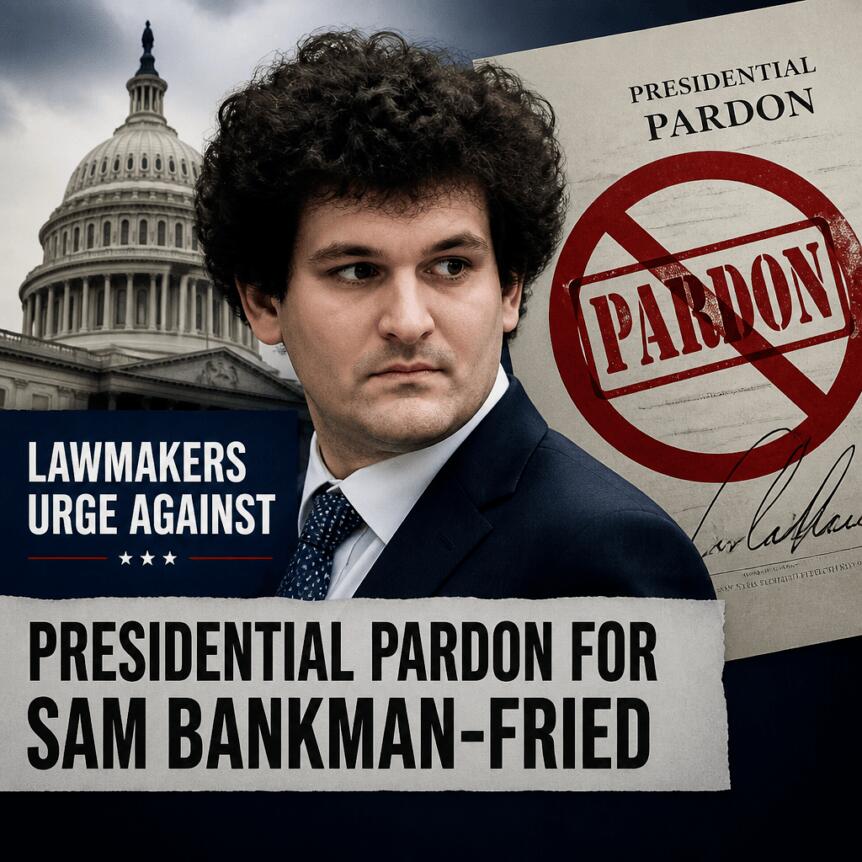
Two US senators—one Republican and one Democrat—are pushing back against any attempt by former FTX CEO Sam Bankman-Fried to secure executive clemency from President Donald Trump. Senator Cynthia Lummis and Senator Rubén Gallego plan to introduce a non-binding resolution stating that under no circumstances should Bankman-Fried receive a pardon or commutation.
The lawmakers say the aim is to protect the integrity of the sentencing outcome and deterrence for large-scale financial fraud. The resolution argues that the 25-year sentence imposed on Bankman-Fried reflects the “extraordinary scale and deliberateness” of his crimes, his lack of remorse, and the harm inflicted on millions of victims.
Key takeaways
- Senators Cynthia Lummis (R) and Rubén Gallego (D) will introduce a non-binding resolution opposing any presidential pardon or commutation for Sam Bankman-Fried.
- The resolution emphasizes that Bankman-Fried’s 25-year sentence reflects the “extraordinary scale” and “deliberateness” of his offenses and the widespread impact on victims.
- Bankman-Fried’s remaining legal options are limited to a presidential pardon or further review by the US Supreme Court after a federal appeals court upheld his conviction and sentence.
- The senators warn that granting clemency would “erase” the conviction, weaken deterrence, and send a “damaging message” that perpetrators of major financial fraud can avoid permanent accountability.
What the Senate resolution would do
According to the text of the resolution to be introduced Wednesday, Lummis and Gallego would effectively register the Senate’s position that President Trump should not grant clemency “under no circumstances,” including a pardon or commutation for Bankman-Fried.
The senators note that a presidential pardon is a constitutional power, meaning any Senate action of this type is not legally binding. Even so, the resolution is intended to create political and legislative pressure by explicitly tying clemency to deterrence and accountability concerns.
The measure further states that the Senate affirms the duration of Bankman-Fried’s sentence and frames that punishment as consistent with justice and the case’s specific circumstances, including the scope of wrongdoing and the consequences for victims.
The resolution is provided through a document published on Gallego’s official website: MEE26050.pdf.
Bankman-Fried’s clemency bid follows an appeals loss
The resolution arrives after Bankman-Fried formally applied for a presidential pardon related to his conviction on seven felony counts connected to the misuse of FTX user funds. Earlier coverage from Cointelegraph detailed that application and the broader push for clemency: SBF clemency bid.
In the latest procedural turn, a federal appeals court upheld Bankman-Fried’s conviction and 25-year sentence, leaving his path forward narrowed to either seeking a pardon or pursuing review by the US Supreme Court. Cointelegraph previously reported on the appeals court decision here: Bankman-Fried loses appeal.
Because the appeals court decision sustained both the conviction and the length of the prison term, clemency would function as the main mechanism for any outcome short of further litigation—an issue the senators appear to be targeting directly with their “no pardon, no commutation” language.
Why deterrence is at the center of the lawmakers’ argument
Lummis and Gallego’s resolution focuses not on the details of the original sentencing alone, but on what they argue would happen if the conviction were undone at the executive level. In their framing, a pardon would “erase” the conviction and, more importantly, could weaken deterrence for future financial crimes.
The lawmakers also portray clemency as a broader signal to the public: that individuals accused and convicted of large-scale financial fraud may escape permanent accountability even after a lengthy federal sentence.
This deterrence theme matters in the context of the FTX collapse, which triggered one of the most significant blowups in the crypto sector’s modern history. Bankman-Fried was convicted in November 2023 following FTX’s collapse in 2022, and he was later sentenced to 25 years in prison. Cointelegraph noted the conviction and sentencing background in its reporting.
The senators’ argument effectively tries to connect executive discretion to market and regulatory confidence—suggesting that the aftermath of high-profile fraud cases influences how seriously deterrence is treated across the financial system.
Other FTX defendants remain in the criminal system
The resolution discussion also sits alongside the continued legal fallout from the FTX collapse. Even as Bankman-Fried seeks clemency, other figures from the broader FTX and Alameda orbit have faced sentencing outcomes ranging from prison terms to time served in exchange for cooperation.
According to the article’s summary of court outcomes, Caroline Ellison, the former CEO of Alameda Research, received a two-year sentence in 2024 and was granted early release in January after serving 14 months. Meanwhile, Nishad Singh, the former engineering director at FTX, and Gary Wang, a co-founder, were both sentenced to time served, with their testimony offered against Bankman-Fried during trial.
Another defendant, Ryan Salame, the former co-CEO of FTX Digital Markets, was sentenced to 90 months in prison tied to unlawful political contributions and conspiracy to operate an unlicensed money-transmitting business.
The article also notes that Salame’s wife, Michelle Bond, was indicted in connection with charges tied to her 2022 run for Congress, with allegations that campaign funds were financed with illegal contributions linked to the crypto exchange. This was reported by Courthouse News Service in coverage referenced by Cointelegraph: indicted.
That broader slate of cases underscores an important point for investors and observers: even if one individual’s sentence is subject to presidential clemency, the overall accountability process tied to FTX and related conduct has not ended.
Going forward, readers should watch whether the White House signals any openness to clemency despite the appeals court ruling—and whether the Senate resolution gains additional support in a way that could influence the political calculus surrounding executive action.
https://www.cryptobreaking.com/us-lawmakers-urge-against-presidential/?utm_source=blogger%20&utm_medium=social_auto&utm_campaign=US%20Lawmakers%20Urge%20Against%20Presidential%20Pardon%20for%20Sam%20Bankman-Fried%20
Comments
Post a Comment