
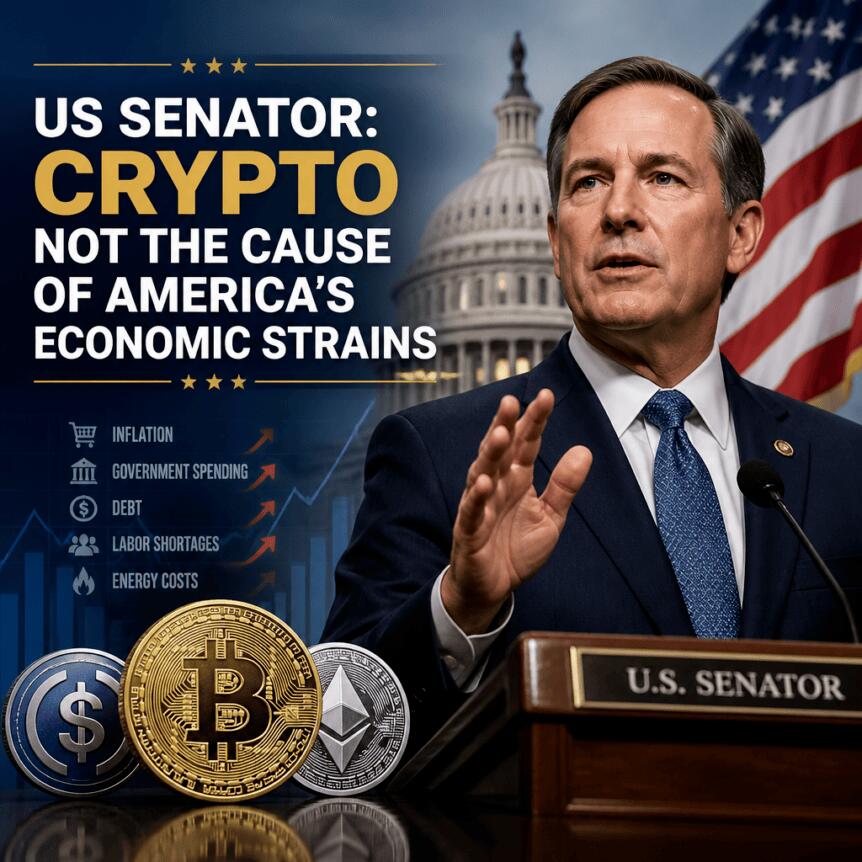
The US Senate Banking Committee convened a hearing on affordability Tuesday, but testimony from the crypto advocacy group The Digital Chamber drew limited engagement from most lawmakers. Cody Carbone, the group’s CEO, argued that the digital asset industry could help reduce costs in everyday payments by enabling faster, cheaper transactions and lowering barriers to owning and transferring assets.
While the hearing—titled The Affordability Agenda—focused on cost-of-living issues, only a small subset of committee members pressed Carbone directly. Indiana Senator Tim Banks asked about the relative costs of foreign remittances versus dollar-pegged stablecoins, while Louisiana Senator John Kennedy largely rejected the premise that digital assets are central to the country’s broader economic problems.
Key takeaways
- Most lawmakers did not interrogate Carbone’s claims on digital assets during the Senate Banking Committee affordability hearing.
- Senator Tim Banks specifically questioned the economics of remittances, contrasting foreign transfer costs with dollar-pegged stablecoins.
- Senator John Kennedy dismissed the idea that cryptocurrency is the core driver of US affordability and economic issues.
- Carbone’s remarks tied directly to momentum for the Digital Asset Market Clarity (CLARITY) Act, though its path remains uncertain due to ethics and industry pushback.
- Separate complaints from gambling industry groups center on whether CLARITY could affect the Commodity Futures Trading Commission’s oversight of certain prediction market activity.
Affordability hearing sidelines crypto questions as lawmakers weigh the bigger bill
Carbone’s testimony presented digital assets as a potential tool for improving affordability through payment efficiency and competition. According to Carbone, the industry could exert “competitive pressure” on existing payment channels by offering faster and lower-cost transfer options, and by reducing “barriers to ‘owning and transferring assets.’”
However, the committee’s attention did not broadly pivot to crypto policy. Beyond Banks’ remittance-related question and Kennedy’s remarks dismissing the premise, most lawmakers did not directly challenge Carbone’s assertions during the hearing.
Kennedy’s response underscored the political friction that often surrounds crypto at traditional legislative hearings: “Mr. Carbone, you seem to be here to promote cryptocurrency,” Kennedy said, adding, “I love cryptocurrency, but I don't think that's the problem with our economy.”
CLARITY Act momentum, but ethics provisions could still complicate passage
Carbone’s message also served as a legislative bridge to the Digital Asset Market Clarity (CLARITY) Act, a crypto market structure bill the Senate Banking Committee advanced in May. As the full Senate approaches a vote “in a matter of weeks,” many lawmakers are signaling that they want additional ethics-related requirements—an addition that could slow or reshape how the measure clears the chamber.
That tension is important for market participants because ethics provisions can influence the compliance and governance expectations embedded in the final version of any regulatory framework. Even when a bill moves forward procedurally, amendments—especially those aimed at conduct standards—can change the regulatory burden for exchanges, issuers, intermediaries, or other market-facing entities.
Carbone’s testimony effectively framed digital assets as a consumer-impacting affordability solution, but CLARITY’s real near-term relevance hinges on whether lawmakers will align on market structure details and the scope of any new safeguards.
Gambling industry pushback targets prediction market oversight concerns
Beyond ethics debates, CLARITY is facing targeted pressure from interest groups outside traditional crypto advocacy. Last week, gambling-related industry groups asked the Senate to clarify that the bill would not give the US Commodity Futures Trading Commission (CFTC) a role in overseeing sports betting in prediction markets.
The concern relates to how regulators may interpret “exclusive jurisdiction.” Under CFTC Chair Michael Selig, the financial regulator has claimed “exclusive jurisdiction” over platforms including Kalshi and Polymarket. According to coverage of the dispute earlier, lawmakers and stakeholders have been watching whether CLARITY’s definitions or market structure provisions could alter or expand how regulators draw authority across prediction markets.
According to reporting, some lawmakers expect the CLARITY Act to move through the Senate before the chamber breaks for an August recess, but as of Tuesday no floor vote was scheduled. That means uncertainty persists not only about the bill’s content but also about timing—both of which matter to those trying to plan compliance roadmaps for the next regulatory phase.
Why the hearing’s limited engagement matters for crypto’s legislative strategy
The affordability hearing offered a useful window into how digital assets are being positioned politically: not necessarily as a standalone topic, but as a possible mechanism for broader cost relief. Carbone’s emphasis on remittances, transaction speed, and asset transfer accessibility aligns with a pragmatic legislative narrative—one that aims to connect crypto policy to mainstream economic outcomes.
Yet the hearing also demonstrated the limits of that framing in front of a committee dominated by other priorities. The fact that only Tim Banks pursued a direct, crypto-adjacent cost comparison suggests that, at least for now, lawmakers may be more receptive to specific, measurable applications—like cross-border transfers—than to wider claims about digital assets reshaping payment systems.
Kennedy’s remarks illustrate another obstacle: lawmakers may be willing to acknowledge cryptocurrency’s existence while rejecting the premise that it is the right lever for affordability. That kind of skepticism can translate into reluctance to advance sweeping reforms, particularly when the bill’s passage depends on negotiating sensitive provisions such as ethics standards and regulatory scope conflicts.
Going forward, observers should watch whether the Senate agrees on additional ethics language and how it addresses the specific prediction-market oversight concerns raised by gambling industry groups. With no floor vote scheduled as of Tuesday, the most immediate question is whether CLARITY can clear both substantive amendments and procedural timing before the August recess.
https://www.cryptobreaking.com/us-senator-crypto-not-the/?utm_source=blogger%20&utm_medium=social_auto&utm_campaign=US%20Senator:%20Crypto%20Not%20the%20Cause%20of%20America’s%20Economic%20Strains%20
Comments
Post a Comment