
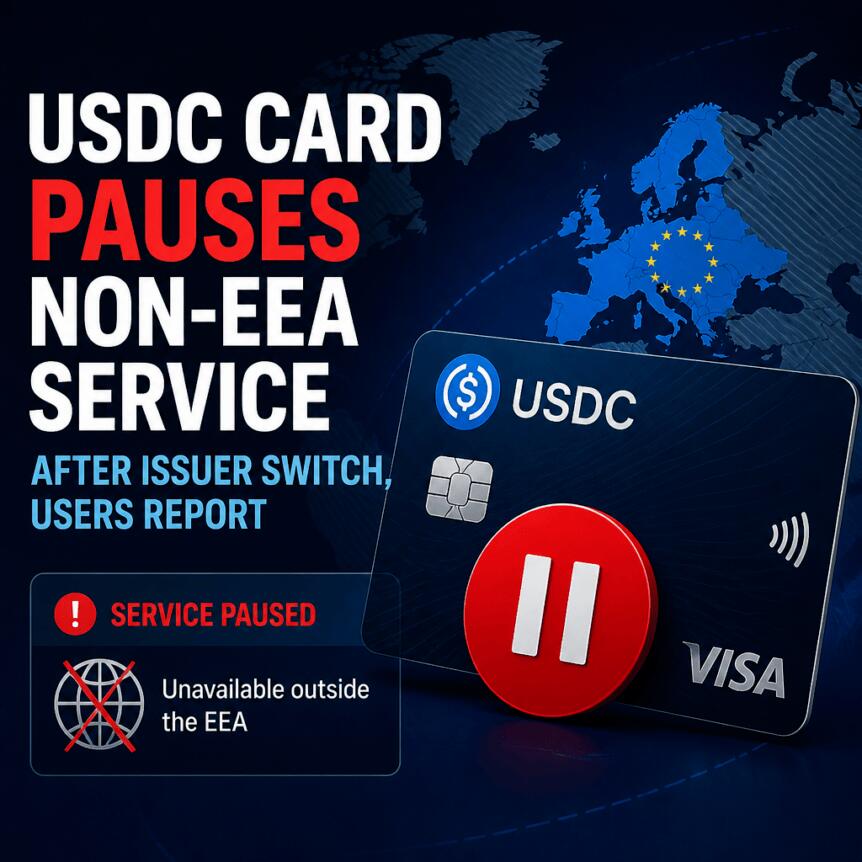
Ready, a self-custodial wallet and crypto payments company, has reportedly disabled USDC-related card functionality for users located outside the European Economic Area (EEA), according to multiple user reports shared on social media.
Users say they received an in-app warning that their “Ready Card will be deactivated within the next hour,” with the message indicating the change affects users “primarily outside the EEA” after what appears to be a card-provider update.
Key takeaways
- Multiple users report Ready disabled Ready Card access outside the EEA with only a short notice period.
- The company linked the change to a card-provider shift, but it has not yet publicly clarified the new provider or the reason for the restriction.
- Screenshots shared by users indicate automatic refunds would be issued for remaining subscription time, within 10 business days.
- Ready’s card functionality centers on USDC spending, while users can still custody and transfer USDC onchain.
Short notice, sudden loss of card access
The reports describe a rapid transition: at least some users say they lost card access within hours of receiving the in-app notice.
One user, posting under the handle TapSatoshi, said the timing left them frustrated, pointing to what they characterized as delays in features such as Apple Pay support and the prioritization of additional product elements like a “Rewards” section. Other screenshots circulating online show the notice framing the deactivation as a change affecting users mostly outside the EEA.
According to those same screenshots, Ready stated that automatic refunds would be processed for any remaining subscription period, with the refund window described as within 10 business days.
Provider change reported, details still unclear
While users attribute the restriction to a change in Ready’s card provider, it remains unclear which provider will be responsible for the Ready Card moving forward, or what specifically triggered the shift.
Public documentation previously associated the program’s issuer-side partner with Kulipa. However, it was not possible to confirm from the user reports whether Kulipa remains involved in any capacity, or whether the restriction is tied to a broader contractual or compliance update.
Cointelegraph reached out to Ready for comment but did not receive a response by the time of publication.
How Ready Card works around USDC
Ready is a wallet designed for the Starknet ecosystem, an Ethereum layer-2 network that uses zero-knowledge rollups. While the wallet supports multiple assets—including Bitcoin (BTC) and Ether (ETH)—the Ready Card functionality is reported to be built primarily around USDC.
Ready documentation states that when a purchase is made, the system checks a user’s USDC balance in real time. Transactions are then processed via Mastercard’s payment network, with crypto converted to fiat at the point of sale. In that design, the card acts as a spending interface layered on top of the user’s self-custody.
That distinction is important for what the restriction likely means for users: if card access is limited, users can still hold and transfer USDC onchain without interruption. The deactivation appears to affect the payment rail connected to the card rather than the underlying ability to transfer funds.
Broader lesson for crypto-linked payments
For users, the reports raise a practical question: how quickly can access to crypto-linked payment cards be curtailed when issuer-side or provider-side arrangements change?
In this case, the combination of a short deactivation window and an as-yet unclear explanation from the issuer highlights a recurring risk in the “self-custody + off-chain spending” model—while the wallet may remain under user control, card availability can depend on external counterparties and their operational or regulatory constraints.
Moving forward, the key items readers should watch are whether Ready publishes an official explanation for the provider change and restriction, how refunds and any future card availability in the EEA are handled, and whether additional regions are affected in subsequent notifications.
https://www.cryptobreaking.com/usdc-card-pauses-non-eea/?utm_source=blogger%20&utm_medium=social_auto&utm_campaign=USDC%20Card%20Pauses%20Non-EEA%20Service%20After%20Issuer%20Switch,%20Users%20Report%20
Comments
Post a Comment