
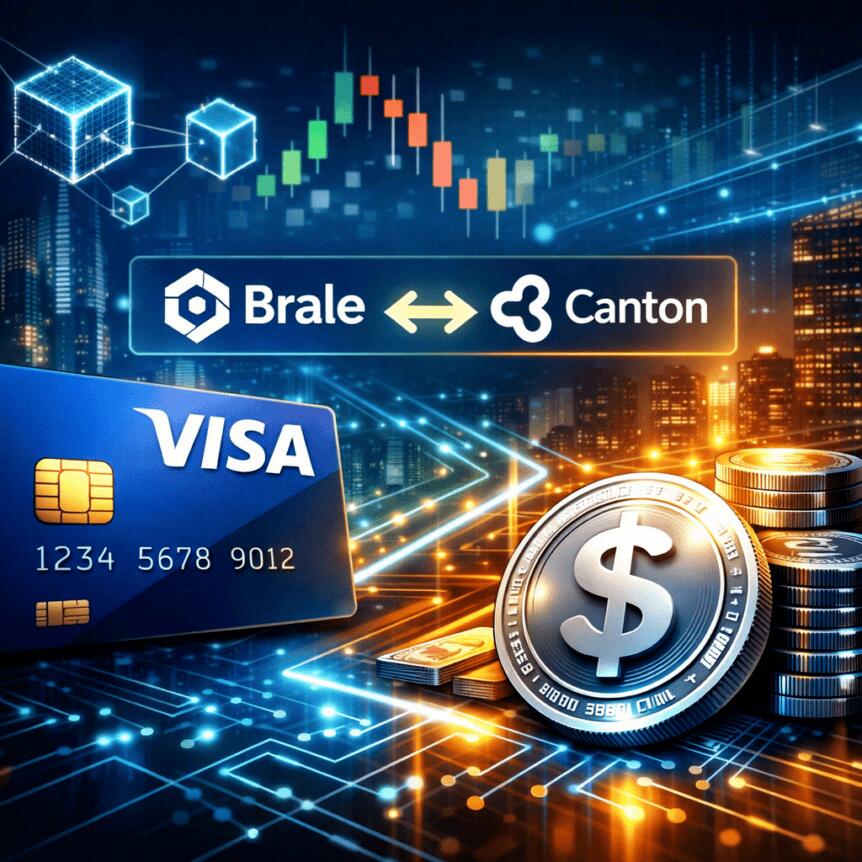
Visa is testing privacy-preserving blockchain networks to support institutional stablecoin settlement without exposing sensitive transaction data. The proof-of-concept pairs Brale, the stablecoin infrastructure firm behind SBC, with the Canton Network—a permissioned ledger developed in collaboration with major Wall Street players—to evaluate whether SBC could become a viable settlement option for banks and market infrastructures.
The project, announced this week via Businesswire, centers on simulating institutional payment flows on Canton to assess if SBC can deliver on-chain settlement while keeping counterparty information, flow details, and other sensitive data under strict governance and access controls. The effort expands Visa’s ongoing experimentation with stablecoins for settlement on public blockchains—an initiative that began in 2021 with USDC settlement on Ethereum—but shifts the focus toward networks that preserve privacy for counterparties and assets involved in large-scale financial operations.
“The aim is to see whether a private, permissioned environment can pair the programmability of on-chain settlement with the confidentiality required by institutions,” Visa and Brale said in the release. While the current test is conceptual, the choice of partners and architecture signals a broader push among banks and market infrastructures to explore on-chain efficiency without broadcasting every detail of a transaction onto a public ledger.
The broader context for this push comes as policymakers and analysts consider how payment-focused stablecoins will evolve. S&P Global Ratings, in a report released this week, noted that global stablecoin issuance has surpassed $300 billion across currencies, with most demand still anchored in crypto trading but showing signs of broader use. The report adds that U.S. policy and regulatory developments—such as those anticipated around GENIUS Act-compliant stablecoins—could eventually unlock new use cases in cross-border payments and merchant remittances, though such flows currently account for only a small, growing share of international payment volumes.
Key takeaways
- The PoC tests private, regulator-accessible settlement of a US dollar-backed stablecoin (SBC) on Canton, aiming to preserve transaction confidentiality while enabling atomic settlement across tokenized assets.
- Brale’s SBC sits at the core of the experiment, representing a pathway for stablecoins designed specifically for institutional settlement rather than retail-facing use alone.
- Canton is a permissioned network designed for institutional applications, where only involved parties and authorized regulators can view sensitive deal data, enabling controlled on-chain settlement without public disclosure of counterparty details.
- Industry context suggests growing interest in GENIUS-compliant stablecoins among U.S. institutions, with potential near-term use cases in cross-border payments and merchant remittances, subject to final regulatory clarity.
- Analysts caution that while pilots highlight technical feasibility and privacy advantages, banks could be affected financially in the longer term as stablecoins reshape settlement rails and funding dynamics.
Private settlement in a public-privacy framework
The Canton Network lies at the heart of this investigation. Developed with input from Digital Asset, Canton connects permissioned blockchain applications used by institutions such as JPMorgan, Goldman Sachs, BNP Paribas, and the Depository Trust & Clearing Corporation. Unlike fully public blockchains, Canton is designed so that only transaction participants and authorized regulators can access specific data, while still enabling atomic settlement across tokenized assets, cash-like instruments, and other financial contracts.
Visa and Brale describe the PoC as a way to explore how Canton’s privacy architecture could support faster, programmable settlement with the ability to retain strict visibility controls for sensitive information. In practice, this could allow large financial institutions to leverage on-chain settlement for stability-focused transactions without exposing the details of who is transacting with whom, or the exact flow of funds, to the broader market.
For banks and market infrastructure providers, the potential was underscored by S&P Global Ratings’ assessment of the evolving stablecoin landscape. While a portion of stablecoin activity today remains tied to crypto trading, the emergence of GENIUS-compliant stablecoins opens a path toward regulated, privacy-preserving settlement rails that could integrate with existing payment networks and correspondent banking processes. The report highlights cross-border settlements as one of the most promising near-term use cases, even as these stablecoins currently account for only a minority share of international payment volumes.
What this implies for market infrastructure and policy
Institutional interest in private settlement networks reflects a broader ambition to combine the efficiency of on-chain settlement with the prudence and governance expected of traditional finance. The Canton-based pilot illustrates a practical route for institutions to test whether their own liquidity, collateral workflows, and cash-like instruments can be tokenized and settled in near real time, without exposing strategic details to competitors or the public.
From a regulatory standpoint, the emphasis on privacy is not merely a technical preference but a governance concern. The GENIUS Act and related regulatory trajectories aim to codify how U.S. stablecoins that meet certain standards can be deployed across the payments ecosystem. While final rules are still pending, the industry is watching closely to understand how such stablecoins will interact with existing payment rails, central-bank policies, and the capital markets framework that underpins settlement infrastructure.
Industry observers also note that the technology threading through Canton—privacy-preserving mechanisms, permissioned access, and cross-token interoperability—could influence how banks approach tokenized deposits and other digital assets in a regulated context. As banks experiment with issuing their own stablecoins or tokenized deposits, they may seek architectures that guarantee data confidentiality while enabling efficient on-chain settlement, reconciliation, and liquidity management.
It is important to acknowledge the lines of communication from the involved parties. Cointelegraph reached out to Visa, Brale, and Digital Asset for comment, but no formal responses were available at publication. The consortium-based nature of the project, with ties to large financial institutions and established infrastructure players, signals a measured, collaborative approach to evaluating new settlement workflows rather than a sudden shift in policy or product strategy.
Looking ahead: the path from pilots to practical adoption
What remains uncertain is how quickly privacy-focused, institutional settlement networks can scale in a live environment and what regulatory guardrails will govern their use. The current PoC is a proof of concept designed to illuminate feasibility and governance considerations, not a deployment timeline. Yet the trajectory is clear: if private settlement on permissioned ledgers demonstrates tangible improvements in settlement speed, counterparty risk management, and operational efficiency, it could push financial institutions to accelerate pilots and potentially migrate portions of their settlement flows onto permissioned, privacy-enabled rails.
For investors and builders, the development underscores two key themes shaping the crypto and digital asset space. First, the line between public and private ledgers is becoming increasingly nuanced as institutions demand both transparency and confidentiality. Second, the market is watching regulatory guidance on GENIUS-compliant stablecoins, and how those rules will interact with cross-border payments, merchant remittance, and wholesale financing needs. The outcome of this policy process will likely influence the speed and scope of adoption for private-stablecoin settlement schemes in the coming quarters.
As the ecosystem continues to evolve, observers should monitor how financial institutions balance the benefits of real-time settlement with the governance requirements that come with private, permissioned networks. The Canton-Visa-Brale collaboration represents a concrete step in that direction—one that could shape the next phase of digital-asset-backed settlement infrastructure if pilot results translate into scalable, compliant, and privacy-respecting operations.
Readers should stay tuned for further updates as more details emerge from ongoing discussions, technical evaluations, and potential broader deployments. In a market where data visibility and settlement speed are both crucial, privacy-preserving on-chain rails could become a pivotal element of the institutional fintech toolkit, provided they align with regulatory expectations and sound risk management practices.
https://www.cryptobreaking.com/visa-advances-private-stablecoin-settlement/?utm_source=blogger%20&utm_medium=social_auto&utm_campaign=Visa%20Advances%20Private%20Stablecoin%20Settlement%20Test%20With%20Brale,%20Canton%20
Comments
Post a Comment