
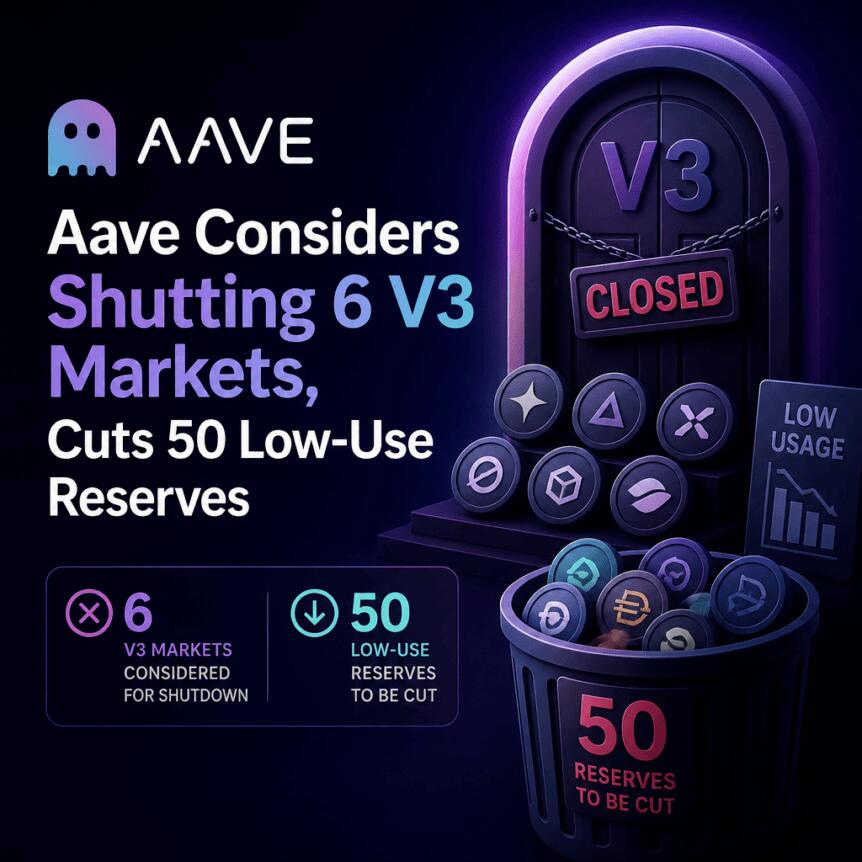
Aave governance is considering a broad cleanup of its V3 lending markets, targeting underused reserves across multiple blockchains and retiring certain matured listings. The proposal, detailed in an ARFC (Aave Request for Comment), outlines offboarding activity on six chains and removing dozens of low-adoption assets, covering $98.1 million in supplied collateral and $15.6 million in outstanding debt, measured as of July 28.
Risk services provider LlamaRisk, working alongside other Aave service providers, recommended deprecating 50 low-use reserves and retiring 21 matured Pendle principal token listings across 11 deployments. The same proposal also calls for retiring all 25 reserves on Sonic, Scroll, zkSync, Metis, Soneium and Aptos.
Key takeaways
- Aave’s ARFC targets low-adoption assets and matured Pendle principal token listings, with balances snapshot at July 28.
- The plan would wind down V3 markets on six blockchains and deprecate 50 low-use reserves across 11 deployments.
- All chain-specific closures proposed here come after earlier freezes and prior governance decisions on certain networks.
- Aave founder Stani Kulechov framed the move as reducing the protocol’s “economic and technical risk surface” under updated frameworks.
- This ARFC is a proposal step, not proof that a final onchain vote has already passed.
Why this proposal is moving forward
ARFCs are a formal governance stage at Aave: they provide detailed recommendations and serve as a precursor to an Aave Improvement Proposal. As such, the publication of this ARFC does not itself confirm that the changes have been approved via an onchain vote or executed by the protocol.
Even so, the scope is notable. The offboarding plan described in the ARFC would restructure Aave’s V3 presence on multiple networks—primarily by removing reserves where usage has been insufficient and by retiring token listings that have reached maturity. In total, the proposal covers $98.1 million in supplied assets and $15.6 million in debt, indicating that the affected V3 markets are meaningful in size even if they are not retaining strong participation.
Aptos exit follows a short-lived V3 rollout
The most time-sensitive portion of the cleanup appears to be the proposed Aptos exit. According to data cited by LlamaRisk, the V3 market launch on Aptos occurred roughly 11 months before this ARFC recommendation.
LlamaRisk attributes weak performance to a sharp liquidity contraction and minimal earning. It reports that available liquidity fell by 94% over six months and that quarterly revenue was below $1,000. Those figures, as referenced in the ARFC summary, set the justification for moving from an active posture to a full deprecation across the network.
The same recommendation also distinguishes between chains that were already inactive in practice and those that were still operating. The ARFC indicates that every reserve on Scroll, zkSync, Metis and Soneium was already frozen. By contrast, Sonic and Aptos were still active at the time of the snapshot, and the ARFC recommends freezing and retiring reserves on those remaining deployments.
How earlier “temp checks” shaped the current cleanup
The proposal builds on prior governance outcomes and implementation steps across Aave’s multichain V3 strategy. Earlier in the process, a “temp check” on Aave’s multichain approach concluded on Dec. 5, 2025. That vote, described in Aave governance materials, recorded 923,400 votes in favor with under 1% voting against, and it covered actions such as increasing reserve factors on underperforming instances, shutting down instances on zkSync, Metis and Soneium, and establishing a $2 million annual revenue floor for new instance deployment.
Additionally, Aave governance processes have already accelerated deprecations on specific chains. In April, Scroll was added to the list of affected protocols through an accelerated procedure. A corresponding governance action described the move as completing Scroll’s deprecation after rapid deterioration in network liquidity and Aave market activity, via a direct-to-AIP proposal filed by LlamaRisk.
Beyond instance closures, Aave’s risk posture has also been formalized in updated internal documentation. The protocol published an updated risk framework on June 9, covering asset risk, bridge and monitoring risks, chain risk, and criteria for winding down reserves or deployments. Separate governance activity later this month indicated de facto adoption of rules under a newer “governance framework v2,” pointing to a more structured approach to deciding when underperforming deployments should be reduced or removed.
Aave founder ties the move to risk-framework changes
Aave founder Stani Kulechov publicly commented that the cleanup is intended to reduce exposure as the protocol applies its new risk approach. In a Thursday post on X, Kulechov said the deprecations would also “reduce Aave’s economic and technical risk surface as part of the new Aave Risk Framework and Technical Asset Listing Framework.”
Source: Stani Kulechov on X
While the current action may look like an exit from certain environments, Kulechov’s framing suggests it is not a retreat from multichain itself. He stated that Aave will continue applying continuous risk assessment for assets across deployments, with the immediate effect being a refocusing on selected chains where usage and performance are stronger.
The comments also arrive amid Aave’s ongoing expansion activities elsewhere. Earlier coverage from Cointelegraph noted that Aave is launching on Avalanche, and the current governance cleanup appears to align with that broader operational theme: expand into targeted environments while methodically trimming underused or deteriorating ones.
What to watch next for Aave V3 users and liquidity providers
If this ARFC advances, the key question will be how quickly the proposed offboarding transitions from governance discussion to formal execution—and whether Aave provides additional updates on how liquidity is expected to migrate as reserves are frozen and retired. Investors and DeFi participants should also watch for signals that the newly adopted risk frameworks keep tightening the threshold for maintaining V3 markets on smaller or less liquid chains.
https://www.cryptobreaking.com/aave-considers-shutting-6-v3/?utm_source=blogger%20&utm_medium=social_auto&utm_campaign=Aave%20Considers%20Shutting%206%20V3%20Markets,%20Cuts%2050%20Low-Use%20Reserves%20
Comments
Post a Comment