
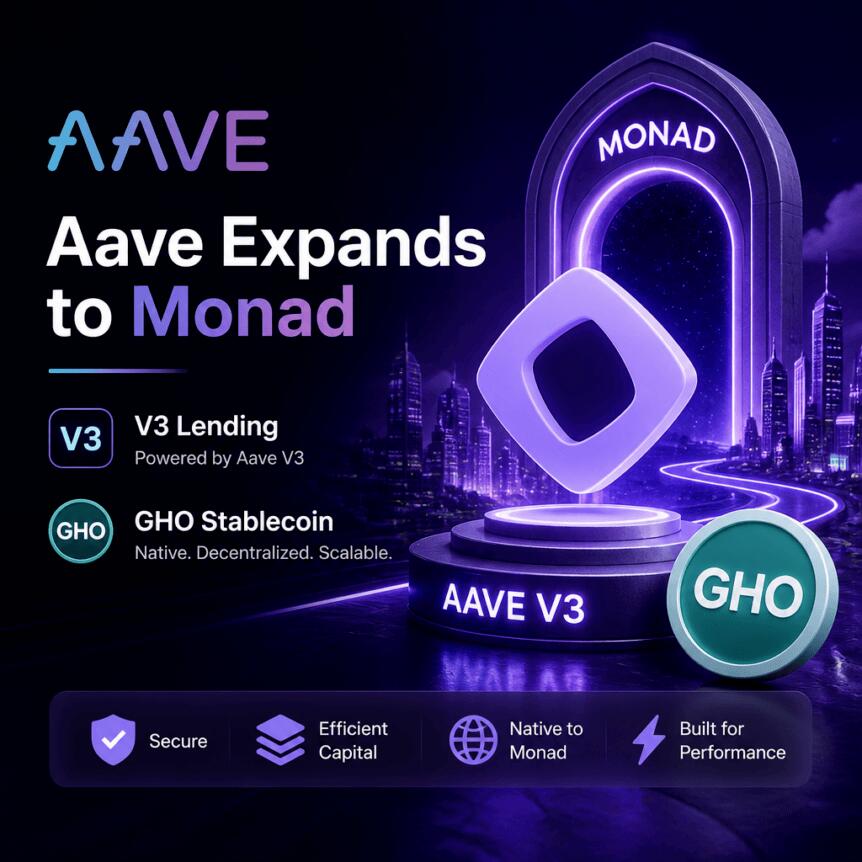
DeFi lending protocol Aave has expanded its multi-chain footprint by deploying its V3 lending markets on Monad, a layer-1 network designed to run Ethereum-compatible applications. The rollout introduces Aave on Monad with 12 supported assets at launch, aiming to give Monad users an established borrowing venue and to accelerate liquidity formation via incentives.
In its announcement on Thursday, Aave said the initial markets include USDT, USDC, Aave’s GHO stablecoin, USDe, mUSD, AUSD, WETH, cbBTC, wstETH, weETH, syrupUSDC, and sUSDe. It also highlighted that this is Aave’s first deployment with Chainlink Smart Value Recapture enabled from day one, a mechanism that redirects part of the value generated from liquidations back to the protocol.
Key takeaways
- Aave V3 is live on Monad with markets for 12 assets, including GHO and multiple stablecoin and wrapped-asset pairs.
- Chainlink Smart Value Recapture is enabled from launch, redirecting a portion of liquidation-generated value back to Aave.
- Governance materials show Monad’s ecosystem support includes $15 million in incentives over the first 12 months and additional GHO commitments.
- A risk assessment cited concerns about early activity on Monad compressing after an initial strong start, with liquidity remaining concentrated in established protocols.
What Aave V3 brings to Monad
The deployment matters for Monad because it moves beyond isolated DeFi activity and adds a battle-tested lending framework with liquidity incentives and a mature stablecoin ecosystem. Aave’s governance proposal notes that Monad is compatible with Ethereum’s application environment, meaning developers can reuse existing Solidity contracts and Ethereum tooling with minimal changes.
Aave also positioned the launch as more than a deployment checklist: it is meant to connect Monad’s users to GHO and to borrowing/lending liquidity designed for sustained market use. In addition to the asset list, Aave underscored the strategic role of Chainlink Smart Value Recapture in its liquidation flows, which can affect how value accrues on the protocol side and how incentives are structured during early adoption.
Incentives to jump-start liquidity—plus a reality check
Aave’s governance documentation indicates that the Monad Foundation committed $15 million in incentives during the first 12 months following activation. The foundation also agreed to acquire and retain 10 million GHO for more than six months, while the Aave DAO committed an additional 500,000 GHO in incentives to support onboarding on Monad.
That funding structure is designed to reduce early friction for borrowers and suppliers, but it does not automatically guarantee long-term utilization. A risk assessment by LlamaRisk pointed to a key uncertainty: while Monad’s mainnet launched on Nov. 24, 2025, network usage reportedly softened after a strong start. As of June 8, LlamaRisk estimated Monad’s total value locked at about $359.5 million, while noting that liquidity remained concentrated in already established protocols.
LlamaRisk backed the Aave deployment with conservative initial parameters, explicitly citing Monad’s short operating history at the time of evaluation. The practical takeaway for investors and traders is that incentive-backed liquidity often looks strong early, but the sustainability of borrow/supply activity will be tested as rewards decline and market participants decide whether to stay without continued subsidization.
Why tokenized assets could make lending more important
The Aave-on-Monad rollout lands as tokenized real-world assets (RWAs) increasingly intersect with DeFi lending strategies. Earlier coverage noted that institutions are looking at ways to bring tokenized assets into DeFi lending markets, and Standard Chartered previously said that tokenized assets entering DeFi could drive deposits into Aave. According to that same earlier reporting, Aave’s deposit base reached roughly $75 billion at its October 2025 peak.
Meanwhile, Centrifuge has discussed bringing tokenized Treasurys, private credit, and AAA-rated collateralized loan obligations to Monad for use across lending, collateral, and secondary-market activity. While the input does not indicate that Centrifuge assets have been integrated into Aave yet, the logic for Monad users is straightforward: if tokenized asset issuers expand into Monad, having an established lending venue such as Aave V3 can lower the barrier for turning those assets into productive borrowing and collateral workflows.
What to watch after the launch
Aave’s deployment gives Monad an immediate, Ethereum-compatible lending destination with a defined set of markets and liquidation value-sharing mechanics. The next signal that will matter most is whether borrowing demand and supply growth persist after early incentives—particularly given LlamaRisk’s observation that activity compressed after Monad’s initial strong start and that liquidity was concentrated in established venues. Readers should watch for changes in utilization across the new Aave markets and for any confirmed integration of tokenized asset products into Aave on Monad as the ecosystem develops.
https://www.cryptobreaking.com/aave-expands-to-monad-with/?utm_source=blogger%20&utm_medium=social_auto&utm_campaign=Aave%20Expands%20to%20Monad%20With%20V3%20Lending%20and%20GHO%20Stablecoin%20
Comments
Post a Comment