
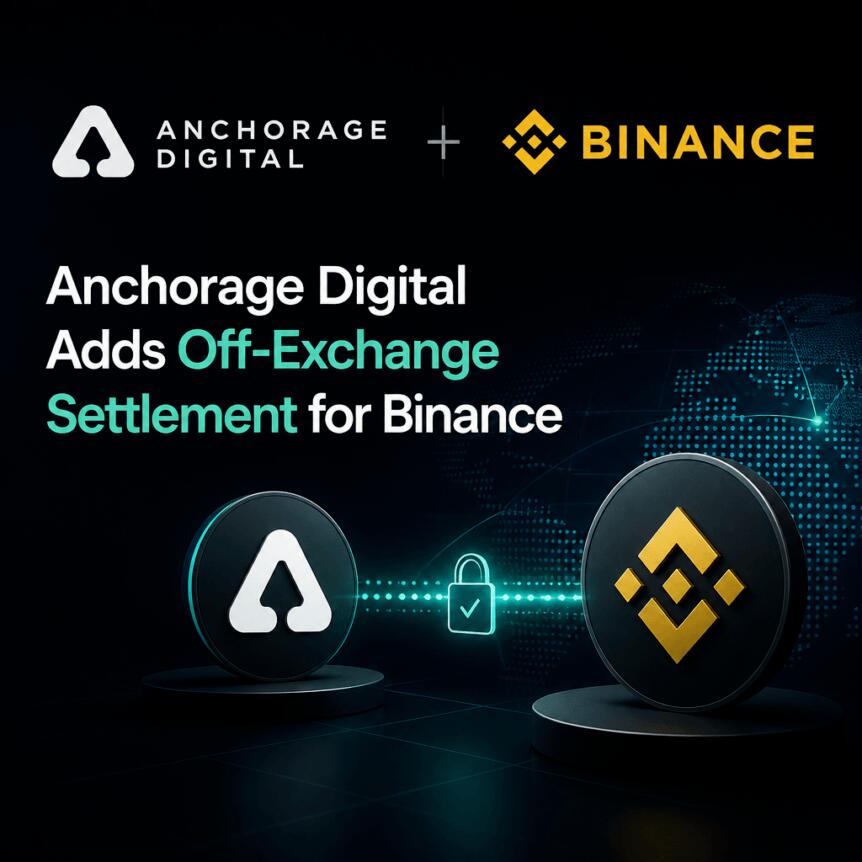
Anchorage Digital says it has integrated its off-exchange settlement system with Binance, enabling select institutional clients to trade on Binance without depositing their crypto or cash directly onto the exchange. Instead, clients’ assets and funds can remain in qualified custody at Anchorage—a federally chartered US crypto bank—until settlement.
The arrangement is built around margin and collateral mechanics: institutions can use crypto assets or US dollar deposits held with Anchorage to satisfy Binance’s margin requirements, without moving those holdings to Binance first. Anchorage and Binance framed the workflow as a separation of custody from trade execution, aiming to reduce the operational friction—and counterparty exposure—that can come with pre-funding trades on exchanges.
Key takeaways
- Anchorage integrated its off-exchange settlement platform with Binance to support institutional trading while keeping custody at Anchorage.
- Clients can use Anchorage-held crypto or US dollar deposits as collateral for Binance margin without transferring assets to the exchange.
- The model is positioned as a response to exchange counterparty risk and aims to improve capital efficiency by avoiding pre-funding.
- Anchorage’s Atlas platform is cited as the infrastructure behind this first off-exchange settlement implementation.
- Financial terms of the partnership were not disclosed.
How the Anchorage–Binance model changes custody and collateral
In traditional exchange-based workflows, institutions typically pre-fund trading accounts—transferring assets to the venue where trades are executed. Anchorage’s stated objective with this integration is to shift that balance. Under the collaboration, institutional clients can maintain crypto and cash in qualified custody with Anchorage while accessing trade execution through Binance.
Practically, the integration focuses on margin: Binance’s margin requirements are met using collateral held with Anchorage. The companies say this keeps assets in an independent custodian until settlement, rather than routing custody into the exchange account itself. By design, it also reduces the need for institutions to move holdings between custody providers and the trading venue ahead of every trade.
Anchorage said the rollout is available initially to select institutional clients, marking the first off-exchange settlement deployment for its Atlas platform—an infrastructure Anchorage describes as supporting institutional trading, settlement, lending, and collateral management using custody-based building blocks.
Why “off-exchange settlement” is drawing institutional attention
Exchange counterparty risk has long been one of the main frictions for institutions considering larger allocations to crypto trading. When assets must be deposited to an exchange to enable trading, risk is concentrated at the execution venue. Off-exchange settlement attempts to address that by keeping custody separate from the trading leg, with settlement handled via a different mechanism.
Anchorage and Binance framed their setup as moving closer to the custody-and-execution structure common in traditional financial markets, where institutions can separate where assets are held from where trades are executed and settled. The proposed benefit is twofold: it reduces exposure tied to pre-funding and may also improve capital efficiency by relying on custody-based collateral rather than tying funds to exchange balances.
While the companies did not disclose financial terms, they emphasized the core operational change: trades can be executed on Binance while crypto and cash remain with Anchorage through settlement—an approach intended to make institutional participation smoother without requiring full custody migration to the exchange.
Off-exchange settlement expands across major venues
This Anchorage–Binance integration sits within a broader industry pattern. Off-exchange settlement has been gaining traction among institutional crypto trading platforms throughout 2026, with multiple firms announcing similar custody-and-trade separation approaches.
According to earlier coverage from Cointelegraph, in April BitMEX partnered with Zodia Custody to allow institutional clients to trade derivatives while keeping collateral in segregated custody rather than depositing it onto the exchange. Under that structure, traders could access perpetual swaps and futures while collateral remained with Zodia and was mirrored for trading. BitMEX said the design eliminated the need to prefund exchange accounts and improved capital efficiency, while also reducing operational risks tied to moving assets between custody and trading venues.
In June, Bitget adopted a comparable model by integrating Fireblocks Off Exchange. Bitget said that its integration enables clients to execute trades from MPC-based wallets while keeping assets in trader-controlled collateral vaults rather than transferring them to the exchange. The company also claimed the platform can verify trading accounts are fully collateralized in real time without taking custody of client assets.
Separately, KuCoin Institutional expanded its custody offering earlier in the year by integrating Ceffu’s MirrorX platform in January. That system, according to the linked Ceffu and KuCoin Institutional material, is designed for institutional trading while digital assets remain in third-party custody, with funds mirrored for trading and settled off-chain every four hours.
Taken together, these deployments show a recurring theme: institutions increasingly want the flexibility of exchange liquidity and execution alongside custody structures that better match their risk controls. Off-exchange settlement is becoming a practical pathway to combine those priorities—at least for use cases offered through specific integrations between exchanges, custodians, and settlement platforms.
What investors should monitor next
For institutions, the most important questions now are likely operational and risk-related: which collateral types are supported end-to-end for margin, how settlement timing works in practice for different product categories, and how widely Anchorage’s off-exchange service will be rolled out beyond the initial select client group. Readers should also watch whether more major venues add similar custody-separated settlement layers, as that trend would further define how institutional crypto trading infrastructure evolves.
https://www.cryptobreaking.com/anchorage-digital-adds-off-exchange/?utm_source=blogger%20&utm_medium=social_auto&utm_campaign=Anchorage%20Digital%20Adds%20Off-Exchange%20Settlement%20for%20Binance%20
Comments
Post a Comment