
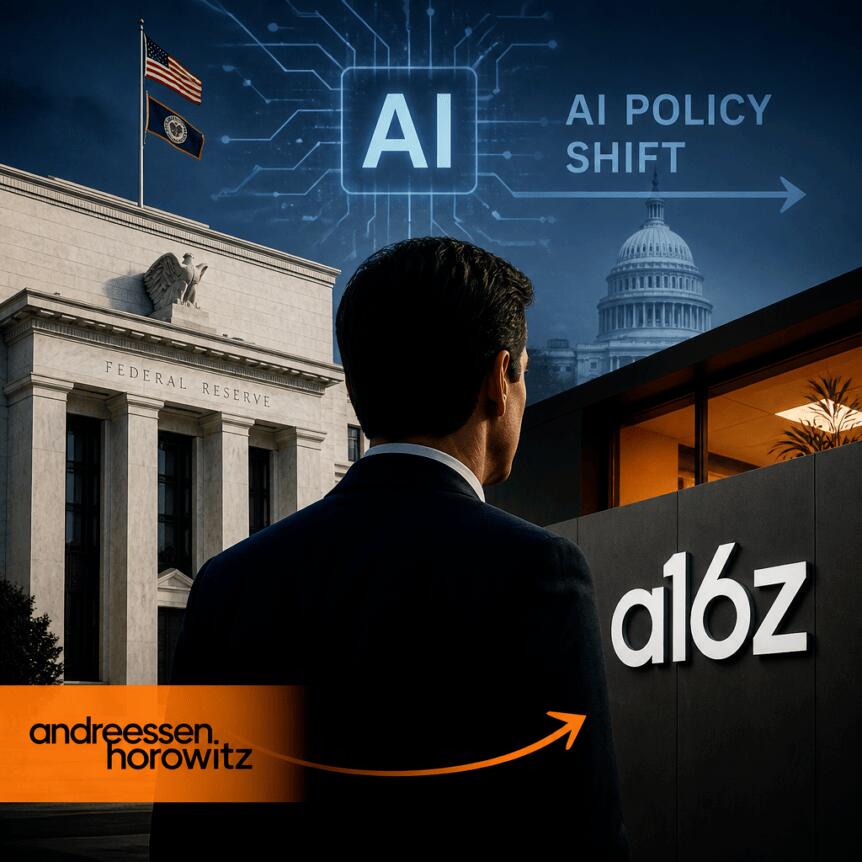
The U.S. Federal Reserve has named Marc Andreessen, a co-founder of Andreessen Horowitz (a16z), to help lead a new task force examining how artificial intelligence and other general-purpose technologies could reshape productivity and jobs.
Alongside Andreessen, the Fed’s Productivity and Jobs task force will include Charles I. Jones of Stanford University and Asha Sharma, a Microsoft executive vice president and Xbox CEO. The group’s mandate is to evaluate potential employment and productivity effects from technologies such as AI to inform future central bank policymaking. The Fed outlined the appointments in a Thursday press release.
Key takeaways
- The Fed is forming a Productivity and Jobs task force to study how AI and other broad technologies may affect employment and productivity.
- Marc Andreessen joins economist Charles I. Jones and Microsoft/Xbox executive Asha Sharma as part of the new working group.
- The appointments come under a wider task-force overhaul led by Fed Chair Kevin Warsh, focused on several areas of monetary policy conduct.
- Fed officials remain split on whether AI will ultimately be disinflationary through productivity gains or inflationary via near-term spending.
A new Fed task force for AI-era labor and output
According to the Fed, the Productivity and Jobs task force will assess how general-purpose technologies—including AI—may influence both labor markets and economic output. That focus matters because productivity trends can affect how quickly the economy can grow without reigniting inflation, while employment dynamics can influence demand, wage pressures, and the broader inflation outlook.
Andreessen will serve as one of the task force’s leaders, joining Charles I. Jones and Asha Sharma. Jones is a Stanford economics professor currently on leave at Anthropic. Sharma brings experience from large-scale technology and consumer platform operations through her role at Microsoft and Xbox. The Fed described the effort as a way to strengthen its policymaking inputs as new technologies evolve.
Warsh’s broader push: five task forces across policy operations
The Productivity and Jobs group is one of five task forces launched under new Fed Chair Kevin Warsh. In separate workstreams, the other teams will examine policy communication, balance sheet policy, data quality, and inflation frameworks.
Warsh revealed the leadership-driven reorganization and the creation of the five task forces during a June 17 press conference. He characterized the topics as timely and consequential and said each group would be independently led by leading experts “both inside and outside the economics profession.”
The chair also indicated the Fed intends to publish policy statements and guidance in shorter, clearer language—an operational shift that could affect how markets interpret Fed decisions and guidance going forward.
How Fed thinking on AI inflation differs
The Fed’s decision to dedicate a task force to technology and jobs arrives amid an ongoing debate inside the central bank about AI’s macroeconomic effects—particularly whether AI is ultimately inflationary or disinflationary.
In a May 27 speech, Governor Lisa Cook said she expects AI to further “boost productivity growth,” contributing to her view that GDP will grow robustly. At the same time, she noted AI carries the risk of “higher inflation,” reflecting concerns that the near-term costs of adopting and building AI infrastructure could feed into prices before productivity gains fully materialize. (Governor Cook’s remarks were delivered in a May 27 speech.)
Former Fed Chair Jerome Powell has also pointed to the inflationary pressure that can come from data center spending. In statements from March 2026 referenced by the Fed, Powell said that data center investment is putting pressure on goods and services and is “probably pushing inflation up at the margin.” The implication is that even if AI later reduces costs through productivity, the path to that outcome may involve heightened demand in the near term—complicating monetary policy timing.
Taken together, the internal split underscores why a labor-and-productivity task force could be significant: employment effects can influence wage growth and consumption, while productivity trajectories influence the economy’s supply side. AI adoption may therefore shift both the demand and supply sides of the inflation equation—just not necessarily in the same direction or at the same speed.
What Andreessen’s appointment signals for the Fed’s tech outreach
Marc Andreessen co-founded Andreessen Horowitz, which the Fed-focused article context describes as a major backer of both crypto and AI startups. While the Fed’s task force is not a statement of endorsement for any technology, the appointment highlights how the central bank is increasingly drawing on expertise from the technology and investment ecosystem as AI moves from research to large-scale deployment.
The connections between Warsh and Andreessen also extend beyond this new role. Earlier reporting tied Warsh and Andreessen to their days at Stanford in the early 1990s, and a CNBC interview from April 2026 cited Warsh describing both Andreessen and Palantir’s Peter Thiel as friends from college. Andreessen also publicly backed Warsh’s Fed chair nomination in a Jan. 30 X post following the nomination, writing that he has known Warsh for 30 years and that Warsh combines insight in economics and finance with an understanding of technology and business. Those remarks were posted by Andreessen on X at the time and are linked through the original coverage (see this post).
For investors and market participants, the more practical takeaway is not personal networking but the Fed’s evolving approach to gathering inputs: a central bank tasked with managing inflation and employment in a high-tech economy may find it increasingly difficult to rely only on traditional econometric relationships, especially when the cost structure and labor implications of AI can evolve quickly.
Going forward, the main thing to watch is how the Productivity and Jobs task force translates its findings into usable policymaking inputs—particularly whether it can better distinguish between near-term price pressures tied to AI investment and longer-term disinflationary effects driven by productivity. With the Fed already split on AI’s direction of travel, the task force’s work could become a key reference point for how officials assess the inflation outlook in the months ahead.
https://www.cryptobreaking.com/andreessen-appointee-brings-fed-role/?utm_source=blogger%20&utm_medium=social_auto&utm_campaign=Andreessen%20Appointee%20Brings%20Fed%20Role%20to%20A16z%20Amid%20AI%20Policy%20Shift%20
Comments
Post a Comment