
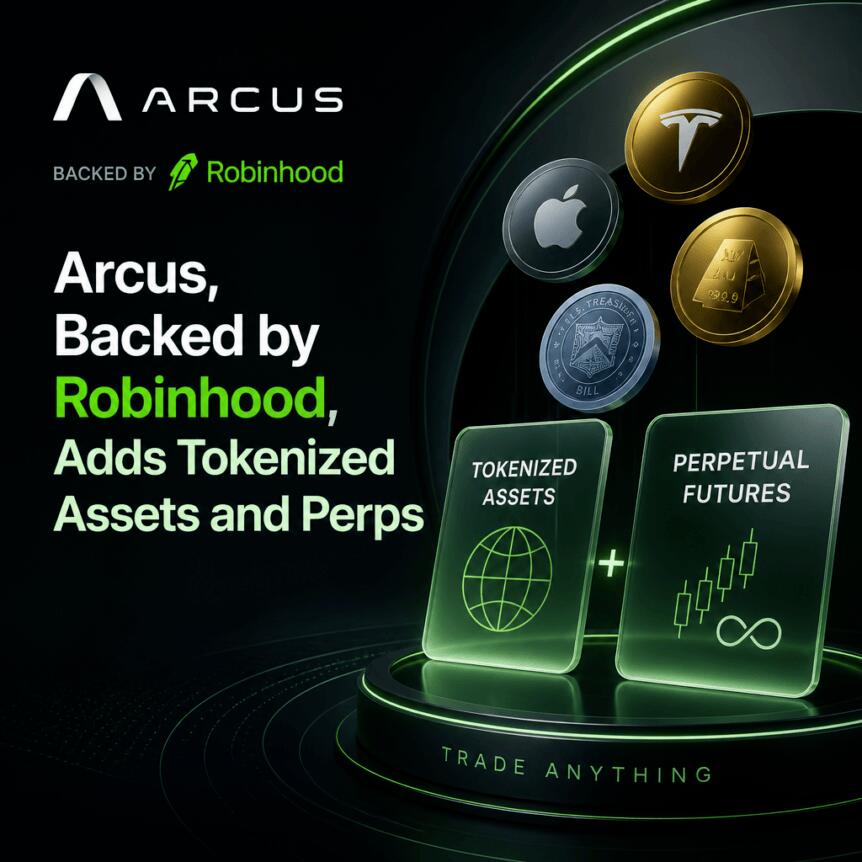
Arcus, a decentralized exchange backed by Robinhood Crypto, has expanded its onchain trading offering on Robinhood Chain by launching tokenized stocks alongside perpetual futures. The development signals how quickly DEX infrastructure is evolving to cover traditional market exposure, not just crypto-native assets.
According to an announcement shared with Cointelegraph, Arcus began trading tokenized equities and perpetual contracts on Tuesday. The platform also previously launched spot markets when Robinhood Chain went live on July 1, including stock token access across a self-custodial trading model.
Key takeaways
- Arcus launched tokenized stocks and perpetual futures on Robinhood Chain on Tuesday, building on earlier spot markets.
- The exchange supports more than 95 stock tokens and offers perpetual markets linked to equities, ETFs, commodities, indexes, and crypto assets.
- Arcus uses a self-custodial approach where users keep control of their wallets, with wallet integration via Privy and connectors such as MetaMask and Ledger.
- Paxos-issued USDG is positioned as Arcus’s primary collateral and settlement asset.
- Arcus restricts stock tokens in multiple regions, including the US, Canada, and the UK, underscoring ongoing regulatory fragmentation for tokenized securities.
Arcus adds tokenized equities and perpetual futures
Arcus is positioning itself as a bridge between onchain trading and traditional capital markets. The new offering includes tokenized versions of well-known US company stocks—such as Nvidia, Tesla, Apple, Microsoft, Meta, Google, and Amazon—alongside perpetual markets tied to equities and other offchain reference categories.
In addition to stock-linked perpetuals, Arcus’s product slate reportedly extends to perpetual markets associated with exchange-traded funds, commodities, indexes, and crypto assets. The company frames the expansion as part of a broader push to “onboard” real-world assets into decentralized trading workflows.
Arcus previously rolled out spot markets shortly after Robinhood Chain launched. Cointelegraph previously reported that Robinhood Chain saw more than 70 million in ETH bridged during its first week, and Arcus’s early spot rollout used that foundation to bring tokenized exposure to the chain.
A self-custody model built around Privy and existing wallets
A defining feature of Arcus is its self-custodial structure. Rather than depositing assets into a centralized exchange custody system, Arcus describes a trading setup where users keep control of their crypto wallets. That matters for traders because self-custody shifts responsibility for key management and reduces reliance on an intermediary to hold funds.
To support onboarding and wallet management, Arcus uses Privy, a wallet infrastructure provider. The platform enables sign-ups via email or social logins, then routes trading activity through wallet-based authorization.
For users who already hold crypto, Arcus supports connecting existing self-custodial wallets, including MetaMask, Ledger, and WalletConnect. The company also indicates support for additional Ethereum-compatible wallets.
Arcus’s trading system is also designed around stablecoin settlement. Paxos-issued USDG is described as the primary collateral and settlement asset for the platform, tying equity-linked trading to a familiar stablecoin infrastructure rather than requiring users to rely solely on native crypto volatility.
Restrictions highlight uneven regulation for tokenized stocks
While tokenized stocks are a core part of Arcus’s expansion, the company is explicit about where those instruments can’t be offered. Arcus states that its stock tokens are unavailable in the US, Canada, the UK, and other restricted jurisdictions.
Cointelegraph contacted Arcus for clarification on the restrictions, but did not receive a response by publication time. Even without additional detail, the regional exclusions reinforce a central theme in tokenized real-world assets: regulatory standards for securities representations vary widely, and product access often becomes the first battleground.
In markets including the US and UK, regulators have been scrutinizing how blockchain-based representations of traditional assets fit within existing financial rules. Key questions typically include who effectively holds or controls the asset, how ownership is defined, and what market structure is created when trading happens through token contracts.
Arcus’s approach suggests it is attempting to scale onchain trading while limiting exposure to jurisdictions where compliance requirements may be more complex or where the classification of tokenized securities remains unsettled.
Competition accelerates for onchain RWA infrastructure
Arcus’s move lands in the middle of a broader sector race: crypto firms and financial platforms are competing to build infrastructure for tokenized real-world assets (RWAs). The push isn’t limited to token issuances—DEX-style trading venues, perpetual markets, and settlement mechanisms are becoming just as important as the onchain representation of the underlying assets.
As Robinhood Chain-based products expand, the DEX landscape is also seeing other efforts to bring traditional financial instruments onchain. Cointelegraph previously reported that platforms including Coinbase-backed Base have been exploring ways to deliver tokenized equities and related products onchain, showing that the “tokenized markets” strategy is no longer confined to a single ecosystem.
There is also a thematic tension in this transition. Tokenized markets depend on regulatory permissions to determine where products can be offered, yet onchain infrastructure is often built to be globally accessible. Arcus’s launch, with explicit geographic exclusions, illustrates how companies may prioritize compliance routing while still using public blockchain networks as the underlying execution layer.
The launch adds to the growing list of platforms trying to translate traditional market participation into decentralized trading patterns—particularly for users seeking exposure to equity-linked references without using legacy brokerage interfaces.
For investors and traders, the immediate watch-items are straightforward: how Arcus evolves its regional availability, whether it expands beyond stock tokens into additional derivatives liquidity over time, and how settlement and custody design choices—centered on self-custody and USDG—hold up as regulatory scrutiny intensifies across major markets.
https://www.cryptobreaking.com/arcus-backed-by-robinhood-adds/?utm_source=blogger%20&utm_medium=social_auto&utm_campaign=Arcus,%20Backed%20by%20Robinhood,%20Adds%20Tokenized%20Assets%20and%20Perps%20
Comments
Post a Comment