
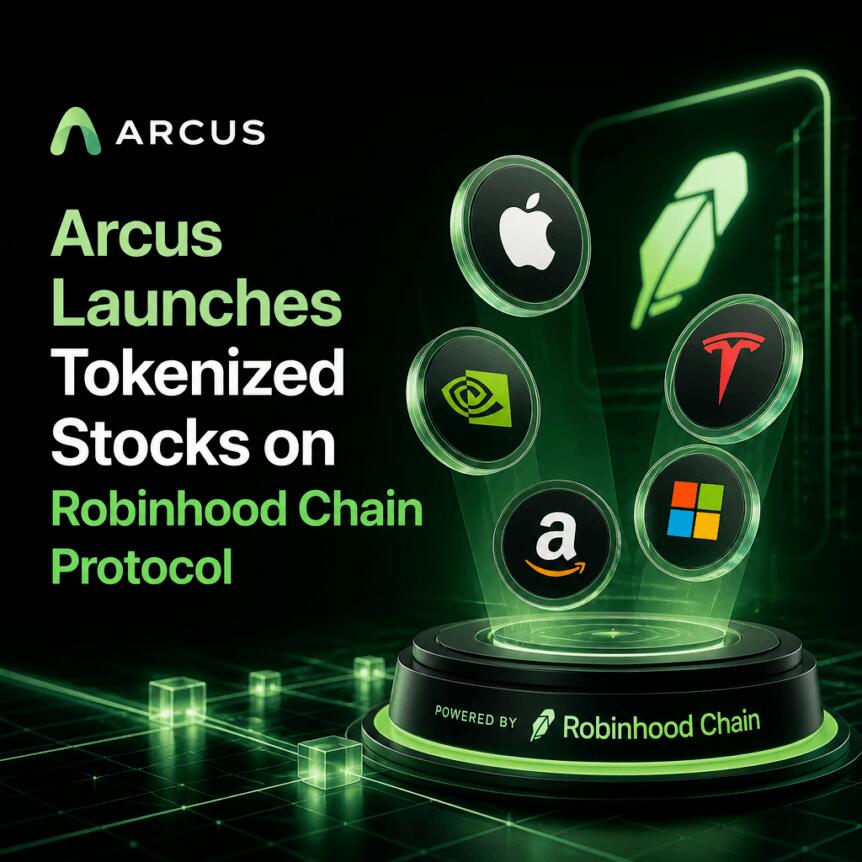
A decentralized exchange (DEX) backed by Robinhood is moving deeper into tokenized traditional assets, launching tokenized stock trading and perpetual futures on Robinhood Chain. Arcus—built by the team behind decentralized trading venue dYdX—rolled out the new products on Tuesday, according to an announcement shared with Cointelegraph.
The expansion follows Arcus’s earlier spot market launch after Robinhood Chain went live on July 1. With the latest release, the platform now supports tokenized stocks alongside perpetuals tied to equities and other underlying categories, using a self-custodial setup designed to keep users in control of their assets.
Key takeaways
- Arcus launched tokenized stocks and perpetual futures on Robinhood Chain, expanding beyond spot trading on the new chain.
- The platform says it operates with self-custody, allowing users to connect existing wallets rather than depositing assets on a centralized venue.
- Paxos-issued USDG is presented as the primary collateral and settlement asset for trading on Arcus.
- Arcus states its stock tokens are restricted in the US, Canada, the UK, and other jurisdictions, underscoring ongoing regulatory complexity for onchain securities.
- The move adds to competitive efforts among crypto-native platforms to build liquidity and trading infrastructure for tokenized real-world assets.
From spot markets to tokenized equities and derivatives
Arcus says its offering now includes more than 95 stock tokens, alongside perpetual markets spanning equities and a wider range of references, including exchange-traded funds, commodities, indexes, and crypto assets. Perpetuals allow traders to take positions without owning an underlying spot asset, typically using ongoing settlement mechanisms tied to an implied market price.
Earlier in the process, Arcus launched spot markets when Robinhood Chain became available on July 1. The new derivatives and tokenized stock functionality indicates Arcus is treating Robinhood Chain not just as a settlement layer for transfers, but as a foundation for a broader trading suite aimed at traditional market participants and crypto traders alike.
For users, that matters because liquidity and product breadth often determine whether tokenized assets become useful beyond hype cycles. Tokenized equities plus perpetuals can, in principle, create more routes to exposure—whether a trader wants an asset-like token representation or a derivative position referencing stock markets.
Self-custody and wallet infrastructure at the center
Arcus is presenting its platform as self-custodial. Instead of requiring users to deposit assets into a custodial account run by a centralized exchange, users maintain control of their holdings through connected wallets.
To support onboarding and wallet operations, Arcus uses Privy, a wallet infrastructure provider. The system enables sign-up through email or social logins, while the platform also supports connections to existing self-custodial wallets, including MetaMask, Ledger, and WalletConnect. Arcus also said it plans to support additional Ethereum-compatible wallets.
In practical terms, self-custody can be attractive during periods when users are sensitive to counterparty risk. But it also shifts more responsibility to the user to manage wallets securely—especially when trading products include derivatives where position management and margin-like collateral behavior are central.
Collateral and settlement: USDG as the key building block
Arcus’s trading engine relies on stablecoin collateral and settlement, naming Paxos-issued USDG as its primary collateral and settlement asset.
Stablecoin choice is frequently a behind-the-scenes decision that affects user experience and liquidity flows. Using a single primary settlement asset can simplify integrations and reduce fragmentation—though the wider effectiveness still depends on how well that stablecoin is integrated across custody, trading, and onchain routing.
Regulatory gaps remain: tokenized stocks are restricted
Despite the expansion into tokenized stocks, Arcus says its stock tokens are unavailable in the US, Canada, the UK, and other restricted jurisdictions. The company’s approach highlights a core tension in tokenized securities: the technology can be deployed quickly, but the ability to distribute or trade certain representations of securities depends on local regulatory interpretations.
Cointelegraph reached out to Arcus for clarification on the restrictions but did not receive a response by publication time. Without additional detail, it remains unclear whether the limits are driven by issuer constraints, exchange and custody requirements, product structure classification, or other legal considerations.
Arcus’s geography-based restrictions also reinforce a broader pattern regulators in the US and the UK have been examining: how blockchain-based representations of traditional assets fit into existing financial frameworks. Questions commonly include custody and ownership, trading venue classification, and how market structure protections translate onto chain.
The launch also intensifies the competitive push among tokenization builders. Cointelegraph notes that platforms including Coinbase-backed Base are exploring ways to bring traditional financial products onchain, reflecting investor and developer interest in expanding beyond crypto-native assets into mainstream categories.
What to watch next for onchain tokenized markets
As Arcus adds derivatives and tokenized equities to Robinhood Chain, the biggest near-term questions are how quickly access expands beyond restricted jurisdictions and whether the product structure will align smoothly with evolving regulatory expectations. Traders and builders should watch for updates on supported regions, wallet and liquidity performance, and any changes to how collateral and settlement are handled as competition for onchain RWA infrastructure accelerates.
https://www.cryptobreaking.com/arcus-launches-tokenized-stocks-on/?utm_source=blogger%20&utm_medium=social_auto&utm_campaign=Arcus%20Launches%20Tokenized%20Stocks%20on%20Robinhood%20Chain%20Protocol%20
Comments
Post a Comment