
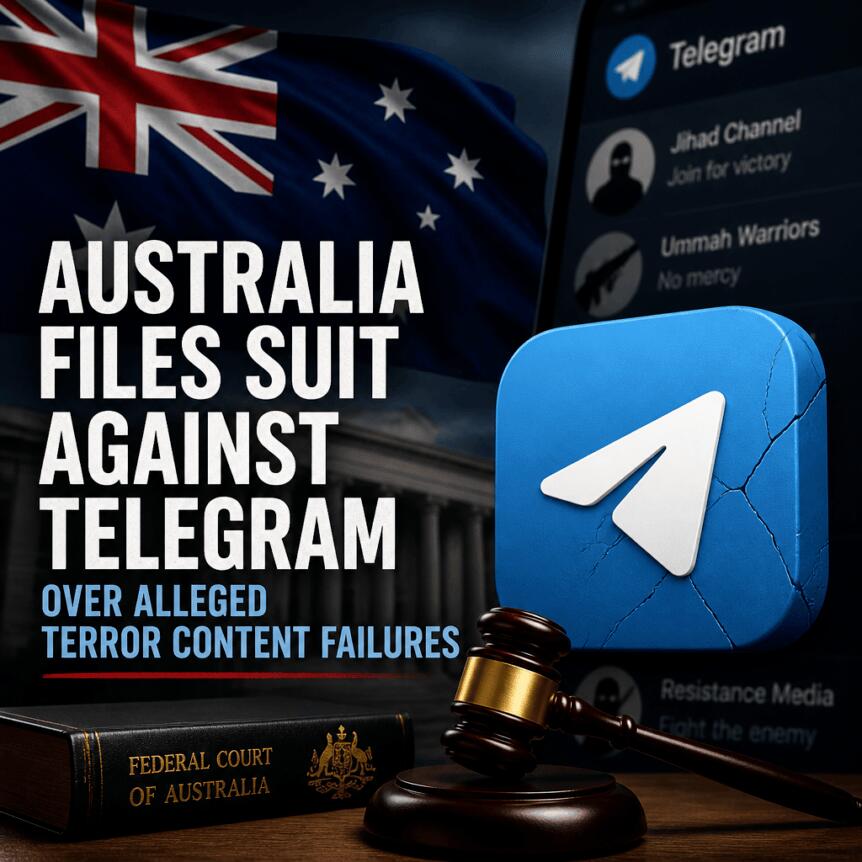
Australia’s eSafety Commissioner has taken Telegram to court, launching civil penalty proceedings in the Federal Court over allegations that the messaging platform failed to address terrorism-linked content under the country’s Online Safety Act. The action was filed on Thursday, according to an eSafety statement.
The regulator’s complaint focuses on what it describes as repeated failures to remove pro-terror material after becoming aware of it, along with insufficient steps to prevent repeated breaches. The case is likely to add pressure to Telegram as governments across Europe and beyond continue testing how large platforms should moderate harmful content.
Key takeaways
- eSafety says Telegram breached obligations under Australia’s Online Safety Act by not responding adequately to multiple user complaints about pro-terror content.
- The regulator alleges some unlawful material remained visible for as long as three weeks after Telegram was aware of it.
- eSafety also claims Telegram did not take sufficient measures to curb repeat distribution, including removing accounts, channels, and groups tied to the content.
- The proceedings seek civil penalties, with potential fines under Australia’s online safety rules reaching up to 54.6 million Australian dollars.
- The case follows heightened legal scrutiny of Telegram and CEO Pavel Durov in other countries, including recent Russian actions.
Australia’s civil penalty case centers on alleged moderation failures
In its filing, Australia’s online safety regulator alleges Telegram failed to remove certain unlawful material after it had notice of the content. eSafety described a year-long investigation that, in its view, showed Telegram did not act in time once it became aware.
According to eSafety, the issue wasn’t limited to a single piece of content. The regulator alleged that reported pro-terror material continued to be visible for up to three weeks, even after warnings were raised. It also claims Telegram did not do enough to prevent repeat violations by adequately disrupting the accounts and communities used to distribute the content.
The allegations include failures to detect known extremist material—specifically footage connected to two major mass shootings: the 2019 Christchurch mosque attack and the 2022 Buffalo mass shooting—before the material was later removed, eSafety said.
Why this matters for Telegram users and platform compliance
Beyond the immediate legal stakes, the case underscores how regulators are increasingly tying platform expectations to concrete operational outcomes: timeliness of takedowns, responsiveness to reports, and the ability to limit repeat distribution. For Telegram users, the dispute highlights a growing tension between broad claims about speech and encryption-based design choices versus statutory duties that require platforms to manage certain categories of harmful content.
For Telegram, the compliance challenge is not only about removing content after it is identified, but also about demonstrating systems that can detect and disrupt known extremist material and prevent reappearance via networks of channels, groups, and related accounts. eSafety’s emphasis on alleged repeated violations suggests the regulator may treat moderation as an ongoing obligation rather than a one-off response to individual reports.
Regulatory pressure is widening internationally
The Australian proceedings arrive amid a broader wave of legal scrutiny targeting Telegram’s moderation approach. The case adds to pressure on both the company and its CEO, Pavel Durov, as multiple governments seek more direct accountability from major communication platforms.
eSafety’s move comes a day after Russia’s Federal Security Service (FSB) charged Durov with facilitating terrorist activity and said it had started steps to add him to an international wanted list. Russia’s allegations include claims that Telegram failed to remove channels, chats, and bots used by Ukrainian intelligence services, terrorist groups, and extremist organizations to coordinate attacks, recruit operatives, and carry out cyber fraud.
Telegram has not issued an official statement on the Australian case. However, the platform’s official X account posted content described as related to “freedom of expression.” In response to international criticism, Telegram has repeatedly framed moderation and legal pressure through the lens of free speech and user rights.
France and Russia-related cases continue to develop
Durov is also facing legal exposure in France following his August 2024 arrest at Le Bourget Airport. French prosecutors have charged him with offenses that include complicity in the distribution of illegal content, including material related to organized crime, through Telegram.
The broader regulatory environment has also shaped Telegram’s public positioning. Durov has criticized what he described as increasing threats to online privacy, arguing that governments were rolling back protections for the free internet. In a post on X dated October 2025, he warned that the promise of free information exchange was being turned into a “tool of control.”
While the Australian case is not identical to the allegations in Russia or France, the common thread is that regulators are increasingly testing whether Telegram’s platform model can meet legal expectations around harmful content—particularly content connected to terrorism and violent extremism.
As the Australian proceedings move forward, investors, traders, and builders will likely watch not only for any outcomes in court, but also for whether Telegram changes its moderation and enforcement processes in a measurable way—especially around response timelines, repeat distribution, and the handling of clearly identified extremist media.
https://www.cryptobreaking.com/australia-files-suit-against-telegram/?utm_source=blogger%20&utm_medium=social_auto&utm_campaign=Australia%20Files%20Suit%20Against%20Telegram%20Over%20Alleged%20Terror%20Content%20Failures%20
Comments
Post a Comment