
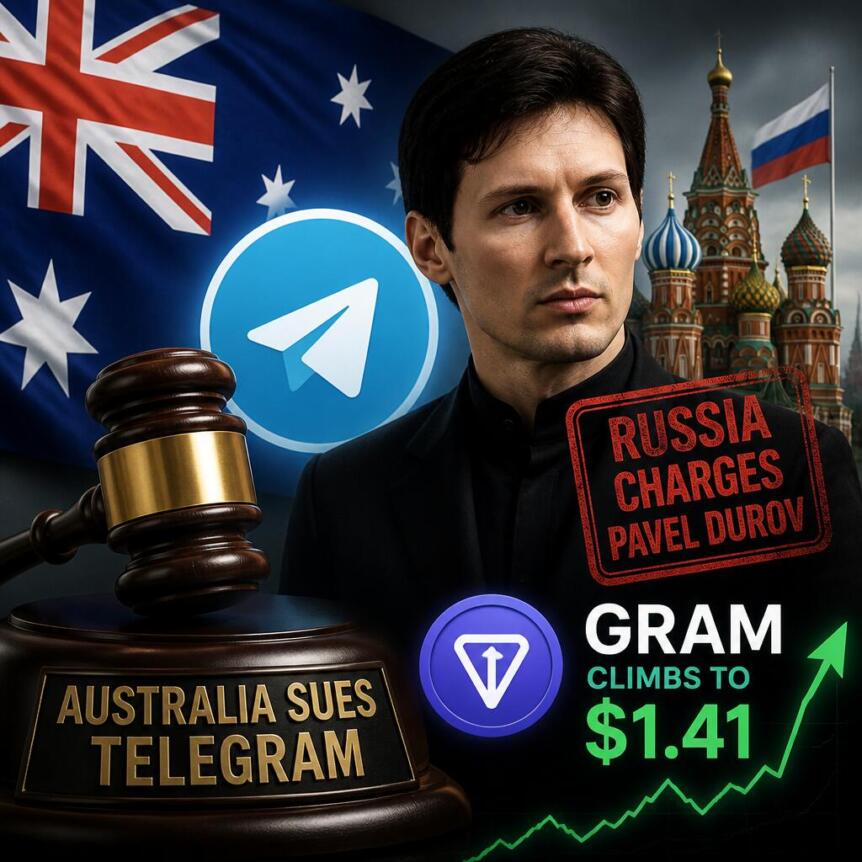
Australia has launched legal action against Telegram over alleged failures to remove extremist content from its platform. The case comes as Russia files criminal charges against Telegram founder Pavel Durov. Meanwhile, GRAM traded at $1.41, recovering after a sharp weekly decline despite growing regulatory pressure.
Australia Targets Telegram Under Online Safety Act
Australia's eSafety Commission has started civil penalty proceedings against Telegram in the Federal Court. The regulator alleges the messaging platform failed to meet safety obligations under the country's Online Safety Act. Authorities are seeking penalties that could reach A$54.6 million if the court finds Telegram breached the law.
The action follows a lengthy investigation into Telegram's handling of harmful online material. Regulators examined whether the company had effective systems to detect and remove extremist content. The review also covered child exploitation material and violent criminal content distributed through the platform.
The commission stated that Telegram left prohibited material available after receiving notifications. The regulator identified videos linked to the 2019 Christchurch mosque attack and the 2022 Buffalo shooting among the reported content. Australian authorities argue that the platform failed to meet mandatory safety standards for digital services.
Global Pressure on Pavel Durov Continues
The legal action in Australia adds to broader regulatory pressure facing Telegram and its founder, Pavel Durov. Russian authorities recently charged Durov with facilitating terrorist activities through the platform. The country's Federal Security Service also placed him on an international wanted list after issuing an arrest warrant.
French authorities have also investigated Telegram over concerns about illegal content and cooperation with law enforcement agencies. Prosecutors examined whether the company responded adequately to official requests involving criminal investigations. Those inquiries have increased scrutiny of Telegram's moderation practices across several jurisdictions.
Telegram has maintained its focus on user privacy despite increasing legal challenges. The company continues to oppose requests that could weaken encryption or create backdoor access. At the same time, Telegram recently introduced network improvements and reduced transaction fees on its ecosystem to almost zero.
Gram Price Recovers Despite Regulatory Challenges
GRAM traded at $1.41 during the latest session after recovering from recent losses. The token gained around 2% over several hours following a weekly decline of approximately 12%. Trading activity placed the daily range between $1.38 and $1.43.
The recovery came even as legal developments surrounding Telegram continued to dominate headlines. Market participants saw the token stabilize after sustained selling pressure during the previous week. Even so, the price remains below levels recorded before the recent decline.
GRAM has historically reacted to major developments involving Telegram because of the close association between the platform and its ecosystem. Regulatory actions have often influenced short-term market activity. However, broader market conditions also continue to affect the token's price performance.
Australia's latest legal action represents another significant challenge for Telegram as governments increase oversight of online platforms. Russia's charges against Pavel Durov further add to the company's legal and regulatory pressures across multiple jurisdictions. The combined developments highlight growing international efforts to enforce stricter online safety standards while Telegram continues to defend its privacy-focused approach.
https://www.cryptobreaking.com/australia-sues-telegram-as-russia/?utm_source=blogger%20&utm_medium=social_auto&utm_campaign=Australia%20Sues%20Telegram%20as%20Russia%20Charges%20Pavel%20Durov%20While%20Gram%20Climbs%20to%20$1.41%20
Comments
Post a Comment