
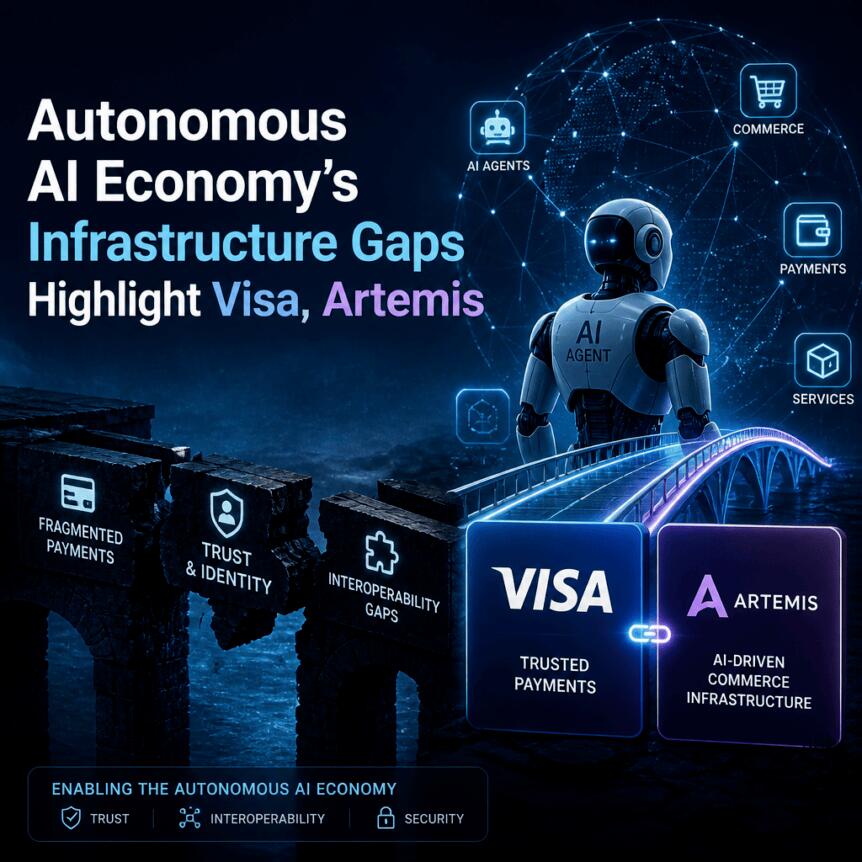
AI agents are starting to change how payments need to work, and Visa is warning that the world’s card rails were never built for the transaction volume, speed, and cost sensitivity required by machine-to-machine commerce. In a joint report released this week with investment thesis platform Artemis, Visa argues that AI-driven micropayments demand near-zero fees and faster settlement to become commercially viable.
The report links the timing to a capability shift: it says AI agents crossed a key threshold in mid-2025, enabling them to discover unfamiliar APIs, assess pricing, and make autonomous payment decisions. That capability, Visa and Artemis say, is pushing commerce toward an agentic model—while existing infrastructure gaps continue to limit mainstream adoption.
Key takeaways
- Visa and Artemis say traditional cards are optimized for low-frequency, human-paced payments, making them poorly matched to high-frequency AI micropayments.
- The report frames 2025 as a turning point for “agentic” payment automation, driven by AI agents’ ability to autonomously evaluate and execute transactions.
- Visa and Artemis propose convergence: cards remain useful for proxy purchases inside merchant networks, while stablecoins fit machine-native micropayments.
- Some machine-payment standards are already gaining momentum, including Coinbase’s x402 protocol, which the report cites as reaching sharply higher monthly transaction counts in late 2025.
Why AI agents stress existing payment rails
Visa and Artemis describe the underlying mismatch as structural. Cards were designed for human commerce—where transactions tend to be less frequent and costs can be amortized across larger purchase sizes. AI agents, by contrast, are expected to generate many more micro-transactions, often on short time horizons and with different cost constraints.
For agentic micropayments to scale, the infrastructure must support payments with extremely low per-transaction overhead and settlement that enables rapid decision-making loops. The report suggests that without these properties, the economics of autonomous “machine-to-machine” payments remain unfavorable—even if the AI itself can now carry out the payment decision.
The report also warns that infrastructure gaps aren’t just theoretical. It frames current limitations as a direct brake on adoption, arguing that the shift from experimenting with agent capabilities to using them in everyday transactions depends on payment networks that can keep up.
x402 shows demand for machine-native transaction patterns
While Visa and Artemis emphasize the broader need for new infrastructure, they also point to early signs that some agentic payment designs are gaining usage. The report cites the x402 payment protocol developed by Coinbase as an example of standards beginning to attract real transactional volume.
According to the report, x402 processed $15 million in adjusted volume across more than 109 million adjusted transactions since its May 2025 launch. It also highlights a significant acceleration in October 2025: the monthly transaction count reportedly increased from 40,000 to 3.8 million, resulting in 38 million transactions processed in October alone. The report attributes this momentum to the growing practicality of the protocol for machine-style payments.
Stablecoins as an on-ramp to agentic micropayments
A central claim in the Visa-Artemis report is that stablecoins could play a key role in enabling machine-native micropayments without forcing all commerce to migrate away from cards. Rather than positioning stablecoins and card networks as direct competitors, the report argues for a convergence model.
“The trajectory points toward convergence rather than competition: cards for proxy purchases inside existing merchant networks, stablecoins for machine-native micropayments, and hybrid flows where both are used within the same workflow.”
This framing matters for investors and builders because it implies that payment interoperability—not replacement—will likely define near-term strategy. In practice, an AI agent workflow may still need cards for certain merchant-bound transactions, but stablecoins (or other crypto rails) could be better suited for the agent’s “background” actions that require very low fees and fast settlement.
The report adds that a single machine-payments framework could support both stablecoin-based flows and traditional card transactions. Visa says this creates a path for card networks to plug into agentic payments over time, rather than treating agent commerce as a separate universe.
Protocols and tooling: connecting onchain and fiat through tokens
Visa and Artemis point to a broader effort to unify payment approaches using shared payment tokens and machine-payment protocols. The report says Tempo’s Machine Payment Protocol (MPP) now spans both onchain crypto payments and fiat payments through shared payment tokens.
Visa also states that its Card Specification SDK was built to extend the protocol into card-based agent commerce. It further notes that Tempo and Visa’s crypto division launched AI-related tools in March, with different focal points: Visa’s tooling is described as enabling same-day payments for AI agents, while Tempo’s Machine Payments Protocol is designed to make it easier for AI actors to send and receive money.
While the report doesn’t spell out new performance benchmarks for every component, it does make one clear point: adoption depends on interoperability across rails and token frameworks. If AI agents can consistently route payments through a machine-friendly layer, then the difference between stablecoin settlement and card settlement becomes a routing and workflow decision—not a structural barrier.
For readers watching the space, this suggests a practical trend: payment infrastructure will likely evolve through standards, SDKs, and shared protocol logic that allow agentic workflows to move between fiat and crypto settlement depending on cost, speed, and merchant coverage.
Going forward, the key question is whether agentic micropayment demand keeps accelerating fast enough to force mainstream payment networks to meet machine-level cost and settlement requirements. Buyers of payments infrastructure, developers integrating agent payments, and traders tracking adjacent stablecoin usage should watch how quickly token-based frameworks and machine payment standards—like x402 and MPP—translate early transaction growth into consistent, scaled deployments.
https://www.cryptobreaking.com/autonomous-ai-economys-infrastructure-gaps/?utm_source=blogger%20&utm_medium=social_auto&utm_campaign=Autonomous%20AI%20Economy’s%20Infrastructure%20Gaps%20Highlight%20Visa,%20Artemis%20
Comments
Post a Comment