
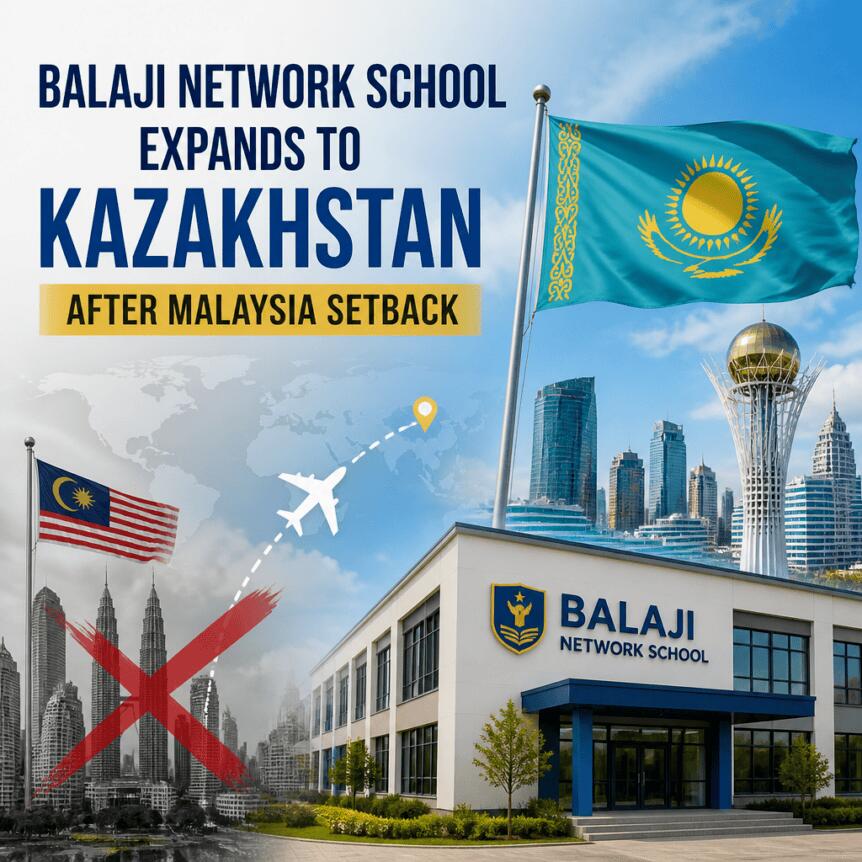
Balaji Srinivasan’s Network School is looking to plant a new campus in Kazakhstan after regulatory pressure in Malaysia forced its Johor operation to halt. The move comes via a memorandum of understanding (MoU) between Kazakhstan’s Ministry of Digital Development, Innovation and Aerospace Industry and Srinivasan, signaling a rapid attempt to preserve the project’s cross-border footprint.
The Kazakhstan agreement positions Network School for a fresh base following actions that disrupted its local operations in Johor. Kazakhstan has been actively courting technology and digital-industry activity, including plans for a Central Asia “crypto city” in Alatau—an environment that Network School appears eager to tap.
Key takeaways
- Network School signed an MoU in Kazakhstan, potentially creating its first local campus there.
- Malaysia’s Johor authorities revoked the business license of NSO Malaysia Sdn Bhd, the operator behind Network School’s Forest City-linked presence.
- Malaysia Digital status is under immediate review, since the operator’s Malaysia Digital recognition is tied to compliance with local and federal laws.
- Srinivasan says the Kazakhstan campus will focus on talent attraction, including expedited visas and streamlined redomiciliation.
Kazakhstan MoU offers a fallback for Network School’s expansion
According to a ministry statement, Kazakhstan’s Ministry of Digital Development, Innovation and Aerospace Industry signed an MoU with Balaji Srinivasan to establish the first Network School campus in the country. The memorandum was signed by Zhaslan Madiyev on behalf of the ministry and Srinivasan on the Network School side.
For the project, the timing matters. Network School’s Kazakhstan plan appears framed as continuity after setbacks in Malaysia. The article also notes that Kazakhstan has been positioning itself as an emerging technology hub, and references ambitions such as a Central Asia “crypto city” in Alatau—suggesting regulators and policymakers there may be more receptive to experiments that sit near the boundary between technology policy and digital-asset culture.
Srinivasan described the new campus as a place designed to accelerate onboarding for participants. In a post dated Tuesday on X, he said the campus would offer a “haven for global techno-optimism,” including expedited visas, streamlined redomiciliation, and active recruitment of talent.
Malaysia regulatory action escalates: license revocation and Malaysia Digital review
Network School’s Kazakhstan pivot follows multiple regulatory developments in Malaysia. On Tuesday, the Iskandar Puteri City Council (MBIP) revoked the business license of NSO Malaysia Sdn Bhd, which operates Network School. The revocation was linked to alleged breaches of licensing conditions and premises-use requirements.
The Malaysia Digital Economy Corporation (MDEC), which oversees the “Malaysia Digital” program, then announced immediate steps to revoke the operator’s Malaysia Digital status. Malaysia Digital recognition is granted to eligible technology and digital companies and, as described in the source coverage, can come with incentives such as tax benefits, flexibility around ownership, and the ability to employ local and foreign workers.
Crucially, the program also requires licensees to comply with local and federal laws. With NSO Malaysia’s license revoked, MDEC’s move indicates the regulator is treating the Malaysia Digital designation as contingent on continued lawful operations.
Johor politics and immigration scrutiny widen the dispute
Beyond the licensing issue, the dispute has also pulled in higher-level political attention. The source reports that Onn Hafiz Ghazi, Chief Minister of Johor, urged Malaysia’s federal authorities to continue investigating whether Network School violated immigration laws. He framed Johor as a “strategic entry point” due to the state’s proximity to Singapore, arguing that any weaknesses or misuse of the immigration system should be addressed promptly and firmly.
This matters for Network School because its model—bringing in global “digital nomads” and hosting a dense community of talent—depends on predictable pathways for visas, residency changes, and compliance. When immigration questions enter the picture, the risk is not only reputational; it can directly affect members’ ability to travel, work, or remain in the country.
The source also indicates that Srinivasan pushed back on reports that Network School was shutting down. On Friday, he denied the closures, saying the project had received two notices: one requiring a sign’s wording to be changed, and another related to a coworking setup created by joining two adjacent units. He said one side of that arrangement had a valid license while the other did not, and claimed the group had a remedial period to address both issues.
According to Srinivasan, members were otherwise unaffected during that remedial window. Cointelegraph reported that it reached out to Srinivasan and Network School for comment, but the article’s account focuses primarily on the regulatory steps already taken by the local council and MDEC.
What changes—and what remains uncertain—if Network School relocates
The Kazakhstan MoU suggests Network School wants to avoid a prolonged pause by securing an alternative operating base quickly. But an agreement is not the same as full operational clearance. Readers should view the MoU as a framework for collaboration and campus establishment, while awaiting more detailed information on licensing, immigration logistics, and the practical timeline for opening.
Still, the contrast between Malaysia and Kazakhstan is instructive. In Malaysia, the dispute moved from licensing conditions to a broader discussion involving Malaysia Digital compliance and immigration law scrutiny. In Kazakhstan, the present reporting centers on cooperation and talent-attraction features—expedited visas and streamlined redomiciliation—language that typically signals a focus on easing administrative friction.
For investors, builders, and community operators watching the “network state” concept, the underlying takeaway may be how regulatory pressure in one jurisdiction can accelerate relocation tactics. A community anchored in one place can gain momentum, but it is also exposed: local licensing, premises rules, and immigration enforcement can rapidly reshape operating reality. Network School’s next steps in Kazakhstan will therefore function as a real-world test of whether the administrative environment for techno-nomad hubs can be replicated across borders.
As the Kazakhstan campus planning progresses, the most important thing to watch is how the MoU translates into concrete permits and member onboarding on the ground—particularly on visas and local compliance. Until then, Network School’s situation remains a moving target shaped by how regulators interpret licensing, premises usage, and immigration obligations in each country.
https://www.cryptobreaking.com/balaji-network-school-expands-to/?utm_source=blogger%20&utm_medium=social_auto&utm_campaign=Balaji%20Network%20School%20Expands%20to%20Kazakhstan%20After%20Malaysia%20Setback%20
Comments
Post a Comment