
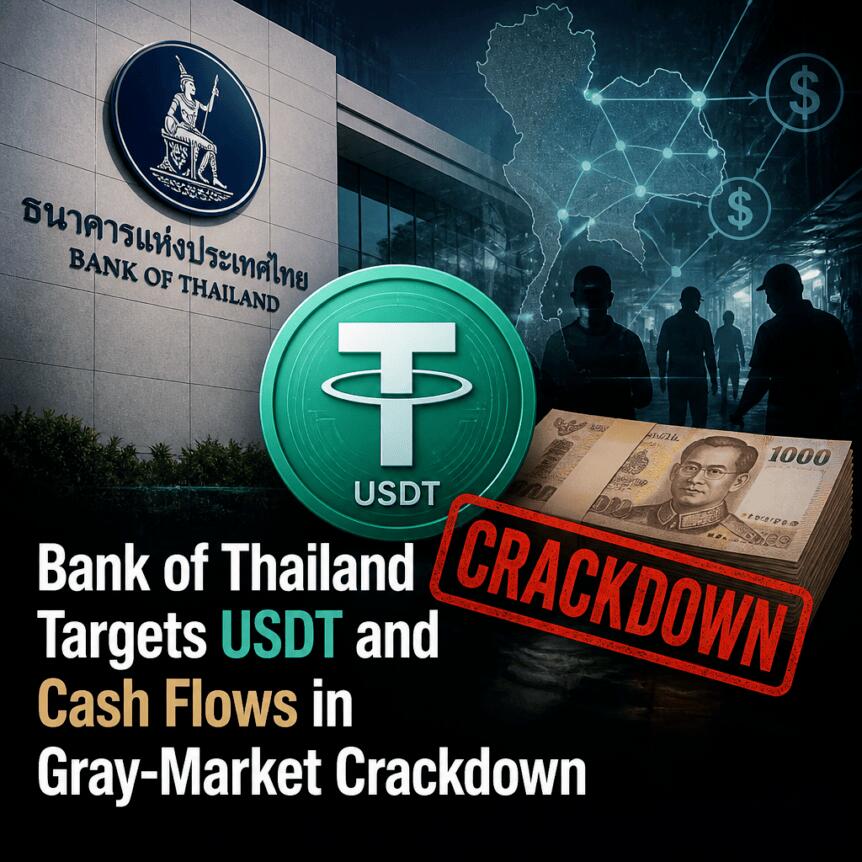
Thailand’s central bank is tightening its scrutiny of stablecoin activity as part of a broader campaign against money laundering, illicit finance and what officials describe as “gray money” flowing through cash-heavy channels. The Bank of Thailand says it is working alongside the Securities and Exchange Commission to audit high-volume stablecoin transfers—particularly those involving USDT—to uncover suspicious patterns and disrupt illicit funds.
According to local media outlet The Nation, Bank of Thailand Governor Vitai Ratanakorn said the response is designed to be ongoing rather than a one-time intervention. The push comes as stablecoins remain attractive for large cross-border movements due to fast settlement times.
Key takeaways
- Thailand’s Bank of Thailand and the Securities and Exchange Commission plan to audit high-volume stablecoin transactions, with a specific focus on USDT (USDT).
- The surveillance effort targets multiple channels, including cash transactions, currency exchanges and “suspicious stablecoin transactions,” to prevent regulated entities from being used for illicit flows.
- New rules expand compliance obligations for banks across cash networks and currency exchange activity, including source-of-funds declarations for certain high-value cash deals.
- Cash deposit thresholds are also being tightened: deposits above 5 million baht (about $150,000) require full disclosure, and large exchanges of big notes for smaller denominations may be monitored if they lack a clear business rationale.
- The crackdown is set against a backdrop of prior anti-scam measures that resulted in widespread account restrictions in 2025, according to earlier reporting.
Why Thailand is turning attention to stablecoin flows
The Bank of Thailand’s initiative is aimed at identifying illicit financial activity that can be hidden within high-volume transfers. The focus on stablecoins—especially USDt (USDT)—reflects their growing role as a transfer mechanism across borders, where near-instant settlement can make transactions harder to slow down or interrupt through traditional payment monitoring.
Thailand’s authorities are also targeting what they call the “gray economy,” a category that the article describes largely as cash that may have originated from suspicious activities, including scam call centers that have spread across the region. While the piece notes there are no reliable overall figures for the gray economy, it cites reported scam losses of 115 billion THB (about $3.4 billion) in 2025, alongside roughly 173 million scam calls and texts recorded.
For market participants, the implication is clear: even where crypto trading is regulated or legal, stablecoin transfer activity may face increased compliance scrutiny—particularly when transaction behavior resembles laundering patterns or attempted integration of illicit funds into legitimate financial systems.
What Thailand’s surveillance and compliance expansion includes
Beyond stablecoins, the planned measures would extend existing compliance expectations across several financial touchpoints. The reporting says the initiative will expand how commercial banks handle monitoring duties for cash networks, currency exchanges, gold bullion trading and suspicious stablecoin activity.
Among the specific steps highlighted in the article:
- High-value cash transactions would require a source-of-funds declaration.
- Banks and related institutions would monitor large exchanges of major banknotes for smaller denominations when there is no clear business justification.
- Cash deposits exceeding 5 million baht (about $150,000) would require full disclosure.
These provisions matter because they shift compliance from a reactive model—where suspicious activity is addressed only after the fact—to a more structured approach focused on documentation and transaction context. In practice, businesses and individuals moving cash at scale may face added paperwork burdens, while intermediaries may need tighter internal controls to flag unusual flows earlier.
The measures also reinforce a message Thailand has been sending for some time: stablecoin use and broader digital-asset payments do not fall into a completely hands-off category. Even with a thriving domestic market for crypto trading, policy authorities continue to tighten oversight around how digital assets interact with the traditional financial system.
Thailand’s crypto environment: legal trading, tighter rules for payments
The article reiterates that Thailand’s central bank has previously outlawed stablecoin and digital asset payments, even while crypto trading itself remains legal. It also points to ongoing regulatory tightening affecting crypto businesses.
Still, activity is visible. The piece cites CoinGecko data indicating Thailand’s largest exchange, Bitkub, is seeing about $26 million in daily volume. However, it also notes that close to 40% of that volume is attributed to forex, with the USDT/THB trading pair described as the most popular.
This split between legal trading and restricted payments is important for traders and compliance teams. Increased stablecoin monitoring could affect liquidity patterns, exchange volumes, and how firms approach onboarding, transaction monitoring, and internal risk assessments—especially if authorities emphasize stablecoin transfers even when trading itself is permitted.
From anti-scam account freezes to stablecoin audits
Thailand’s stablecoin surveillance drive is landing after a major episode of enforcement actions targeting scams and “mule” accounts. The article references an earlier crackdown in 2025 in which banks reportedly imposed sweeping account restrictions and froze three million bank accounts.
But it also highlights that the operation reportedly ensnared thousands of individuals and legitimate businesses. Media coverage referenced in the article characterized the situation as a “scammer crackdown gone wrong,” emphasizing the risk of overreach when targeting illicit activity.
That background shapes how market participants may interpret the new stablecoin focus. It suggests regulators are trying to improve how they detect harmful activity—potentially by extending scrutiny to structured transfer mechanisms such as stablecoins—while still confronting the real-world challenge of avoiding collateral damage to legitimate users.
At the same time, the article signals that authorities plan to deploy “multiple parallel strategies,” rather than relying on one narrow fix. If implemented carefully, that approach could refine targeting over time; if not, it may again raise friction for compliant users who don’t fit laundering profiles.
For investors, exchanges, and compliance teams, the next question is how Thailand will operationalize this stablecoin auditing—particularly what qualifies as “high-volume” and what transaction behaviors trigger deeper review. Monitoring whether enforcement focuses narrowly on suspected illicit patterns or broadens to capture ordinary stablecoin usage will likely determine how disruptive the policy becomes for legitimate market activity.
https://www.cryptobreaking.com/bank-of-thailand-targets-usdt/?utm_source=blogger%20&utm_medium=social_auto&utm_campaign=Bank%20of%20Thailand%20Targets%20USDT%20and%20Cash%20Flows%20in%20Gray-Market%20Crackdown%20
Comments
Post a Comment