
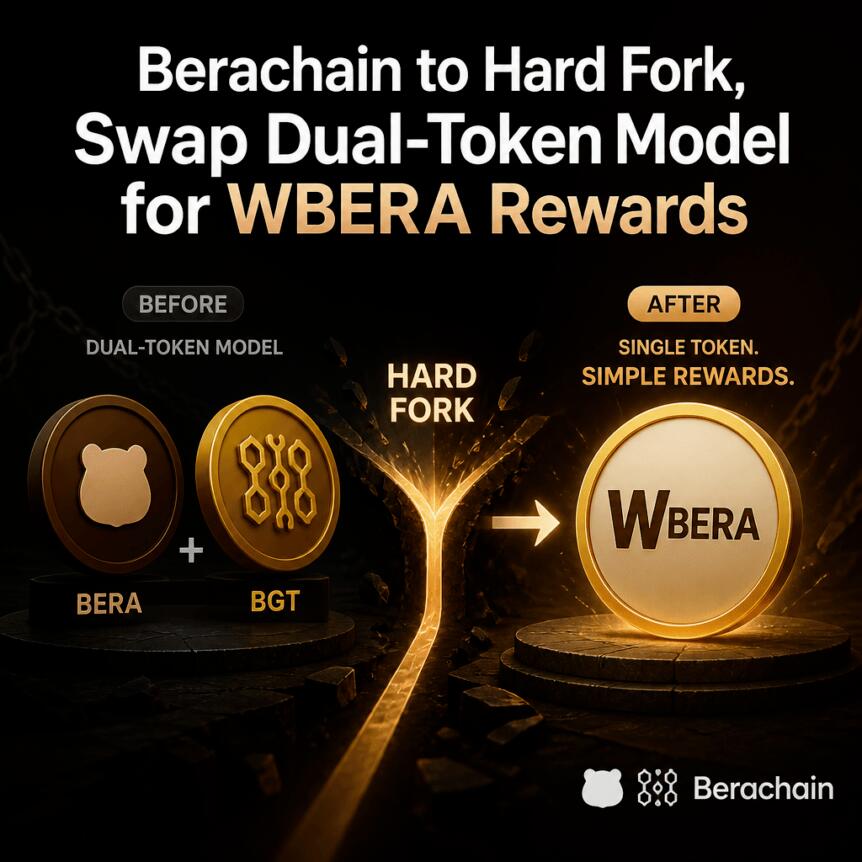
Berachain is set to undergo a major protocol change this Wednesday that will reshape how the network pays incentives to participants. The upgrade, scheduled for 4:00 p.m. UTC, will retire the current Bera Governance Token (BGT) emissions and switch Berachain’s reward design to focus on its main BERA token via Wrapped BERA (WBERA).
In an announcement shared on Tuesday via the Berachain Foundation’s X account, the foundation said the hard fork will replace the network’s previous dual-token incentive structure. That model split incentives between transferable BERA and BGT, a governance asset that cannot be transferred. After the change, block rewards will be distributed as fixed WBERA amounts rather than BGT.
Key takeaways
- Berachain’s hard fork on Wednesday (4:00 p.m. UTC) will stop BGT emissions and end the dual-token incentive setup.
- Reward payouts will shift to WBERA block rewards, with the foundation describing the new design as simpler and more sustainable.
- WBERA emissions began on Tuesday, while BGT emissions are scheduled to be halted during the hard fork.
- Berachain’s foundation says APR may rise materially after the upgrade, but warned early yields could be volatile.
- Data tracking from CoinMarketCap and DefiLlama shows BERA and network TVL have recently been under pressure, suggesting activity remains subdued ahead of the change.
A shift from BGT to WBERA—and the mechanics behind it
The upgrade is designed to consolidate Berachain’s incentive system around WBERA, the wrapped form of its BERA token. According to the Berachain Foundation, the network will move away from BGT-based rewards and instead center incentives on staked WBERA (sWBERA), which it described as a more straightforward approach.
Before the upgrade, participants chasing higher yields reportedly had to work through several different reward pathways, including liquid staking mechanisms that were tied to BGT. The new plan reduces that complexity by changing what the network issues and how rewards flow.
Mechanically, the foundation outlined a two-stage transition. First, WBERA emissions started Tuesday. Then, at the scheduled time Wednesday, the hard fork will halt BGT emissions. In the days following the upgrade, the network will also phase out reward vaults and liquid staking incentives that are tied to BGT.
What it means for staking returns
Berachain’s foundation said the change could significantly improve yields, stating that annual percentage rates (APR) may triple after the upgrade. However, the foundation also cautioned that returns may swing during the first few days as the system settles into its new reward configuration.
For users, the practical implication is that the upgrade may initially produce short-term uncertainty even if the long-run incentive structure is intended to be more attractive. Traders and liquidity providers watching post-fork APR should expect the first window after Wednesday’s block transition to differ from the steady-state the foundation is aiming for.
Token performance and on-chain activity ahead of the fork
While Berachain prepares for the incentive overhaul, the market signal coming into Wednesday is not particularly strong. CoinMarketCap data cited in the coverage shows BERA was down about 7% over the 24 hours to 8:34 a.m. UTC. That move extends a broader slump in the token over the past year, bringing the decline to roughly 88%.
On the network side, DefiLlama data indicates Berachain’s total value locked (TVL) fell by $1.79 million, or about 3%, over the same 24-hour period. DefiLlama places the network around rank 37 by TVL, with approximately $56 million locked.
Activity metrics also point to a comparatively muted moment for the chain. Over the past 24 hours, the network generated $41 in chain fees and $3,359 in application revenue, while distributing $14,816 in token incentives. Together, these figures suggest that while incentives are currently being paid out under the existing model, overall utilization has not accelerated sharply ahead of the scheduled hard fork.
Why the “simpler” token economy matters
The foundation’s stated rationale is that the upgrade improves sustainability and reduces friction for users. In a dual-token system, participants often need to understand more than one asset’s role—especially when governance-related tokens like BGT are not freely transferable. By aligning incentives more directly with WBERA and emphasizing staked WBERA (sWBERA), the foundation is effectively trying to streamline how users participate and how rewards are structured.
That matters for investors and builders because incentive design can influence where liquidity concentrates. When reward logic is complex—especially when it involves multiple vaults and liquid staking pathways—capital can fragment across products and strategies. Streamlining rewards into a single centered asset may make it easier for users to evaluate positions and for liquidity to move as the network’s incentive targets shift.
At the same time, the transition introduces a period of adjustment. Since WBERA emissions started Tuesday and BGT emissions will stop only when the hard fork executes Wednesday, participants will be navigating a changing reward landscape on both days. This is especially relevant given the foundation’s own warning that yields could be volatile early on.
What remains uncertain is how quickly incentives will translate into measurable changes in on-chain activity—such as fees, application revenue, and TVL—after the upgrade. With recent data showing BERA and TVL trending downward, the post-fork period will be the real test of whether the new incentive system meaningfully boosts participation.
All eyes will be on Wednesday’s block upgrade and the days immediately afterward: whether APR stabilizes, how reward vault and liquid staking behavior changes as BGT-linked incentives are phased out, and whether chain usage improves enough to offset the current softness in TVL and token performance.
https://www.cryptobreaking.com/berachain-to-hard-fork-swap/?utm_source=blogger%20&utm_medium=social_auto&utm_campaign=Berachain%20to%20Hard%20Fork,%20Swap%20Dual-Token%20Model%20for%20WBERA%20Rewards%20
Comments
Post a Comment