
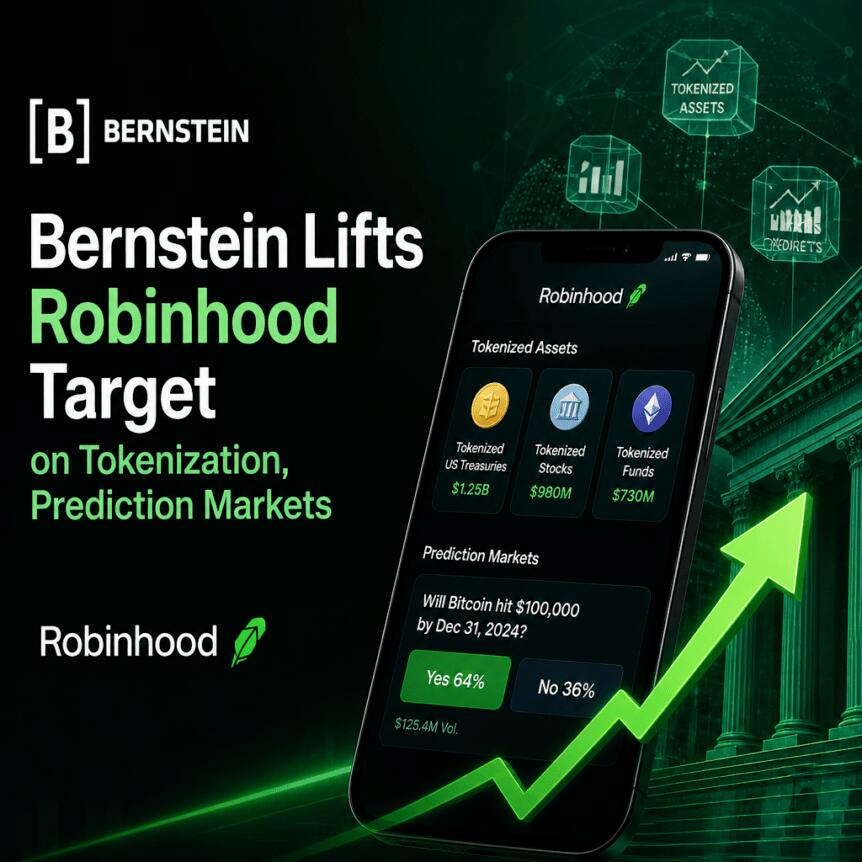
Robinhood Markets is drawing fresh attention from Wall Street as analysts argue the company’s next growth leg could come from tokenized assets and prediction markets rather than traditional retail crypto activity. In a Monday research note, Bernstein lifted its price target for Robinhood stock to $160 from $130, while keeping an Outperform rating. The shares were last reported around $101.
Bernstein’s thesis centers on the idea that two adjacent segments—prediction markets and tokenized equities—could scale faster than legacy revenue streams. The firm expects prediction markets to become Robinhood’s fastest-growing business, projecting segment revenue of $1.7 billion by 2028, which it frames as a 64% compound annual growth rate.
Key takeaways
- Bernstein raised Robinhood’s stock price target to $160 from $130 and maintained an Outperform rating.
- The research note argues prediction markets could become Robinhood’s fastest-growing segment, with revenue projected at $1.7 billion by 2028.
- Tokenized equities are presented as a major long-term opportunity, supported by Robinhood’s blockchain infrastructure strategy.
- Bernstein points to a broader market backdrop: growth in onchain real-world assets that could expand to $2 trillion–$4 trillion by 2030 from about $35 billion today.
- Infrastructure providers are also accelerating governance and issuance tooling for tokenized securities, suggesting institutional momentum is building.
Bernstein’s shift: prediction markets and tokenized equities
Bernstein’s Monday note emphasizes that Robinhood’s expansion path is increasingly tied to product categories that extend beyond straightforward crypto trading. The firm singled out prediction markets as the most immediate growth driver, forecasting rapid scaling that could outpace other lines of business.
Importantly, Bernstein also linked the prediction markets story to Robinhood’s broader platform ambitions—positioning the company to compete across multiple “battleground” asset types. While the note highlights several categories, its core investment case is that Robinhood can leverage its distribution and user base to build market activity around new trading paradigms.
Tokenized equities: Robinhood Chain and the infrastructure angle
On the tokenized equities front, Bernstein identified Robinhood’s engagement with blockchain infrastructure as a long-term differentiator. The firm referenced Robinhood Chain, describing it as the company’s Arbitrum-based layer-2 network used to support tokenized real-world assets.
According to Bernstein, Robinhood’s approach is designed to allow the platform to develop on-chain financial products without needing to depend on third-party blockchains. This matters for investors because infrastructure choices can affect product rollout speed, integration complexity, and the economics of building and operating blockchain-enabled services.
Bernstein tied its tokenization view to a macro capital markets shift, arguing tokenization is becoming a foundational layer for capital markets. The analysts projected the total value of onchain real-world assets could rise to $2 trillion to $4 trillion by 2030 from roughly $35 billion today. They further expect tokenized equities to capture an increasing portion of that growth as issuance and adoption broaden beyond certain asset types such as Treasury securities and private credit.
Rather than treating tokenized equities as a narrow experiment, Bernstein frames them as part of a larger, compounding trend in how financial institutions may issue, transfer, and govern assets digitally. For traders and users, that could eventually translate into more choices for tokenized instruments; for builders and issuers, it signals rising demand for compliant rails that can support custody, governance, and reporting.
Wall Street builds governance tooling for tokenized securities
Bernstein’s note landed as institutional infrastructure continues to mature. On Monday, Alpaca and Broadridge Financial Solutions announced they had integrated Broadridge’s shareholder governance capabilities into Alpaca’s Instant Tokenization Network.
The integration is aimed at giving holders of tokenized securities governance rights closer to those of traditional shareholders, including features such as proxy voting, investor communications, and regulatory disclosures.
That announcement follows last week’s partnership between Securitize and investment bank Cantor Fitzgerald, which focused on developing infrastructure for blockchain-based initial public offerings and follow-on equity offerings under existing U.S. securities regulations. Together, the developments suggest tokenized assets are moving beyond issuance experiments toward operational completeness—particularly around governance and regulatory workflows.
Tokenized stocks have also been gaining visibility in market tracking. RWA.xyz reports the asset class has grown to nearly $2 billion in market value this year.
What to watch next for Robinhood and tokenized markets
For readers following Robinhood’s trajectory, the key question is whether management can translate these infrastructure and segment-level bets into consistent revenue growth as prediction markets scale and tokenized equities gain traction. In the broader market, investors should watch whether governance tooling and compliance layers—such as the Broadridge-Alpaca integration—continue to expand, since that infrastructure often determines how quickly tokenized securities can move from pilots to repeatable offerings.
https://www.cryptobreaking.com/bernstein-lifts-robinhood-target-on/?utm_source=blogger%20&utm_medium=social_auto&utm_campaign=Bernstein%20Lifts%20Robinhood%20Target%20on%20Tokenization,%20Prediction%20Markets%20
Comments
Post a Comment