
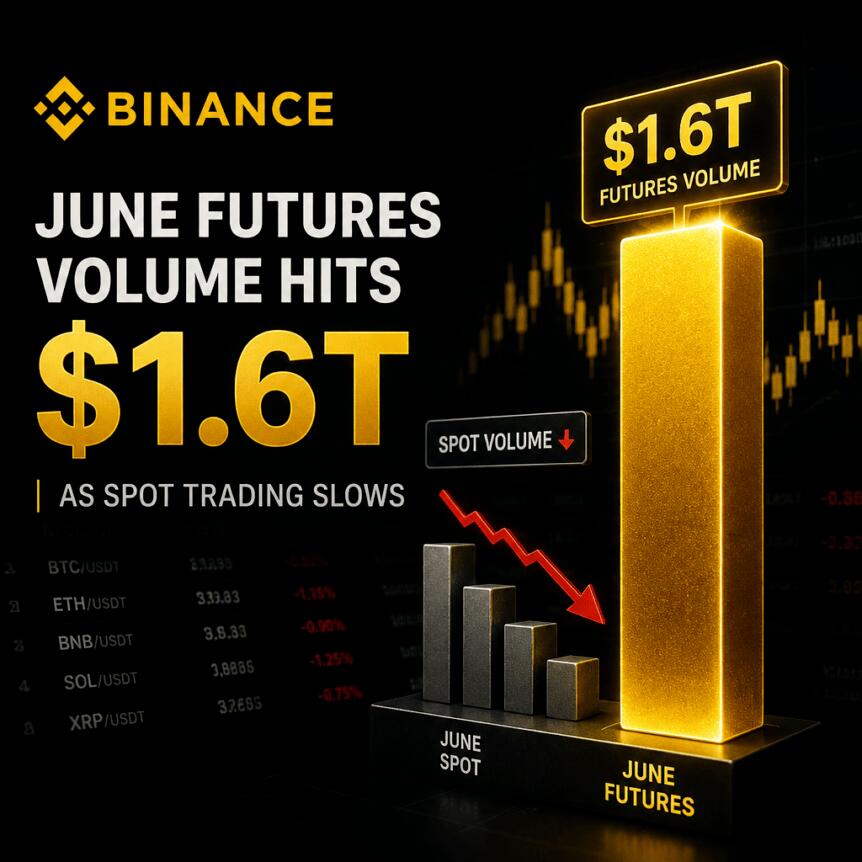
Binance’s futures desk is showing signs of a renewed momentum spike, reaching a 2026 high even while spot trading on centralized exchanges remains subdued. According to CryptoQuant analyst Maartuun, Binance logged $1.6 trillion in futures volume in June—its strongest month of the year—despite Bitcoin trading in the mid-$60,000s and a broadly cautious tone from many market participants.
The contrast between accelerating derivatives activity and weak spot volumes highlights a tension investors are watching closely: whether leverage is re-entering the market ahead of a broader risk rebound, or simply reflecting short-term positioning in an otherwise lethargic trading environment.
Key takeaways
- Binance futures volume hit $1.61 trillion in June, up 80% from May’s $893 billion, marking a 2026 high.
- OKX and Bybit also grew in June, but Binance outpaced them by volume and again led the market.
- Quarterly CEX futures volume continued to decline: Q2 fell to $15.7 trillion, down 11% from Q1, according to CryptoRank.
- Spot volumes on CEXs remain weak, with Q2 spot trading at $3 trillion—the weakest quarter in two years.
- Binance’s uptick arrives near regulatory changes in the EU, including the MiCA transition schedule and related licensing developments.
June’s derivatives rebound at Binance
CryptoQuant’s Maartuun said Binance processed $1.61 trillion in futures trading volume in June, the highest monthly figure recorded so far in 2026. The jump was stark: June volume rose by about 80% versus May’s $893 billion.
The strength wasn’t limited to Binance. OKX reported $609 billion in June futures volume, while Bybit recorded $434 billion. Both exchanges increased versus May—OKX up 9% and Bybit up 18%—suggesting the rise was broad-based across major venues rather than isolated to a single platform.
Even so, Binance’s lead stood out. Maartuun noted that the trio of exchanges has not seen futures activity near these levels since January 2026, when Binance moved roughly $1.5 trillion and OKX and Bybit reached $667 billion and $502 billion respectively.
Broader market still shows hesitation: futures down overall, spot at multi-year lows
While June’s spike looks encouraging for derivatives activity, the bigger picture remains mixed. CryptoRank data cited in the report shows that total CEX futures volume fell to $15.7 trillion in Q2 2026, down 11% from $17.6 trillion in Q1. This represented the third consecutive quarterly decline for centralized exchange futures.
The pace of contraction did ease compared with Q1, when futures volume dropped 31% versus Q4 2025. In Q2, Binance maintained its position as the largest futures venue, holding approximately 28% market share.
Spot markets, however, were more clearly impaired. CEX spot volume reportedly fell to $3 trillion in Q2, the weakest quarter in two years and an 18.9% decline from Q1. Binance remained the largest spot exchange by volume, with $731 billion for the quarter, but its market share slid from 27% to 24%, signaling that the downturn wasn’t just a dip in overall activity—it also came with share erosion.
Taken together, the numbers suggest June’s futures surge may reflect traders seeking exposure through leveraged instruments even when broader spot participation has not recovered. For investors, that distinction matters: derivatives volume can rise during periods when spot demand is still muted, but it can also precede volatility rather than stable trend formation.
EU MiCA transition: Binance futures activity continues after the shift
The timing of June’s futures strength also lands near Europe’s Markets in Crypto-Assets (MiCA) transition period. Earlier coverage noted that the end of the transition schedule raised questions about how major exchanges would adapt operationally and how quickly trading patterns would normalize under the new compliance framework.
In late June, Binance withdrew its application for a license in Greece just days before the framework moved into its next phase on July 1. Against that regulatory backdrop, early July data from CryptoQuant indicated Binance’s futures market remained active after the transition, recording $418 billion in futures volume in the first 10 days of July.
That continuation doesn’t confirm that regulation improved trading conditions; it does, however, provide at least an early signal that activity did not abruptly stall at the transition boundary. The next key question for traders and exchange operators will be whether this level of derivatives throughput persists over subsequent weeks and whether spot volumes begin to respond as regulatory uncertainty fades.
What to watch next for traders and exchange users
June’s futures surge is a clear data point: Binance’s derivatives volume jumped sharply to a 2026 high while broader quarterly trends show that CEX spot and futures volumes remain under pressure. Investors should watch whether July sustains similar momentum and whether spot trading starts to recover alongside futures—or whether the market continues to concentrate activity in leveraged instruments as traders navigate ongoing regulatory and macro uncertainty.
https://www.cryptobreaking.com/binance-june-futures-volume-hits/?utm_source=blogger%20&utm_medium=social_auto&utm_campaign=Binance%20June%20Futures%20Volume%20Hits%20$1.6T%20as%20Spot%20Trading%20Slows%20
Comments
Post a Comment