
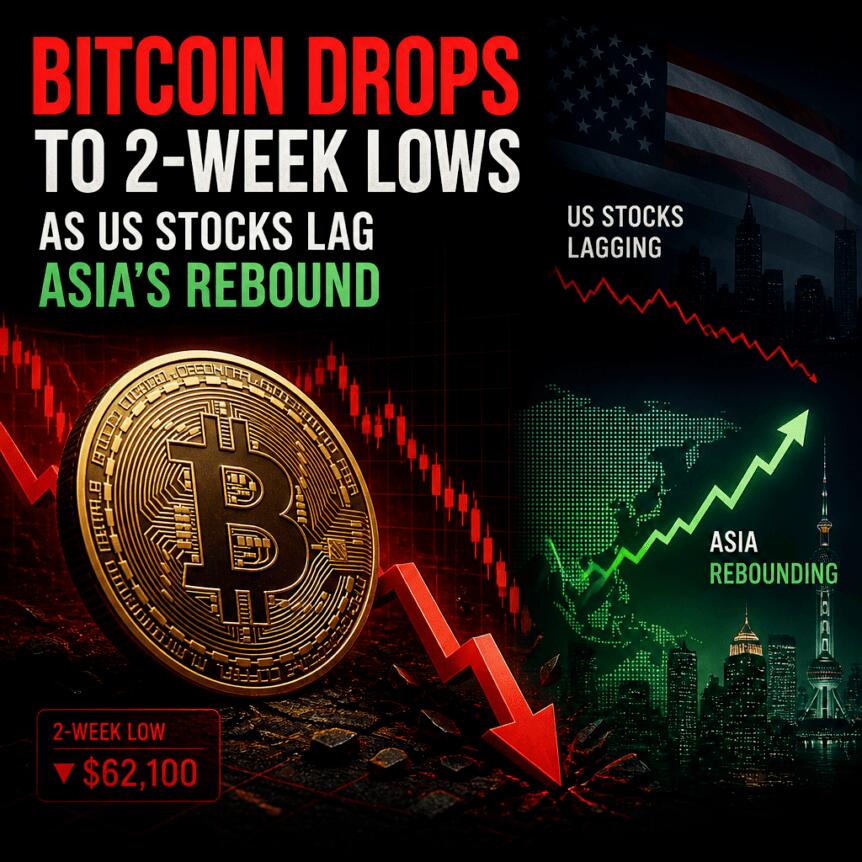
Bitcoin slipped Friday and tested its weakest levels in more than two weeks as market participants pushed risk assets toward the end of the monthly trading window. According to TradingView data, BTC/USD dropped about 3.5% to trade near $62,369 on Bitstamp, a price zone last seen on July 14.
While crypto did not seem to receive the same tailwind as parts of Asia’s equity rebound, the day’s macro cross-currents were hard to ignore. QCP Capital pointed to the outsized role of semiconductor and AI-related exposures in driving swings across regional markets—an environment that appears to be feeding back into crypto liquidity and positioning.
Key takeaways
- BTC/USD fell roughly 3.5% to around $62,369 on Bitstamp, the lowest level in over two weeks.
- US stocks weakened around the monthly close, contrasting with Asia’s rally—especially South Korea’s KOSPI.
- QCP Capital linked crypto activity to the relationship between equity positioning, regional tech sentiment, and crypto liquidity.
- Analysts at CoinGlass showed July ended with strong gains, but at least one trader warns August could bring a rollover similar to 2022.
- Rekt Capital highlighted the 50-month EMA around $65,820 as ongoing resistance after failed breakouts since mid-June.
BTC drifts lower as US equities soften into month-end
TradingView indicated BTC/USD lost ground during Friday’s session, moving toward $62,000 amid broader pressure into the monthly close. The move came despite a rebound elsewhere earlier in the day, when parts of Asia stabilized after a semiconductor-led sell-off.
According to the same macro framing cited by QCP Capital, semiconductor stocks drove both the decline and subsequent recovery because major indices remain heavily weighted to the global AI and memory-chip cycle. That concentration helps explain why an equity catalyst can quickly translate into shifts in sentiment—and potentially liquidity—across correlated markets, including crypto.
QCP Capital added that crypto trading activity increased around the KOSPI’s sharp swings, describing it as evidence of a growing relationship between crypto liquidity, regional equity positioning, and broader technology-sector sentiment. The firm’s argument is less about a single day’s price and more about how the plumbing of liquidity may be changing alongside technology-driven equity narratives.
Asia rebounds while the US turns cautious
US stocks traded red at the open before leveling out, which diverged from the earlier rebound seen in Asia. South Korea’s KOSPI index finished the day up 17.9%, its largest single-day gain on record, according to figures referenced in the market commentary.
The day’s backdrop also included currency and rate dynamics. The commentary noted that both Japan and Korea reportedly engaged in currency interventions on Thursday, while Japan’s central bank kept benchmark interest rates at 1.0% after the US Federal Reserve decided to hold steady earlier in the week, following the US PCE inflation update.
For crypto traders, the practical takeaway is that “risk-on” can appear in pockets while “risk management” remains active in other major venues. When that happens, BTC can still underperform even as some regional equities bounce—particularly when liquidity flows are being reallocated quickly between markets.
July strength sets up a test for August
Even with Friday’s pullback, BTC’s monthly performance has looked constructive. CoinGlass data referenced in the article showed BTC/USD was up 8.5% for the month as of the end of the monthly candle, its strongest July showing since 2022.
That improvement mattered because earlier positioning had already shifted toward the idea of a relief bounce extending into August. The comparison traders were drawing was specifically to the 2022 bear-market structure: a rally that ultimately transitioned into a subsequent move toward a next longer-term bottom.
Rekt Capital—one of the analysts cited for that 2022 mapping—forecast that any bullish attempt might not hold immediately. In an X post on Friday, he wrote that price could try to “maintain these highs in the early stages of August,” but that history suggests a rollover similar to what occurred in 2022.
Technical resistance remains in focus near the 50-month EMA
Rekt Capital also pointed to a technical level that has limited follow-through. He reiterated that Bitcoin’s 50-month exponential moving average (EMA), currently around $65,820, has continued to act as resistance. In his view, that has been visible through two failed breakouts since mid-June.
For investors and traders, the implication is straightforward: even when BTC can put together a strong July, the next phase depends on whether it can clear longer-term trend resistance rather than merely bounce within an existing range. Levels like the 50-month EMA tend to attract both systematic and discretionary attention because they represent a longer horizon for trend definition.
That context also helps reconcile the mixed picture on Friday. BTC weakening toward the low-$60,000 area may be consistent with traders taking profits or reducing exposure as the market transitions from a month-end catalyst period into a new monthly cycle—especially if macro uncertainty and equity volatility persist.
Going forward, readers should watch whether BTC can reclaim and hold above the mid-$60,000 resistance area highlighted by the 50-month EMA and whether August follows through on the “rollover” scenario traders cite from 2022—or instead breaks the pattern and sustains higher levels despite the month-start shift.
https://www.cryptobreaking.com/bitcoin-drops-to-2-week/?utm_source=blogger%20&utm_medium=social_auto&utm_campaign=Bitcoin%20Drops%20to%202-Week%20Lows%20as%20US%20Stocks%20Lag%20Asia’s%20Rebound%20
Comments
Post a Comment