
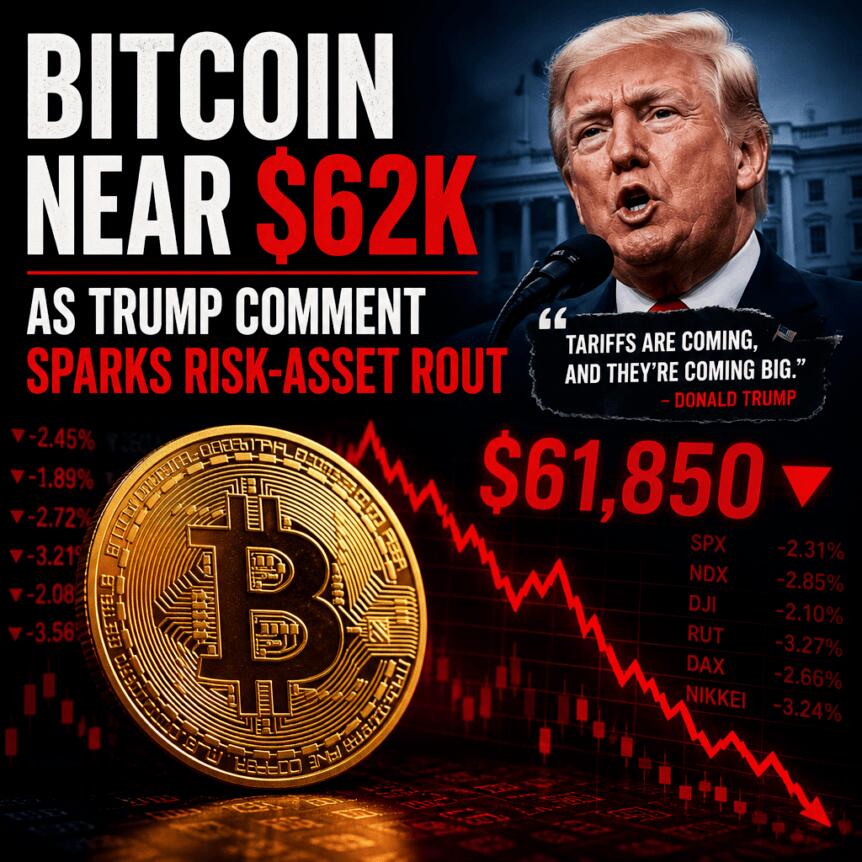
Bitcoin weakened further at the start of Monday’s Wall Street session as investors digested renewed US–Iran tensions, with the cryptocurrency sliding toward the $62,000 area. The move came alongside risk-off weakness in US equities, while energy markets held firm after heightened developments involving the Strait of Hormuz.
On the political front, US President Donald Trump said the United States would “run” the Strait of Hormuz after Iran closed the route over the weekend—an escalation that helped keep oil prices elevated and added uncertainty for broader markets. Against that backdrop, some traders described aggressive BTC short positioning and pointed to key intraday levels that could determine whether selling continues or sparks a rebound.
Key takeaways
- Bitcoin slid toward roughly $62,000 as US stocks opened lower and sentiment was pressured by US–Iran escalation.
- Trump’s comments about taking over the Strait of Hormuz coincided with firmer oil prices, with WTI hovering around the mid-$70s.
- Traders cited “massive” short activity into the pre–New York open, with price pinned near a volume-weighted average level (mVWAP) that bulls may need to defend.
- Despite the weakness, some market participants still see a path back toward the $70,000–$75,000 zone, citing exhaustion signals and exchange data.
Bitcoin tests key levels as shorts lean in
Market charts from TradingView showed BTC/USD edging toward the $62,000 region as Monday’s session got underway. One trader highlighted what they described as “massive” short trading into the period leading up to the New York open, arguing that price was being pushed directly toward mVWAP—a level bulls typically watch because it represents the average traded price weighted by volume across exchanges.
In a post on X, JDK Analysis said the market was “now sitting directly at mVWAP,” adding that $60,000 could resurface if the level fails. JDK also suggested the selloff looked “very weak,” but that a bounce remained possible if New York attracts meaningful spot demand and mVWAP holds, potentially trapping some short sellers.
Other participants echoed the bearish flow. Exitpump, for example, previously flagged a “crazy amount of aggressive shorting” while also noting that open interest appeared to be rising—an observation often associated with expanding derivatives positioning as price moves.
Oil steadies higher on Strait of Hormuz escalation
The BTC pullback also tracked broader macro conditions at the open. US stocks were broadly lower, with the Nasdaq Composite down about 1% at the time of writing, reinforcing a cautious risk tone across markets.
Energy prices remained supported by geopolitical risk tied to the Strait of Hormuz. According to Fox News’ live coverage, Trump said the US would take responsibility for the strait, describing the country as a “guardian” and suggesting it should be “reimbursed” for that role. Reuters and other outlets have frequently framed the Strait as a key international oil shipping route, meaning disruptions or heightened control can quickly spill into expectations for supply and transportation risk.
In crypto markets, that matters because sustained oil-driven inflation and risk premium shifts can influence both liquidity conditions and investor appetite for high-beta assets like BTC—especially during periods where derivatives positioning is already crowded.
WTI crude was reported by TradingView to be circling around $75 per barrel, holding gains as traders priced in continued uncertainty.
Traders still target a rebound toward $70,000
Even with the sell pressure, some traders continued to argue that downside momentum could be nearing exhaustion. Roman, a trader who previously laid out bullish expectations, said on X that several metrics pointed toward a move higher and that timing depended on how the market forms on the way up.
Roman specifically referenced higher-timeframe and lower-timeframe signals, while also pointing to exchange-related observations suggesting that more spot was being bought than sold. He pointed to a potential upside window in the $70,000–$75,000 area, implying that shorts could face a squeeze if buyers regain control and derivatives demand flips.
Importantly for readers, these views do not negate the immediate weakness: they frame the current trading as potentially offering a setup for a rebound rather than a straight line reversal. In markets where price is pinned near levels like mVWAP, bulls typically look for confirmation through sustained spot buying and follow-through after the open.
What to watch next: confirmation, spot demand, and derivatives positioning
For traders trying to gauge whether the current dip evolves into continued downside or a tactical bounce, the near-term focus is likely to remain on whether BTC can hold key intraday benchmarks such as mVWAP and whether spot demand increases during US trading hours. At the same time, monitoring open interest and the pace of short activity could help signal whether the market is building new bearish exposure—or if shorts are starting to get forced out.
With geopolitical headlines still capable of moving both oil and risk sentiment, the next session’s order-flow and follow-through (rather than any single forecast) may determine whether Bitcoin’s $62,000 test turns into a deeper move toward lower support levels or a renewed attempt at reclaiming the $70,000 area.
https://www.cryptobreaking.com/bitcoin-near-62k-as-trump/?utm_source=blogger%20&utm_medium=social_auto&utm_campaign=Bitcoin%20Near%20$62K%20as%20Trump%20Comment%20Sparks%20Risk-Asset%20Rout%20
Comments
Post a Comment