
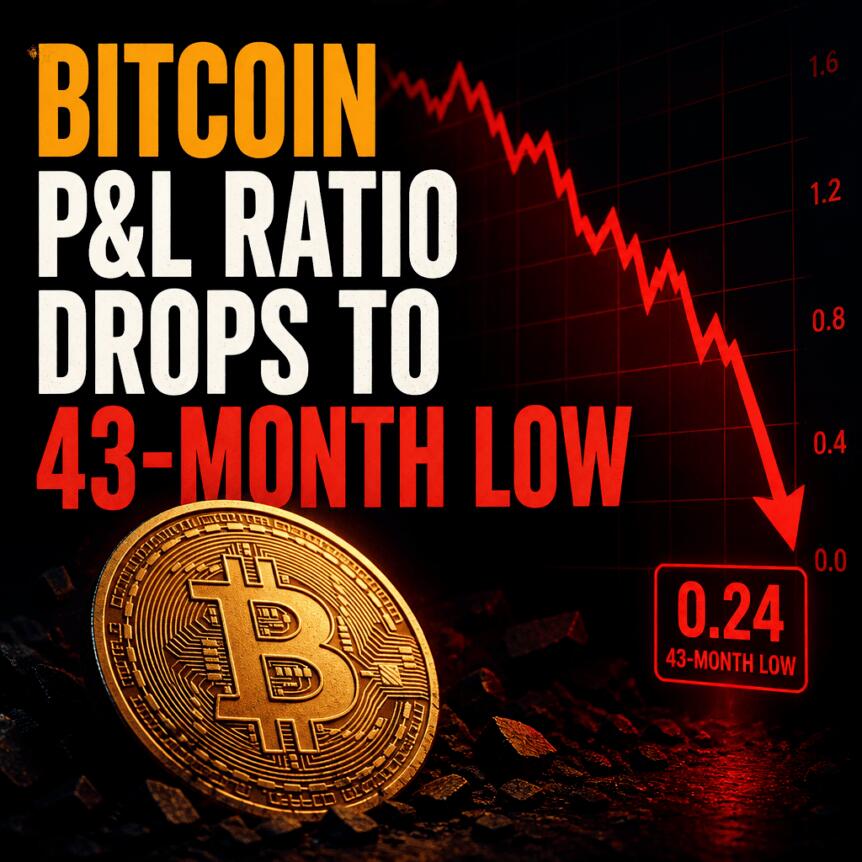
Bitcoin is flashing a highly unusual on-chain signal: its realized profit-and-loss ratio has fallen to a 43-month low of -0.35, an indicator CryptoQuant says reflects “extreme” loss conditions across the market. Historically, CryptoQuant adds, that type of reading has tended to appear close to major price bottoms.
The metric has not been this low since shortly after the FTX collapse, when Bitcoin traded below $16,000 in late 2022. With BTC still recovering from a steep drawdown that began after a peak near $126,080 in October, the new data is adding fuel to a broader debate among analysts over whether the market is past its worst stress—or merely approaching it.
Key takeaways
- CryptoQuant reports Bitcoin’s realized P&L ratio hit -0.35, the lowest reading in 43 months, last seen around late 2022.
- CryptoQuant says past occurrences of readings below -0.35 in 2015 and 2019 preceded subsequent rallies.
- CryptoQuant’s on-chain stress signal is arriving as “Fear and Greed” sentiment has moved off near-record lows and Bitcoin has bounced more than 7% from a June 25 trough near $58,190.
- Some analysts link the current drawdown to Strategy’s Stretch (STRC) preferred-stock offering and related concerns about dividend coverage.
- Other commentators argue investors should not wait for a “bottom” to be obvious because historical discount zones have been associated with strong 6- and 12-month forward returns.
Realized P&L reaches a historically rare loss zone
According to CryptoQuant, the Bitcoin realized profit-and-loss (P&L) ratio has dropped to -0.35. The realized P&L ratio measures the net percentage of Bitcoin currently in profit or loss relative to total supply, using on-chain cost basis information. In practical terms, a more negative reading indicates that a larger share of holders are underwater on their realized entry prices.
CryptoQuant emphasized that the -0.35 threshold has shown a strong historical relationship with major bottoming behavior. In its analysis published Thursday, the firm said that realized P&L has “marked BTC bottoms with extreme precision,” citing earlier periods where the ratio slipped below -0.35 before later rebounds.
The indicator’s last comparable level came around December 2022, shortly after the FTX collapse exposed fragile market liquidity. Back then, Bitcoin fell to levels under $16,000—an episode that many market participants still reference as a stress test for crypto’s risk assets.
What the signal may mean for sentiment and timing
CryptoQuant’s indicator arrives during a sharp correction cycle that began from a high set in October near $126,080, after which Bitcoin experienced a roughly 50% drawdown. While past realized P&L readings can be informative, timing remains the key question for investors: a bottom signal can appear before prices fully recover, and it does not rule out additional volatility.
Still, broader sentiment gauges show signs of stabilization. The “Fear and Greed” index has risen cautiously over the past 10 days, according to the index page on Alternative.me. During the same window, Bitcoin has climbed more than 7% after falling to a near two-year low of about $58,190 on June 25, as reflected in prior reporting by Cointelegraph.
In other words, the on-chain data and the sentiment recovery are moving in the same direction, even if they don’t provide a precise “day of the bottom” forecast.
Strategy’s STRC episode and the leverage unwind narrative
A significant part of the discussion around the latest selloff centers on corporate Bitcoin exposure. Cointelegraph previously reported that analysts attributed much of the recent weakness to Strategy—the largest corporate Bitcoin holder—after its top perpetual preferred stock offering, Stretch (STRC), deviated from its $100 par value. The move reportedly pushed STRC below $75, raising concerns that Strategy’s dividend model may have been strained.
On Thursday, Cointelegraph noted that Bitwise chief investment officer Matt Hougan said the STRC incident likely helped “squeeze out excess leverage” and could be pushing the market closer to a bottom as participants work through the fallout.
For traders and long-term holders alike, this matters because leveraged positioning can magnify moves on the way down. If leverage is truly being unwound—whether through forced deleveraging, hedging adjustments, or repricing of capital-market products—then the market may become less mechanically vulnerable to sudden liquidations. What remains unclear is how much of that unwind is complete and whether new risk reappears as prices rise.
Why some analysts say buying before the “bottom” may be rational
Not all commentary is framed around waiting for confirmation. Swan Bitcoin analyst Adam Livingston pointed to how close Bitcoin is currently trading relative to its realized price—the network’s aggregate cost basis, which often acts as a reference point in on-chain analysis.
According to Livingston, Bitcoin is trading about 16% above the realized price. He argued that this historically aligns with strong forward returns, citing research showing 41% gains over six months and 81% gains over 12 months following similar discount conditions.
Livingston acknowledged that buying at this stage “feels awful,” but he argued the psychological discomfort is part of why the opportunity can appear. In his view, waiting for a “bottom” is flawed because bottoms rarely announce themselves in a way that’s reliable enough to time entries perfectly.
While that argument is not a guarantee, it reframes the debate: rather than trying to predict the exact turn, investors may focus on whether market-wide indicators—on-chain loss concentration, realized valuation levels, and sentiment—suggest that downside pressure is fading.
What to watch next
For the near term, traders and investors will likely keep comparing this realized P&L trough with subsequent price action: if Bitcoin continues to stabilize while sentiment improves and leverage unwinds, the market may be shifting from capitulation toward consolidation. The key uncertainty is whether the current signals mark a decisive bottoming phase—or simply another stage in a volatile transition.
https://www.cryptobreaking.com/bitcoin-pl-ratio-drops-to/?utm_source=blogger%20&utm_medium=social_auto&utm_campaign=Bitcoin%20P&L%20Ratio%20Drops%20to%2043-Month%20Low%20
Comments
Post a Comment