
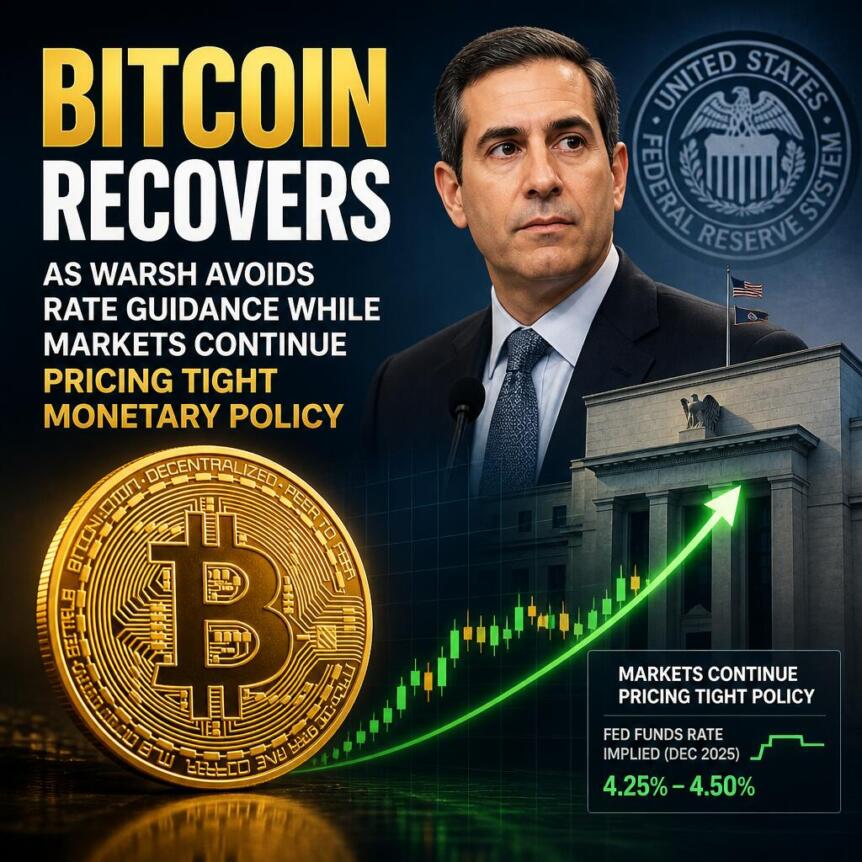
Bitcoin rebounded during Tuesday’s trading session after Federal Reserve Chair Kevin Warsh avoided signaling the direction of the July interest rate decision. The cryptocurrency recovered from an intraday decline below $58,000 and approached the $60,000 level. Meanwhile, traders continued assessing monetary policy expectations and broader macroeconomic developments that could influence digital asset prices.
Bitcoin Rebounds After Warsh Avoids July Rate Signals
Bitcoin recovered after Kevin Warsh declined to provide guidance on the Federal Reserve’s next policy decision. Instead, he maintained that policymakers would rely on incoming economic data before making any interest rate adjustments. As a result, markets reacted to the absence of new policy signals rather than expectations of immediate action.
The cryptocurrency climbed nearly 2% from its intraday low and traded around $59,700 during the session. Earlier, Bitcoin had slipped below the key $58,000 psychological level before regaining momentum. Consequently, buyers returned as uncertainty around immediate monetary policy eased.
Warsh also continued his preference against providing advance policy guidance. He indicated that future Federal Reserve decisions would remain dependent on economic conditions instead of preset commitments. Therefore, market participants received no indication about whether July would bring another rate adjustment.
Rate Expectations Continue to Shape Bitcoin Outlook
Despite Bitcoin’s recovery, markets still expect the Federal Reserve to leave interest rates unchanged during the July Federal Open Market Committee meeting. CME FedWatch data currently assigns a 72.7% probability to unchanged policy rates. However, expectations beyond July remain divided because inflation risks have not completely disappeared.
Recent geopolitical tensions involving the United States and Iran have contributed to inflation concerns across financial markets. Even so, Warsh indicated that inflation expectations eased during the opening weeks of the recent conflict period. He also reaffirmed the Federal Reserve’s commitment to returning inflation toward its long-term 2% target.
Prediction markets still suggest that another rate increase remains possible before year-end. Polymarket data currently assigns a 54% probability to at least one additional Federal Reserve rate hike. Accordingly, those expectations continue influencing sentiment across cryptocurrencies and other risk-sensitive assets.
Broader Market Factors Continue Influencing Bitcoin
Expectations of tighter monetary policy remain one of several pressures affecting Bitcoin’s broader price outlook. Higher interest rates generally reduce demand for risk assets because borrowing costs increase across financial markets. Therefore, traders continue weighing economic data alongside central bank policy expectations.
Another source of pressure involves the possibility that Strategy could sell up to $1.25 billion worth of Bitcoin. Such a transaction could temporarily increase available market supply and influence short-term price action. However, no confirmed sale has occurred, and the possibility remains one among several market considerations.
Meanwhile, Morgan Stanley recently projected that the Federal Reserve could maintain current interest rates throughout the remainder of the year. The bank also noted that persistent inflation or a stronger labor market could eventually revive discussions about additional tightening. As a result, Bitcoin continues responding to changing macroeconomic expectations while broader financial conditions remain uncertain.
Bitcoin has frequently reacted to changes in United States monetary policy over recent years. Lower interest rates often support demand for higher-risk assets, while higher borrowing costs usually reduce liquidity across markets. Consequently, Federal Reserve decisions have become an important driver of cryptocurrency performance alongside industry-specific developments.
The Federal Reserve continues balancing inflation control with broader economic growth objectives. Economic reports on employment, consumer prices, and spending remain central to future policy decisions. Therefore, upcoming data releases could influence both interest rate expectations and Bitcoin’s short-term direction during the coming months.
https://www.cryptobreaking.com/bitcoin-recovers-as-warsh-avoids/?utm_source=blogger%20&utm_medium=social_auto&utm_campaign=Bitcoin%20Recovers%20as%20Warsh%20Avoids%20Rate%20Guidance%20While%20Markets%20Continue%20Pricing%20Tight%20Monetary%20Policy%20
Comments
Post a Comment