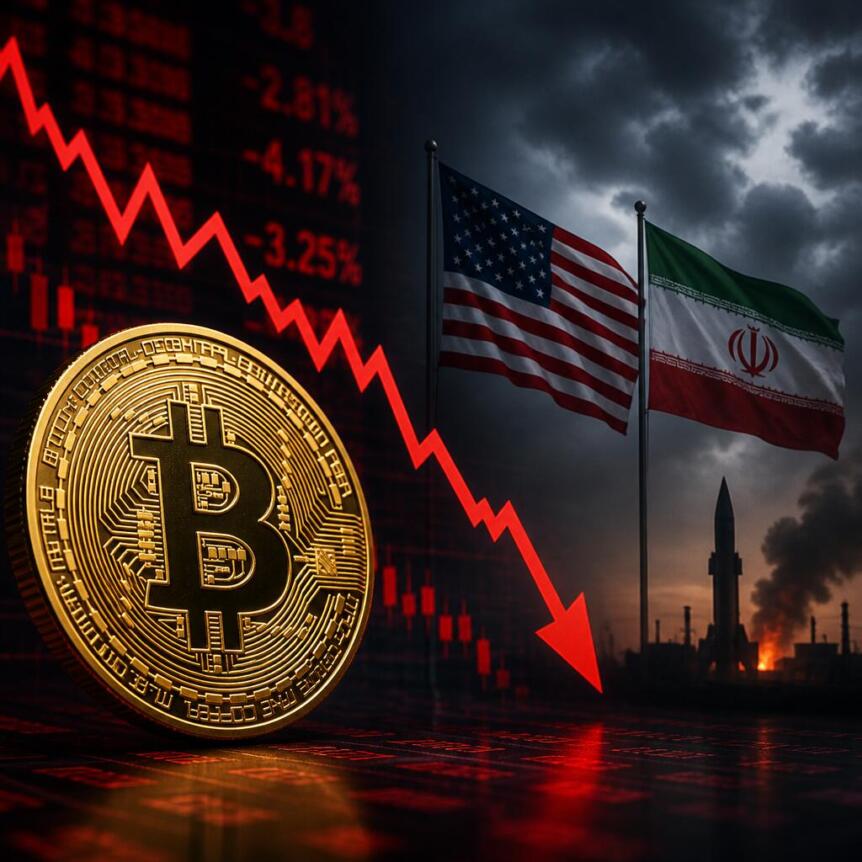
Bitcoin Retreats As Fresh US-Iran Tensions Spook Jittery Markets


Bitcoin (BTC) started the week in positive territory, reclaiming $65,000 and extending its gains on Tuesday, crossing $66,000 and reaching an intraday high of $66,923.

However, the flagship cryptocurrency failed to cross $67,000 as another escalation in hostilities between the US and Iran raised oil prices and dampened optimism.

Bitcoin Stumbles After Fresh Geopolitical Headwinds

Bitcoin (BTC) almost breached the $67,000 mark before sellers stepped in and drove prices lower. Price action is still being dictated by three key drivers: US-Iran tensions, the Federal Reserve meeting scheduled for July 28 and 29, and risk appetite. The immediate reason for BTC’s latest downturn is fresh tension between the US and Iran.

The ongoing geopolitical situation has adversely impacted global markets and investor sentiment. Oil prices briefly declined thanks to a fragile truce between the warring nations.

However, the latest round of escalatory actions has pushed prices higher again. US Crude rose nearly 3% to $84.70 per barrel as supply fears, amid the prospect of another closure of the crucial Strait of Hormuz, resurfaced. Rising oil and energy costs could push inflation higher. A report in Reuters also confirmed a damaged tanker near the Strait of Hormuz and warned of delays in Saudi crude shipments. Houthi forces have also issued threats to ships in the area.

Clarity Act Progress And Sustained ETF Inflows Behind Bitcoin Push Above $65,000

Bitcoin (BTC) pushed higher on Tuesday after the Trump Administration reached an agreement on comprehensive federal ethics rules. The rules could also apply to President Donald Trump’s crypto interests, an issue raised repeatedly by Senate Democrats. However, it remains unclear how the restrictions will be imposed. Democratic senators have pushed for tighter restrictions on political crypto dealings, with Senator Elizabeth Warren stating that a bill that does not address the president’s links to the crypto industry would be worthless.

Reports of the agreement also pushed crypto-linked stocks higher, with Coinbase and Circle shares surging nearly 10%.

Meanwhile, spot Bitcoin ETFs extended their inflow streak for a sixth day, recording $203.2 million in inflows on Tuesday, according to Coinglass data. Total inflows over the past six days currently stand at $930.2 million. Additionally, over $223 million was liquidated in 24 hours, of which $181 million were short positions.

Bitcoin Price Action

Bitcoin (BTC) briefly pushed above the upper Bollinger band when it crossed $66,000, indicating substantial buying pressure. However, with sellers dominating around $67,000, the flagship cryptocurrency has lost ground over the past two sessions.

BTC reached an intraday high of $66,923 on Tuesday but failed to cross the resistance at $67,000. As a result, it declined to $66,086 and has extended its decline during the ongoing session, and currently trades around the $65,700 mark.

Disclaimer: This article is provided for informational purposes only. It is not offered or intended to be used as legal, tax, investment, financial, or other advice.


https://www.cryptobreaking.com/bitcoin-retreats-as-fresh-us/?utm_source=blogger%20&utm_medium=social_auto&utm_campaign=Bitcoin%20Retreats%20As%20Fresh%20US-Iran%20Tensions%20Spook%20Jittery%20Markets%20

Comments

Popular posts from this blog

Mastercard Launches AI Agent Pay System With Ripple and Solana Help

Mastercard has launched Agent Pay for Machines, a payments system built for autonomous software agents. The service allows AI agents to send and receive payments without direct human action. It brings Ripple, Coinbase, and Solana Foundation into Mastercard’s push for automated digital commerce. Ripple Brings XRPL and RLUSD to Mastercard’s Agent Pay System Mastercard introduced Agent Pay for Machines on June 10 as a tool for machine-led payments. The system targets high-volume and low-value transactions across business and consumer use cases. It also supports automated settlement between software agents and connected machines. Ripple will support the system through the XRP Ledger and its RLUSD stablecoin. The company said that settlement will become more important as automated commerce grows. It also sees blockchain rails as useful for fast and rule-based payments. RippleX senior vice president Markus Infanger said XRPL and RLUSD support enterprise-grade agent payments. He said the tool...

Coinbase's x402 launches AI agents app store for payments

Coinbase-backed x402 has unveiled Agentic.market, a dedicated marketplace aimed at increasing the usefulness of AI agents by aggregating thousands of apps and services that agents can access without any API keys. The rollout positions the platform as a central hub for agents to discover, evaluate, and deploy capabilities across a standardized payments layer. Coinbase product lead Nick Prince described Agentic.market in a video posted on X as a storefront for discovering, comparing, and using x402 services. The marketplace is designed to give both humans and their AI agents access to a wide range of tools—from data feeds to consumer apps—without the friction of managing API credentials. A storefront for discovering, comparing, and using x402 services. Thousands of services. Zero API keys. Powered by x402. Prince added that the market offers a web interface for humans to browse and assess services, alongside a programming layer that lets AI agents autonomously search, filter, and integra...

Solana Policy Institute Calls on SEC to Safeguard DeFi Developers from Overly Strict Regulations

US Crypto Policy Innovation: Advocates Push for Clear Regulations and Developer Protections The Solana Policy Institute has urged the U.S. Securities and Exchange Commission (SEC) to differentiate between centralized crypto exchanges and non-custodial decentralized finance (DeFi) software. The nonprofit emphasizes that developers creating and publishing non-custodial code should not be classified as intermediaries, advocating for balanced regulation that fosters innovation without compromising security or legality. Key Takeaways Advocates call for regulatory clarity distinguishing between non-custodial DeFi protocols and centralized exchanges. The Institute argues that applying traditional securities laws to DeFi code risks stifling innovation and pushing activity offshore. Authorities are encouraged to adopt a custody-and-control-based framework to clarify legal liabilities. Legislation proposals aim to shield developers from legal liabilities associated with blockchain code and activ...