
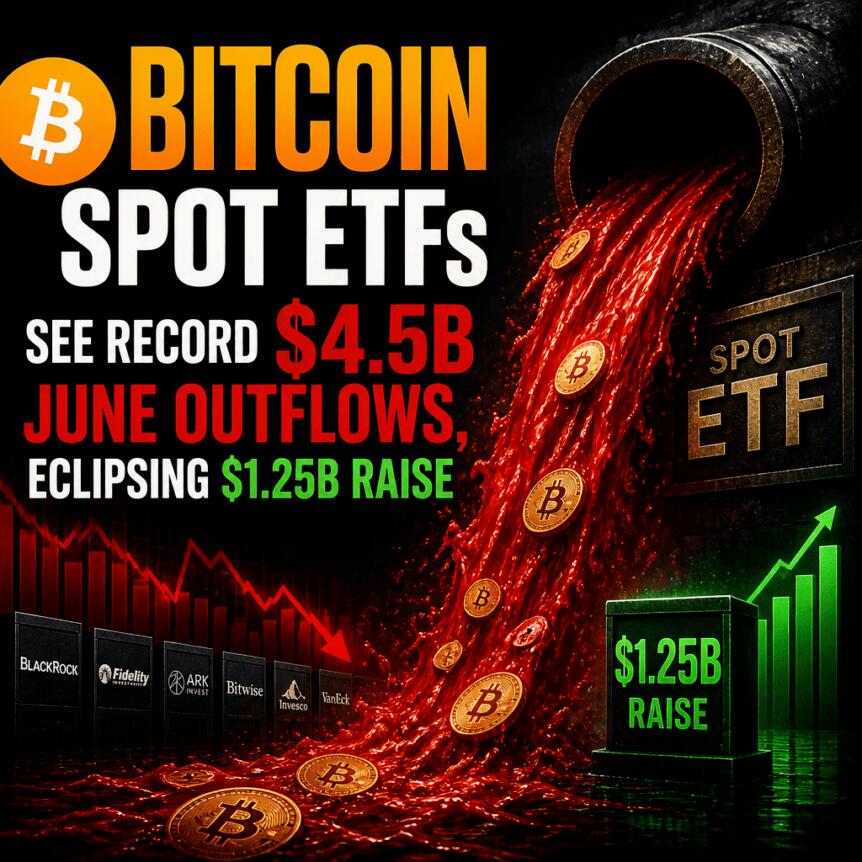
US-listed spot Bitcoin exchange-traded funds (ETFs) saw another sharp drawdown in June, recording $4.5 billion in net outflows—an amount that vastly exceeds the $1.25 billion Strategy is authorized to raise under its recently announced Bitcoin monetization program.
SoSoValue data updated Wednesday shows the record withdrawals pushed US spot Bitcoin ETFs to about $5.5 billion in year-to-date net outflows for 2026. Even with a still-positive overall position since launch, cumulative net inflows have fallen to roughly $51.2 billion, underscoring cooling investor demand for the product.
Key takeaways
- June’s $4.5 billion net outflows represent the largest monthly outflow figure cited for US spot Bitcoin ETFs in this period.
- That drawdown widened year-to-date net outflows for 2026 to roughly $5.5 billion, according to SoSoValue.
- BlackRock’s iShares Bitcoin Trust (IBIT) accounted for about 79% of June’s withdrawals, with $3.55 billion in net outflows (Farside Investors).
- Despite net inflows rising 4.6% year-over-year, CryptoQuant says ETF holdings remain below year-ago levels and total holdings are now under 1.25 million BTC.
- The scale of ETF outflows highlights a broader mismatch between renewed corporate Bitcoin monetization plans and fund-level investor behavior.
June outflows hit a record, led by IBIT
SoSoValue’s tracking shows June produced $4.5 billion in net outflows from US spot Bitcoin ETFs. The same period saw a heavy concentration in IBIT, which posted $3.55 billion in net outflows—about 79% of the total, according to Farside Investors.
For traders and long-term allocators, this concentration matters. When the majority of withdrawals are coming from a single flagship vehicle, it can signal that institutional allocation decisions are shifting in a coordinated way rather than being spread across the ETF complex. It also means changes in sentiment around the most liquid fund can ripple through broader ETF flow patterns.
Year-to-date flows remain negative even as lifetime inflows persist
The June outflows have pushed US spot Bitcoin ETFs toward a deeper negative 2026 trajectory. SoSoValue data indicates year-to-date net outflows are approximately $5.5 billion, while cumulative net inflows since the funds launched stand at about $51.2 billion.
In other words, the ETFs are not losing their overall historical inflow advantage—but the direction of travel is becoming more challenging. Record monthly withdrawals make it harder for new inflows to offset earlier net selling pressure, particularly if outflows remain elevated beyond a single month.
Holdings trail the year-ago baseline, signaling weaker underlying demand
SoSoValue reports cumulative net inflows into US spot Bitcoin ETFs have increased 4.6% compared with roughly $49 billion a year earlier. However, CryptoQuant’s data suggests that this net inflow picture does not translate into higher Bitcoin holdings at the same point in time.
CryptoQuant head of research Julio Moreno wrote on X on Tuesday that “US-based Bitcoin ETF holdings are now lower than at this same day last year.” He also said that overall demand for Bitcoin is weakening, pointing to total holdings across US spot Bitcoin ETFs falling below 1.25 million BTC.
This distinction—between net inflows and actual ETF holdings—can be crucial for interpretation. Net flow measures can move differently from holdings when redemption and creation activity, custody changes, or other accounting effects alter the timing relationship between “fund flows” and the amount of Bitcoin sitting inside the ETFs. For investors, the practical takeaway is that the balance sheet reality inside the funds is not matching the improved net inflow comparison.
Moreno’s commentary is consistent with the larger message investors may be trying to reconcile: ETFs can attract capital in aggregate while still losing BTC exposure year-over-year, which is often a sign that demand is not as resilient as headline inflow numbers imply.
Strategy’s $1.25 billion authorization runs into ETF outflows of a larger magnitude
Against this backdrop, Strategy announced a Bitcoin monetization program earlier this week. The company said it would seek authorization to raise up to $1.25 billion, framed as part of a broader capital framework intended to support dividend obligations tied to its preferred securities. The move was widely interpreted as responding to funding pressure within Strategy’s capital structure.
Community reactions were mixed. Some investors viewed the plan as financial flexibility, while others questioned the long-term sustainability of the new structure and argued it could lead to selling more Bitcoin than the initial authorization amount suggests.
In market reaction, Strategy’s Class A common stock (MSTR) initially rose as much as 12% above $90 after Monday’s announcement, according to Yahoo Finance, before reversing course and closing at $86.93 on Tuesday, down 6.2% on the day. Strategy’s preferred stock (STRC) traded higher at $84.86 on Tuesday, as reported by Yahoo Finance.
What stands out for readers is the scale mismatch between the corporate financing target and the ETF market’s behavior. June’s $4.5 billion in US spot ETF net outflows is more than three times the $1.25 billion Strategy is authorized to raise. While the two are not directly comparable in mechanism—corporate monetization versus retail/institutional ETF allocations—the comparison helps frame an important tension: renewed corporate efforts to manage capital around Bitcoin exposure are occurring as ETF-level demand is showing clear signs of cooling.
Going forward, investors will likely watch whether the ETF flow weakness is a temporary dip or a continuing trend—especially given CryptoQuant’s warning that ETF holdings remain below year-ago levels. If outflows persist, Strategy’s monetization plan may become part of a wider debate about where incremental Bitcoin demand will ultimately come from.
https://www.cryptobreaking.com/bitcoin-spot-etfs-see-record/?utm_source=blogger%20&utm_medium=social_auto&utm_campaign=Bitcoin%20Spot%20ETFs%20See%20Record%20$4.5B%20June%20Outflows,%20Eclipsing%20$1.25B%20Raise%20
Comments
Post a Comment