
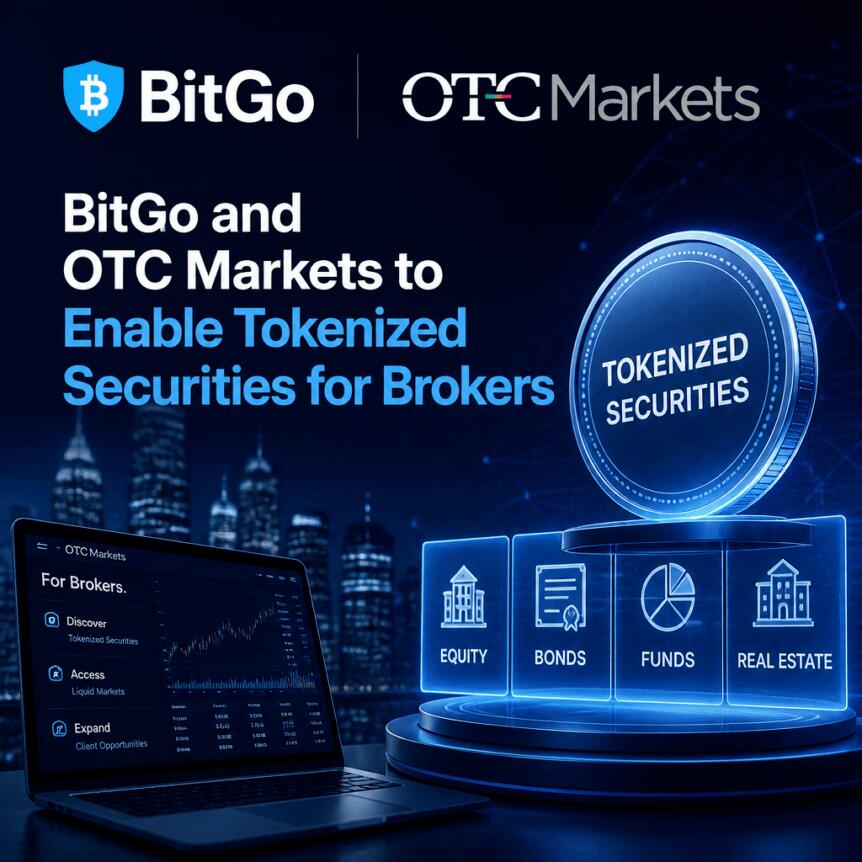
BitGo and OTC Markets Group have announced a proposed partnership aimed at bringing digital asset trading and custody capabilities into the broker-dealer workflow used in US over-the-counter markets. The plan is designed to let broker-dealers leverage the same electronic infrastructure for quoting, trading, and settling “digital asset securities” that they already use for conventional OTC and US equity activity.
According to the companies, the alliance would initially serve more than 150 broker-dealers connected to OTC Link ATS, an SEC-regulated alternative trading system. If the framework is implemented, participating firms would be able to route tokenized securities through familiar market channels—while BitGo would handle custody and settlement functions within the proposed operating model.
Key takeaways
- BitGo and OTC Markets Group plan to integrate digital asset securities into OTC Link ATS, allowing broker-dealers to use established trading and settlement infrastructure.
- BitGo Bank & Trust is intended to act as the qualified custodian, with settlement facilitated through BitGo’s Go Network.
- The initial scope is digital asset securities, with room for expansion toward tokenized assets and commodities as relevant regulatory guidance evolves.
- The announcement arrives amid accelerating industry focus on tokenized real-world assets and growing regulatory efforts to clarify rules for digital assets in the US.
- OTC Markets Group shares rose about 2.7% to roughly $53.50 by midday Wednesday, reflecting market attention on the proposal.
A bridge between crypto infrastructure and broker-dealer rails
The core idea behind the BitGo–OTC Markets Group proposal is operational fit. Broker-dealers already operate under mature securities market rules and processes; according to the companies, the partnership would connect digital asset securities to the electronic trading ecosystem broker-dealers use today.
OTC Markets Group operates OTC Link ATS, an alternative trading system regulated by the US Securities and Exchange Commission. Under the plan, broker-dealers using that venue would be able to quote and execute trades in digital asset securities using the same general infrastructure environment already in place for OTC and US equity trading and settlement.
For investors and market participants, that approach matters because it targets one of the most common friction points in institutional crypto adoption: integration complexity. Instead of requiring broker-dealers to move entirely to “crypto-native” systems, the framework aims to plug tokenized securities functionality into established brokerage workflows—potentially lowering onboarding costs and reducing the scope of operational change.
How the custody and settlement model would work
The companies outlined a two-part operational structure. Under the proposal, BitGo Bank & Trust would serve as the qualified custodian. Settlement, meanwhile, would be handled through BitGo’s Go Network.
The partnership’s initial intent is focused on digital asset securities, but the companies also indicated the framework could be expanded to support tokenized assets and commodities as regulatory frameworks develop. That conditional language is important: while tokenization is a rapidly progressing theme, the specific asset classes and the precise regulatory pathway can vary materially depending on how regulators treat different instruments.
BitGo’s role as a qualified custodian is reinforced by its recent US banking milestone. In December, BitGo received final approval from the US Office of the Comptroller of the Currency to operate as a federally chartered national trust bank. That approval positions the firm to provide qualified custody services under federal banking oversight—an element that may be attractive to broker-dealers and other institutional participants seeking clearer custody governance.
Why broker-dealers are central to tokenization’s next phase
Broker-dealers could become a major conduit for tokenized securities because they sit at the intersection of regulation, market access, and capital formation. The BitGo–OTC Markets Group plan effectively tries to transform tokenization from a largely experimental pipeline into something more compatible with existing market plumbing.
The rationale aligns with broader market forecasts. Bernstein analysts have projected that the value of tokenized real-world assets could reach up to $4 trillion by 2030, citing expansion across equities, commodities, and other financial assets. Earlier coverage from Cointelegraph also highlighted how tokenization efforts are increasingly tied to exchange and broker distribution networks.
That context matters because tokenization is not just about issuing tokens—it’s also about where they can be traded and settled. The BitGo–OTC Markets Group proposal suggests a pathway to move tokenized instruments into venues where broker-dealers already operate, rather than relying solely on separate systems.
It also follows similar initiatives aimed at bringing tokenization closer to mainstream capital markets. Cointelegraph previously reported on efforts by companies such as Securitize and Cantor Fitzgerald to pursue tokenized IPOs and follow-on equity offerings, pointing to an industry push to adapt tokenization to established issuance and trading channels.
What to watch: implementation details and regulatory compatibility
While the announcement outlines an operating framework, the most significant uncertainties for market participants are whether and how quickly the partnership can move from proposal to execution, and what the operational scope will be at each stage. The companies’ statement that the approach is “initially intended” to support digital asset securities implies a phased rollout tied to asset-class readiness and regulatory clarity.
Investors and broker-dealers watching this story should focus on three practical questions: how OTC Link ATS would be configured for tokenized securities, what operational requirements are placed on participating broker-dealers, and how BitGo’s custody and settlement services are integrated for actual trade flows. The answers will determine whether tokenized securities become meaningfully accessible through existing institutional pathways—or remain a limited pilot concept.
For now, the proposal reinforces a broader shift in the industry: tokenization is moving from isolated experimentation toward integration with regulated market infrastructure, where broker-dealer connectivity could be a decisive factor in scaling adoption.
https://www.cryptobreaking.com/bitgo-and-otc-markets-to/?utm_source=blogger%20&utm_medium=social_auto&utm_campaign=BitGo%20and%20OTC%20Markets%20to%20Enable%20Tokenized%20Securities%20for%20Brokers%20
Comments
Post a Comment