
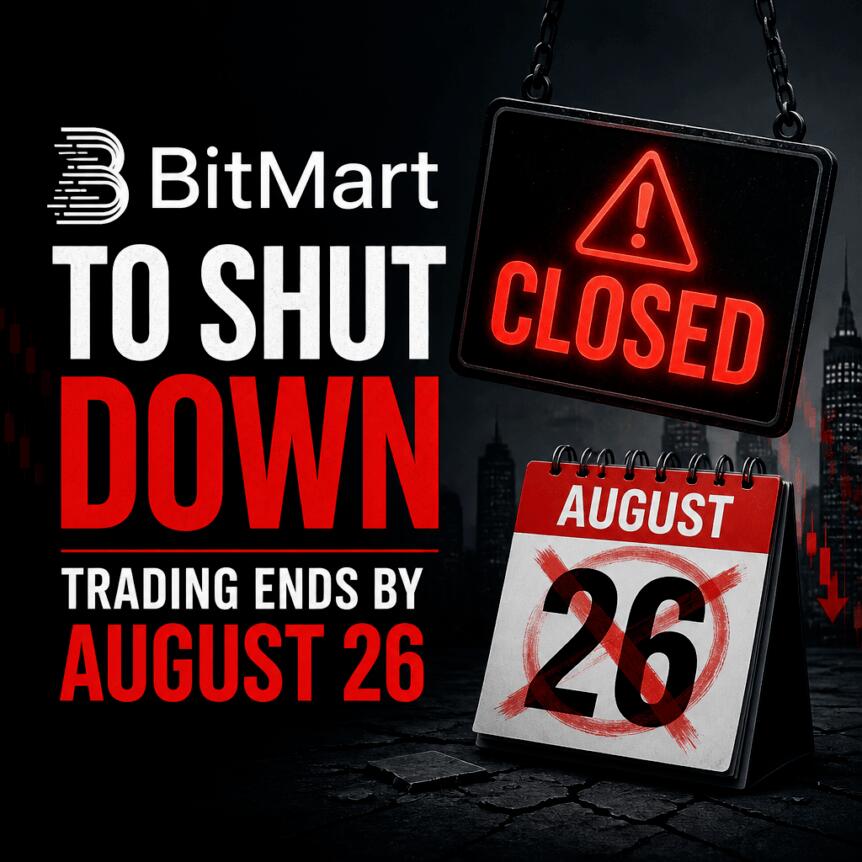
BitMart, a cryptocurrency exchange, has announced an orderly wind-down of its trading platform. The firm will end all trading services on Aug. 26 and fully cease operations on Jan. 31, 2027, according to a notice posted to its support portal on Sunday.
As part of the shutdown plan, BitMart said it has stopped accepting new user registrations and deposits. Futures trading has been moved to reduce-only mode, while spot markets will no longer accept new orders—changes that can materially affect liquidity and how quickly users can reposition or exit positions.
Key takeaways
- BitMart will halt trading services on Aug. 26 and close permanently on Jan. 31, 2027, following an orderly wind-down announcement.
- The platform has stopped new registrations and deposits; futures are reduce-only and spot trading no longer accepts new orders.
- BitMart’s native token BMX fell sharply, losing nearly 70% in a short window amid user complaints about withdrawals.
- According to Arkham data, wallets attributed to BitMart held about $71 million in crypto assets on Sunday, down from roughly $102 million on July 6.
BitMart’s wind-down timeline and trading restrictions
In its notice, BitMart said it reached the decision after evaluating “operating conditions, market environment, and future strategic direction,” and that it would begin an orderly wind-down of its trading platform operations.
Operationally, the company has already tightened access: it stopped accepting new user registrations and deposits. It also introduced trading limitations consistent with a platform winding down risk: futures trading was shifted to reduce-only mode, and spot markets stopped taking new orders.
For users, these restrictions typically mean the exchange becomes less capable of accommodating new risk-taking activity, and positions may become harder to manage as market depth changes. The policy also increases the importance of withdrawal functionality, since exiting holdings may be the primary remaining action.
BMX plunges as withdrawal complaints surface
BitMart’s BMX token came under heavy pressure during the announcement cycle. At the time of writing, BMX traded around $0.09464, down nearly 70% from about $0.31 late Friday. The token reportedly slipped as low as $0.1058 early Saturday before extending its decline.
Several users on X reported that withdrawals were taking longer than usual. Some claims focused on Tether’s USDT withdrawals remaining pending for hours.
BitMart also warned that some withdrawal requests could be subject to additional compliance and security reviews, which may extend processing times. That detail can be important for users deciding whether to wait, cancel, or resubmit withdrawal requests as the exchange transitions toward shutdown.
Before publication, BitMart did not respond to a request for comment made by Cointelegraph.
On-chain balances and what Arkham data suggests
While trading has been winding down in stages, attention has turned to whether user funds can be withdrawn smoothly. Arkham data, accessible via its explorer, indicated that wallets attributed to BitMart held about $71 million in crypto assets on Sunday—down from roughly $102 million on July 6.
Of the tracked holdings, about $41.5 million was in stablecoin-banking platform WeFi’s WFI tokens, while BitMart-attributed wallets held about $91,000 in USDT, according to the same Arkham view.
The decline in total assets over the period highlighted by Arkham does not, by itself, explain whether assets are moving into customer withdrawals, into other custody arrangements, or into operational buffers. Still, it provides traders and users with a real-time way to observe whether BitMart-attributed balances are shrinking as the wind-down progresses.
More platform shutdowns—and token confusion around BitMart vs BitMEX
BitMart’s plan places it among a growing list of crypto trading platforms announcing closures. Earlier in the week, BitMEX and Dango also said they would shut down their respective trading platforms, according to Cointelegraph’s coverage of those announcements.
Separately, social media chatter showed some confusion between BitMart’s token and BitMEX-related tickers. On Saturday, an X user in a Mandarin-speaking crypto community referred to BMX’s drop while speculating about the reason, and another user responded—citing a mismatch between online discussion and BitMEX’s announced shutdown date.
That reference did not align with BitMEX’s Sept. 23 shutdown date, as Cointelegraph previously reported. Cointelegraph also noted that BitMEX’s own token BMEX fell about 90% shortly after BitMEX’s notice, while multiple accounts in the same community appeared to mix up BMX with BitMEX.
It was not immediately clear whether that confusion materially affected BMX trading or simply reflected broader information noise during the broader shutdown cycle. Still, it highlights a recurring risk for users: during periods of exchange closures, similarly named products and tokens can lead to misinterpretation of price moves and the underlying drivers.
As BitMart moves from trading restrictions toward full cessation in January 2027, users should watch withdrawal processing times and any further changes to compliance review steps, while traders may want to monitor whether on-chain balances tied to BitMart continue trending downward as the wind-down advances.
https://www.cryptobreaking.com/bitmart-to-shut-down-trading/?utm_source=blogger%20&utm_medium=social_auto&utm_campaign=BitMart%20to%20Shut%20Down:%20Trading%20Ends%20by%20August%2026%20
Comments
Post a Comment