
Blockchain Adoption Not Benefiting Public Chains And Networks Is A Bigger Threat To Bitcoin Than Strategy
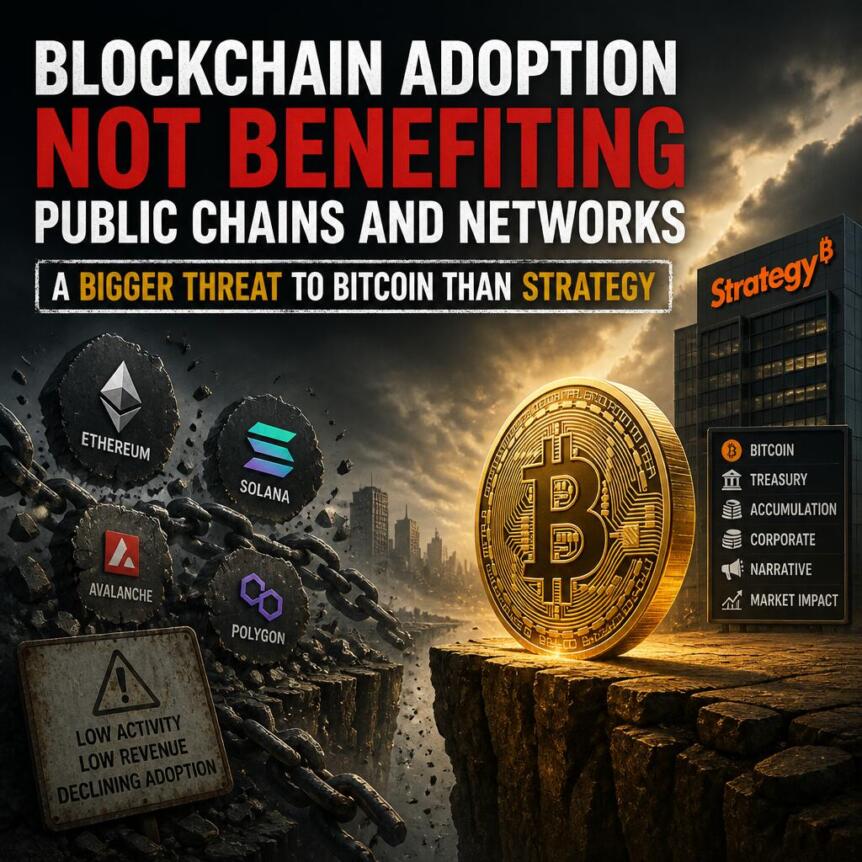
JPMorgan analysts believe blockchain adoption that does not benefit public blockchains and their tokens poses a greater risk to Bitcoin than to Strategy and its BTC monetization program.
According to a report by the banking giant, investors view Strategy’s monetization program as a risk to the crypto market that may create periodic selling pressure.
Strategy Isn’t Bitcoin’s Biggest Risk
The analysts, led by managing director Nikolaos Panigirtzoglou, said that if tokenization, payments, and settlements happen outside public networks, the broader crypto ecosystem could see lower activity, liquidity, and weak capital inflows, which could put pressure on Bitcoin.
The analysts said, “We do not see Strategy as the main structural threat to bitcoin. In our view, the more important risk to bitcoin stems from the broader crypto ecosystem and from blockchain adoption within traditional finance continuing to develop in ways that bypass public permissionless networks.”
A Threat For Public Blockchains
The analysts highlighted that institutions have largely favored permissioned blockchains because of stronger know-your-customer (KYC), anti-money laundering (AML), and privacy controls. They also provide regulatory certainty, legal accountability, and throughput. This preference for permissioned blockchains creates increased competition for public blockchains like Ethereum.
They also pointed to the Bank for International Settlements’ (BIS) warning against using public permissioned blockchains for financial infrastructure due to concerns about scalability, governance, accountability, and settlement finality. BIS has promoted permissioned ledgers offering tokenized central bank money, commercial bank deposits, and tokenized assets within regulated departments.
Additionally, banks are building blockchain infrastructure, including tokenized deposits backed by existing banking regulations, deposit insurance frameworks, and customer relationships. Widespread adoption of tokenized deposits could reduce dependence on stablecoins in institutional payments and settlements. SWIFT’s recent launch of its own blockchain ledger and other central bank digital currency (CBDC) projects also strengthen regulated alternatives to public blockchains.
The analysts also noted that real-world asset (RWA) tokenization could remain within traditional financial infrastructure rather than move to public blockchains.
Public Blockchains To Take A Limited Role
Institutional adoption could push custody, settlement, issuance, and lifecycle management toward permissioned blockchains that are better suited to meet requirements around privacy, confidentiality, and governance. Meanwhile, public blockchains could see limited use for distribution, secondary trading, and interoperability. However, the prevalence of private and permissioned blockchains could relegate public chains to a secondary role.
The analysts also questioned the efficiency of public blockchain settlements, noting that netted settlement could reduce liquidity needs, improve capital efficiency, and help manage funding and operations. They also highlighted examples such as DTCC’s work developing tokenized workflows on permissioned infrastructure and selective collaboration with Stellar. DTCC has also piloted tokenized US securities using the Canton Network and ComposerX.
Disclaimer: This article is provided for informational purposes only. It is not offered or intended to be used as legal, tax, investment, financial, or other advice.
https://www.cryptobreaking.com/blockchain-adoption-not-benefiting-public/?utm_source=blogger%20&utm_medium=social_auto&utm_campaign=Blockchain%20Adoption%20Not%20Benefiting%20Public%20Chains%20And%20Networks%20Is%20A%20Bigger%20Threat%20To%20Bitcoin%20Than%20Strategy%20
Comments
Post a Comment