
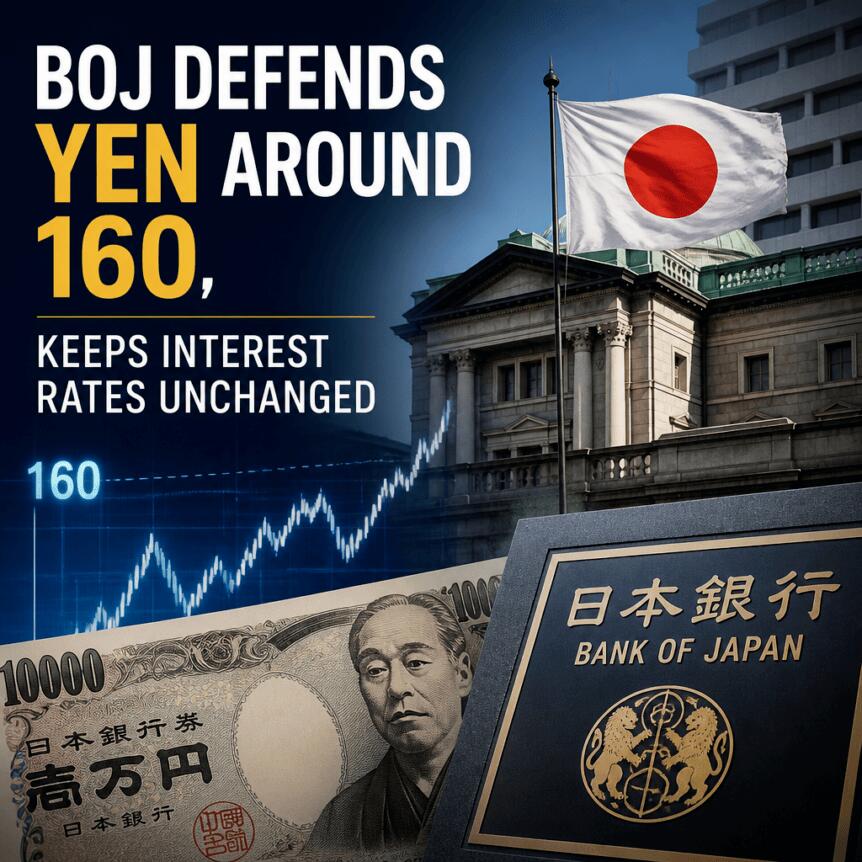
Japan’s central bank kept interest rates unchanged at 1.0% on Friday, according to a Bank of Japan (BoJ) statement issued after its policy decision. The meeting outcome landed in line with market expectations, even as the yen had just swung sharply following reports of intervention.
The BoJ’s decision came shortly after the Japanese currency strengthened quickly against the US dollar—moving up as much as 3.5% overnight, based on TradingView data—an advance many traders linked to coordinated or related foreign-exchange actions involving the yen. With Japan also flagging inflation pressures later in the year, investors are now watching how currency policy, yields, and global risk appetite intersect for crypto markets.
Key takeaways
- The BoJ held the uncollateralized overnight call rate at around 1.0% after an outcome supported by eight of nine Policy Board members.
- Recent yen volatility reportedly coincided with currency intervention activity involving Japan and South Korea, as the JPY briefly jumped versus the USD.
- The BoJ warned that CPI inflation may accelerate to clearly above 2% from the second half of fiscal 2026.
- Since the yen carry trade unwind in 2024, JPY moves have continued to influence Bitcoin and altcoin risk sentiment.
BoJ holds rates steady after yen turbulence
In its latest statement, the BoJ said it would “encourage the uncollateralized overnight call rate to remain at around 1.0 percent,” confirming a broadly shared view among officials for keeping policy unchanged. The decision was passed by eight of nine members of the Policy Board, with Hajime Takata the only dissenting vote, proposing a 0.25% rate hike.
Markets had largely expected this result ahead of the meeting, according to earlier coverage referenced by Cointelegraph. The policy decision also arrived just hours after the yen’s brief surge—an FX move that coincided with speculation about official action. While the BoJ did not comment directly on the reported intervention, the timing is likely to keep FX traders attentive to any future shifts in the currency’s direction.
Reported Japan–Korea involvement raises the stakes
Several reports tied the yen’s sharp move to intervention efforts. The BoJ did not confirm the details, but commentary in regional media pointed to alignment between Japan and South Korea’s policy priorities. At the time, the South Korean won was reportedly rising as well, suggesting traders were reacting to developments across both currencies.
Analyst Lee Min-hyuk of KB Kookmin Bank, as quoted by Straits Times, argued that cooperation could amplify the impact because the won and yen are closely linked. Separate reporting also noted that the US had conducted “rate checks”—a softer form of intervention that can precede stronger operations—during Thursday’s session, fueling speculation about a wider, multi-country FX response.
Traders typically treat intervention expectations as a constraint on how far a currency can move in either direction. If intervention remains a credible backstop, it can affect not only FX markets but also broader capital flows—an important link for assets like Bitcoin that have repeatedly shown sensitivity to liquidity conditions and global risk changes.
BoJ turns to inflation headwinds for fiscal 2026
Beyond the rate decision, the BoJ’s outlook for prices may carry longer-term significance. In its quarterly Outlook for Economic Activity and Prices, the central bank said the year-on-year rate of increase in the consumer price index (CPI) “is likely to accelerate to a level clearly above 2 percent from the second half of fiscal 2026.”
In the same report, the BoJ pointed to additional drivers of inflation such as durable goods prices. It also referenced the “waning of the effects of high crude oil prices,” tying this shift to factors including the ongoing US–Iran war and the closure of the Strait of Hormuz oil-transit route—elements that can influence energy costs and therefore the inflation trajectory.
For investors, this matters because inflation expectations can eventually pressure policymakers toward tighter conditions, or at minimum change the path of interest-rate expectations. Even though Friday’s decision was unchanged, the direction of the BoJ’s CPI outlook can affect longer-dated yields and, by extension, currency dynamics and carry-trade behavior.
Why yen moves still matter for crypto
FX volatility has remained a meaningful input for crypto traders since the “unwinding” of the yen carry trade in August 2024, when yen funding pressures and related liquidity shifts coincided with significant downside across Bitcoin and other major tokens. Since then, Japan-related rates and the yen’s direction have continued to serve as a proxy for risk conditions—especially when changes in JPY funding costs trigger broader adjustments in global portfolios.
Earlier this year, Arthur Hayes, former CEO of crypto exchange BitMEX, suggested that a weak yen combined with rising Japanese bond yields could encourage some investors to rotate away from low-yielding US bond exposures. In his framing, central bank liquidity interventions and related yield dynamics can flow through to crypto demand by shifting broader risk and liquidity availability.
Hayes also previously argued that USD/JPY could rise significantly—he predicted in December 2025 that the pair might reach as high as 200. While Friday’s BoJ decision does not validate that forecast on its own, the ongoing interplay between FX moves, yields, and policy signals remains central to how traders map macro conditions onto digital-asset positioning.
With the BoJ holding rates steady, the immediate question for markets is whether recent yen strength proves durable or fades—particularly given reports of intervention-linked volatility and the central bank’s warning that inflation pressures could strengthen later in fiscal 2026. Crypto traders will likely watch for follow-through in JPY/USD and Japanese yield expectations, because those variables continue to shape liquidity assumptions that underpin risk appetite.
https://www.cryptobreaking.com/boj-defends-yen-around-160/?utm_source=blogger%20&utm_medium=social_auto&utm_campaign=BOJ%20Defends%20Yen%20Around%20160,%20Keeps%20Interest%20Rates%20Unchanged%20
Comments
Post a Comment