
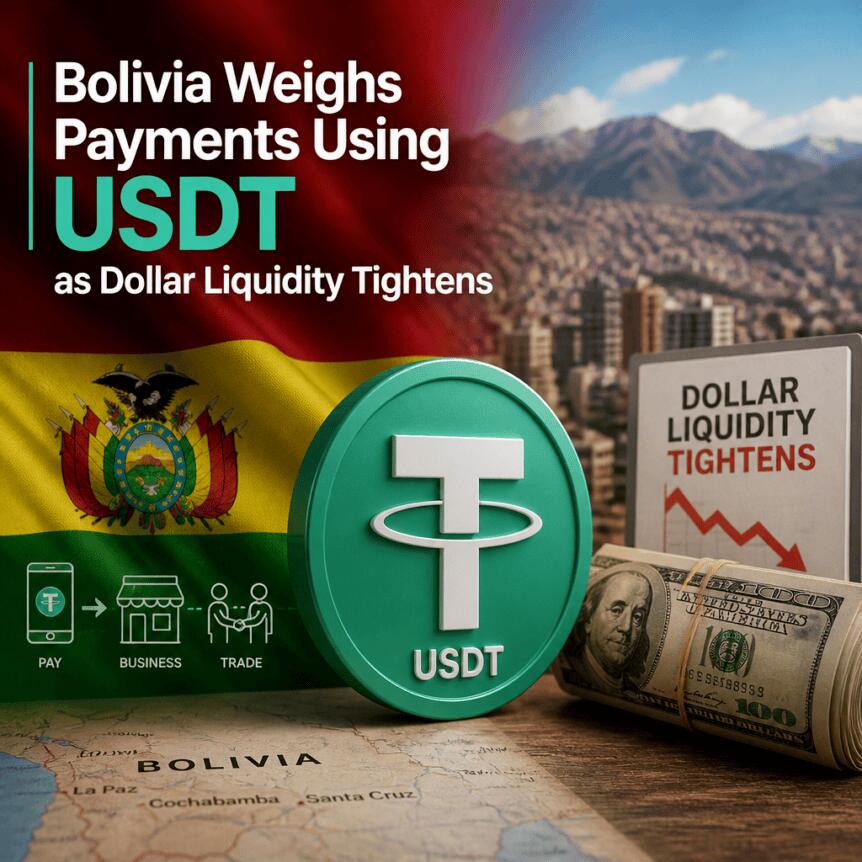
Bolivia is considering adding Tether’s USDT to its national payments infrastructure, a potential milestone for stablecoin adoption in Latin America amid a long-running shortage of US dollars. The government says it is working on a regulatory approach that would treat USDT as a payment instrument alongside the boliviano and the US dollar—rather than a fringe asset outside the formal economy.
Economy and Public Finance Minister Jose Gabriel Espinoza said at a press conference on Monday that the state is assessing a framework to allow USDT “to circulate as just another currency.” Any rollout, he added, would need strong oversight and anti-money laundering controls because Bolivia remains on the Financial Action Task Force (FATF) grey list.
Key takeaways
- Bolivia is evaluating whether USDT could be recognized for everyday transactions such as payments, savings and trade.
- The proposal would require a regulatory structure that can place USDT inside the country’s formal payments system.
- Bolivia’s FATF grey-list status means anti-money laundering safeguards are expected to be central to any approval process.
- The move comes as the country confronts a widening gap between official and parallel exchange rates that has increased demand for dollar-denominated alternatives.
USDT would be treated as part of everyday payments
According to CriptoNoticias, the regulatory framework being considered is still under review. If adopted, it would aim to formally recognize USDT for retail and commercial activity, including payments, savings and trade, without relying solely on cash or the traditional banking channel.
Espinoza’s framing matters because it suggests Bolivia is not merely allowing crypto trading or occasional transfers, but contemplating a system design where USDT functions as a practical alternative for transactions. For consumers and businesses, that could mean more predictable settlement options when local access to dollars is constrained.
Regulatory hurdles tied to FATF monitoring
Espinoza also emphasized that any implementation would depend on a “robust regulatory framework” and effective anti-money laundering protections. His comments connect directly to Bolivia’s placement on the FATF grey list, which flags jurisdictions with increased monitoring needs due to deficiencies in preventing money laundering and terrorist financing.
That context helps explain why the government is taking a cautious, framework-first approach. Moving stablecoins into a national payments role typically requires clear responsibility lines—who can distribute or process them, how compliance checks are performed, and how suspicious activity reporting would operate. For Bolivia, those requirements could become a gating factor for how quickly a USDT rollout can move from proposal to practice.
Dollar scarcity and exchange-rate strain push demand toward stablecoins
The policy discussion comes against a backdrop of persistent dollar shortages in Bolivia. Reuters previously reported that Bolivia kept an official exchange rate of 6.86 bolivianos per US dollar for purchases and 6.96 for sales for years, before later abandoning the long-standing peg after pressure on foreign exchange reserves.
As Reuters noted, the abandonment of the peg contributed to the expansion of a parallel foreign exchange market where the dollar traded at a steep premium relative to the official rate. When the cost of dollars diverges sharply between official channels and informal markets, demand tends to shift toward instruments that track or approximate dollar value. In this environment, stablecoins such as USDT can become appealing for payments because they offer a dollar-denominated unit of account without requiring direct access to physical dollars.
Industry research also points to growing activity. Chainalysis’ 2025 evaluation of crypto adoption across Latin America reported $14.8 billion in total transaction volume over a 12-month period for Bolivia included within the regional assessment. While this figure does not isolate stablecoins alone, it supports the broader claim that digital assets—often used in response to currency pressures—have become more integrated into real economic behavior across the region.
Bolivia’s return to crypto-friendly policy after the 2024 ban
The USDT payments initiative fits into a broader pivot by Bolivia toward digital assets following the lifting of its longstanding cryptocurrency ban in 2024. Since taking office in late 2025, President Rodrigo Paz Pereira’s administration has pledged to incorporate digital assets into the formal financial system, an approach described by earlier coverage from Cointelegraph as paving the way for banks to introduce crypto-related products and services, potentially including stablecoin-based accounts.
What’s notable now is the specificity: instead of focusing only on banking products or general “blockchain integration,” the government is explicitly weighing how USDT could fit into everyday payments. That difference could determine how quickly stablecoins move from parallel usage toward regulated, widely accepted channels.
Readers should watch how Bolivia’s draft regulatory framework is shaped—particularly around compliance obligations given its FATF grey-list status—and whether authorities set measurable timelines for pilot programs or bank participation. The next question is not only whether USDT will be recognized, but how the state plans to govern distribution, monitoring and settlement in a way that can survive both financial controls and real-world liquidity constraints.
https://www.cryptobreaking.com/bolivia-weighs-payments-using-usdt/?utm_source=blogger%20&utm_medium=social_auto&utm_campaign=Bolivia%20Weighs%20Payments%20Using%20USDT%20as%20Dollar%20Liquidity%20Tightens%20
Comments
Post a Comment