
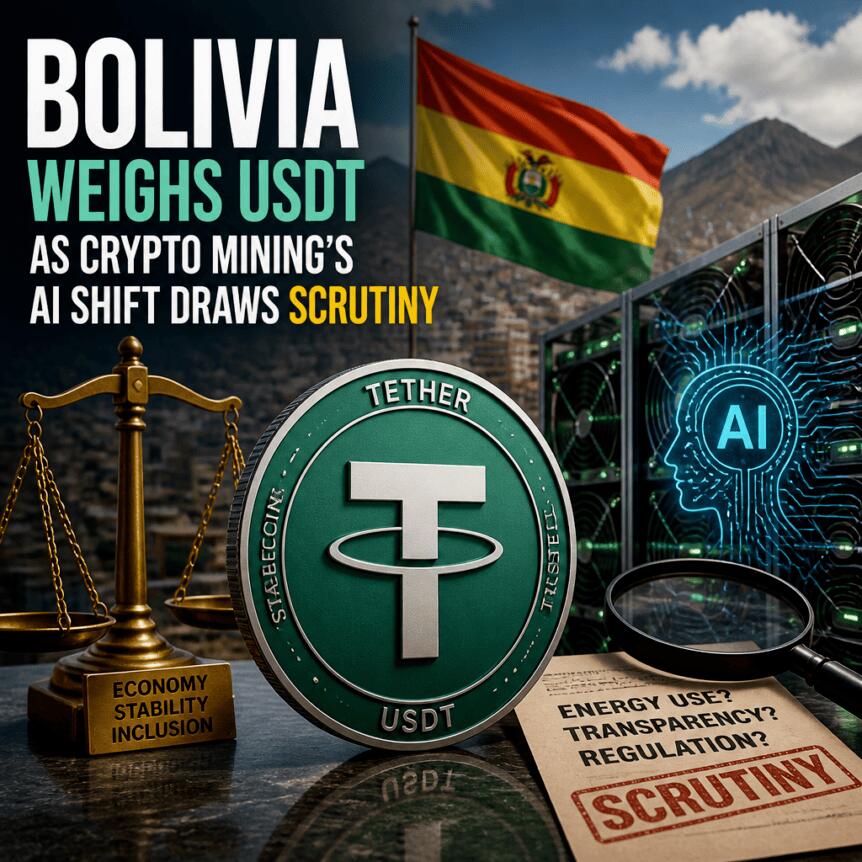
Stablecoins are increasingly moving beyond the “faster transfer” narrative and into more basic functions: helping people and businesses access dollars when local currency conditions are unstable. In Bolivia, a new proposal would formally recognize Tether’s USDT for payments—an attempt to widen access to dollar-denominated value as the country grapples with persistent foreign-exchange pressure.
Meanwhile, the market’s attention is also shifting to how crypto-native infrastructure companies translate new strategies into shareholder value. Bitcoin miners pitching AI and high-performance computing plans are drawing renewed scrutiny as investors focus on governance and insider activity, even as selected deals attract major attention.
Key takeaways
- Bolivia is reviewing a framework that would allow USDT to circulate alongside the boliviano and the U.S. dollar for payments and savings, with anti-money laundering controls planned.
- The push is tied to a prolonged shortage of dollars and widening pressure on official versus parallel exchange rates, increasing demand for dollar-denominated alternatives.
- Bitcoin miners’ AI infrastructure pivots are facing closer investor scrutiny, including questions around insider stock sales and whether AI-driven upside reaches public shareholders.
- CleanSpark’s Georgia data center lease highlights the sector’s effort to replace or supplement mining revenue with longer-term infrastructure contracts.
- Bitmine reported $45.7 million in revenue from Ethereum staking and validation last quarter, underscoring that staking businesses can remain cash-generative even when token prices are choppy.
Bolivia moves to recognize USDT as a payment option
Bolivia is considering a regulatory approach that would recognize Tether’s USDT as a payment currency, according to earlier coverage from Cointelegraph (Bolivia weighs USDT payment currency amid dollar shortage). If adopted, the rules would reportedly enable USDT to circulate in parallel with the boliviano and the U.S. dollar for both payments and savings.
Economy and Public Finance Minister Jose Gabriel Espinoza said the proposal would also include anti-money laundering safeguards. That matters in Bolivia’s case because the country is still on the Financial Action Task Force’s “gray list,” a status that tends to raise compliance expectations for any financial product that could touch broader cross-border flows.
The initiative follows two related developments. First, Bolivia lifted its crypto ban in 2024. Second, Cointelegraph previously reported that the new administration has pledged to broaden access to digital asset services (Bolivia integrate crypto stablecoins financial system).
While stablecoins have often been marketed as a tool to move value quickly across borders, Bolivia’s case highlights a different driver: domestic dollar scarcity. The proposal comes as Bolivia has faced a prolonged shortage of U.S. dollars after pressures on foreign-exchange reserves forced the government to abandon a long-standing currency peg earlier this year. That shift has increased demand for dollar-denominated alternatives, with USDT becoming a practical payment channel for those seeking steadier value than the boliviano.
For investors and builders, the significance is not only policy-level. It’s a signal that stablecoins are being pulled into mainstream economic coping mechanisms—especially in markets where official access to dollars is constrained and parallel market spreads are widening. What remains uncertain is how quickly the framework could move from proposal to implementation, and how regulators will operationalize AML requirements in practice.
Miners’ AI strategy meets governance and insider-trading questions
In a separate thread of crypto industry news, investor attention is increasingly turning from miners’ AI aspirations to the question of execution and accountability. Earlier coverage from Cointelegraph noted that investors are scrutinizing insider stock sales at Bitcoin miners pursuing AI infrastructure strategies as enthusiasm for the theme cools and governance concerns come into focus (Bitcoin miners’ AI pivot faces investor scrutiny over insider sales).
According to Blocksbridge Consulting, executives at TeraWulf, Cipher Digital, Riot Platforms, and Core Scientific have disclosed stock sales in recent months. Many of these sales were reportedly made under prearranged Rule 10b5-1 trading plans. In addition, Blocksbridge said that some strategic investors also reduced their holdings, including Tether—reported to have cut its stake in Bitdeer after Bitdeer’s AI-related rally.
The scrutiny is landing at a time when the AI narrative may not be performing as strongly as investors expected. Cointelegraph cited that the TEM AI Infrastructure Growth Index has fallen 16% over the past month, suggesting the “AI tailwind” for infrastructure-adjacent equities has cooled.
Blocksbridge’s framing for why this matters is straightforward: investors are looking beyond the AI growth story to evaluate whether the benefits of miners’ strategic pivots are translating into value for public shareholders. In other words, it’s not enough to adopt AI infrastructure as a theme—markets want clarity on timing, cash flows, and whether management’s incentives align with long-term shareholder outcomes.
CleanSpark’s lease deal signals a shift toward contracted infrastructure revenue
Even with investor scrutiny in the background, not all AI infrastructure developments are treated equally. CleanSpark’s stock surge—reported as up as much as 22%—followed its signing of a 20-year data center lease in Georgia, according to Cointelegraph coverage (CleanSpark shares jump after Georgia data center lease).
The agreement covers a 175-megawatt data center at the company’s Sandersville, Georgia campus. Cointelegraph reported the lease was signed with an undisclosed investment-grade global technology company, with the tenant expected to install computing equipment at the site. Phased deliveries are expected to begin in the fourth quarter of 2027.
CleanSpark could see substantial contracted revenue: Cointelegraph said the deal could generate up to $6.6 billion in contracted revenue. If the customer exercises two five-year extension options, the total value could reportedly reach $11.6 billion. Deals like this can be especially important for miners because they may provide more predictable income streams beyond operating-margin swings tied to mining economics.
The context also matters. Cointelegraph noted that the agreement reflects a broader trend among publicly traded miners seeking new revenue sources as post-halving mining conditions remain under pressure. While many peers have reduced Bitcoin holdings to bolster liquidity, CleanSpark has largely remained a net accumulator, though it reportedly sold some BTC earlier this year to fund operations. The company’s stance is closely watched because it influences how aggressively it can invest while still maintaining exposure to Bitcoin’s upside.
For readers following the sector, the key is to watch whether more miners can structure similar long-term contracts with clear timeline milestones—and whether these assets produce measurable diversification benefits in financial results, not just in announcements.
Bitmine adds $45.7 million from Ethereum staking and validation
On the business side of crypto infrastructure, Bitmine Immersion Technologies reported financial performance driven heavily by staking. According to Cointelegraph, the company generated $45.7 million in revenue from Ethereum staking and validation last quarter (Bitmine generated $46m from Ethereum staking last quarter).
For the three months ended May 31, Ethereum staking represented 98% of Bitmine’s revenue. By comparison, Cointelegraph reported $624,000 from self-mining Bitcoin and $168,000 from consulting services.
The results build on Bitmine’s staking platform roadmap. Cointelegraph noted that Bitmine launched MAVAN in March, an institutional Ethereum staking platform built on the acquisition of validator operator Pier Two Holdings. The company said it has staked roughly 85% of its Ether holdings—about 4.9 million ETH.
Chairman Tom Lee said Bitmine now stakes more Ether than any other entity and projects annualized staking rewards of $284 million once its holdings are fully staked through MAVAN and its partners. Even without the narrative excitement that often surrounds mining-related headlines, staking operations can offer a different kind of resilience: fees and staking participation can remain a core revenue engine when price volatility affects trading activity.
What to monitor next is how quickly Bitmine can reach full staked exposure through MAVAN and partner channels, and whether the company’s reward outlook holds as network conditions and competitive staking dynamics evolve.
Across these stories, the common thread is how crypto infrastructure is adapting to real constraints—whether that’s dollar shortages driving stablecoin payments, or miners searching for steadier cash flows through contracted computing capacity, or staking providers scaling revenue through platform distribution. The near-term question for market participants is which of these approaches translate into durable compliance, predictable income, and shareholder-aligned governance rather than just short-lived momentum.
https://www.cryptobreaking.com/bolivia-weighs-usdt-as-crypto/?utm_source=blogger%20&utm_medium=social_auto&utm_campaign=Bolivia%20Weighs%20USDT%20as%20Crypto%20Mining’s%20AI%20Shift%20Draws%20Scrutiny%20
Comments
Post a Comment