
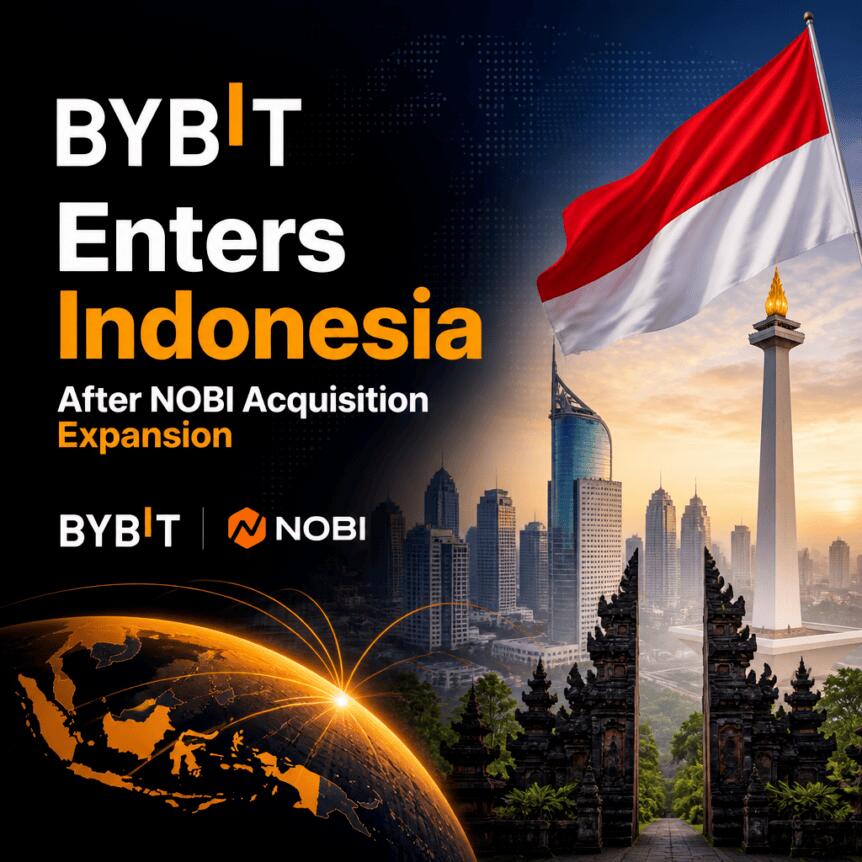
Bybit has moved deeper into Southeast Asia by launching a locally operated crypto trading platform in Indonesia, a step it says follows a majority acquisition of NOBI. The exchange announced Thursday that it has launched the new Indonesia entity after taking control of digital asset firm PT Enkripsi Teknologi Handal, which previously operated under the name NOBI.
The deal results in a rebrand: NOBI is now Bybit Indonesia. Bybit said it intends to roll out its services in stages, beginning with 500 cryptocurrency trading pairs, and to expand from there as the platform ramps up.
Key takeaways
- Bybit has launched a locally operated Indonesia platform after acquiring a majority stake in PT Enkripsi Teknologi Handal (formerly NOBI).
- NOBI has been rebranded as Bybit Indonesia, with the company set to expand its trading offering in phases.
- The exchange plans to start with 500 trading pairs and build from there rather than opening the full set at once.
- Leadership will come from former NOBI executives, with Lawrence Samantha as CEO and Dionisius Evan as chief operating officer.
- Indonesia’s regulator reports a rapidly growing crypto user base, alongside a licensing framework covering exchanges, custodians, and traders.
Bybit’s Indonesia push: acquisition to local operation
For Bybit, the launch is not just a marketing move—it reflects a shift toward operating within Indonesia’s local regulatory and market structure. The exchange said its acquisition allows it to pair Bybit’s global capabilities with an experienced local team that understands Indonesia’s market dynamics and regulatory requirements.
The company’s statement names Lawrence Samantha as CEO and Dionisius Evan as chief operating officer. Both previously served as senior executives at NOBI, indicating that Bybit is using the acquired firm’s institutional know-how and local relationships as it enters a regulated environment.
What Bybit plans to launch first
Bybit Indonesia will be introduced in phases. According to the announcement, the rollout will start with 500 cryptocurrency trading pairs. That staged approach suggests Bybit is likely pacing market access and product configuration rather than attempting a full-scale launch overnight, which can be important in jurisdictions where onboarding, compliance processes, and platform readiness must be managed carefully.
While Bybit did not provide a detailed timeline for subsequent phases in the information available, the initial pair count is a key operational signal: the exchange is aiming to offer broad spot market coverage from day one, giving Indonesian users a range of trading choices as liquidity and infrastructure are established.
Indonesia’s growing crypto market and the licensing environment
Indonesia has been steadily expanding its crypto user base under a framework overseen by the Indonesia Financial Services Authority (OJK). As of February 2026, OJK reported 21.07 million registered crypto asset users, and it cited total crypto transaction value of $26.85 billion (482 trillion Indonesian rupiah) in 2025.
Regulatory activity has also accelerated. As of April 2026, OJK reported that Indonesia had licensed 31 crypto-related entities. That includes two crypto exchanges, two clearing institutions, two custodians, and 25 digital asset traders. PT Enkripsi Teknologi Handal—Bybit’s acquired company—was listed among those licensed entities.
For investors and users, the significance is that Bybit’s local launch is arriving in a market where regulatory status and licensing are increasingly central to participation. In other words, the opportunity is expanding, but so are compliance expectations. Bybit’s decision to structure entry via an acquired, locally licensed firm may reduce friction compared with trying to build a local regulated presence from scratch.
Why the local leadership model matters
Bybit Indonesia’s management lineup is drawn from the former NOBI leadership, with Samantha taking the CEO role and Evan serving as COO. That continuity can matter operationally: local executives typically have deeper context around compliance workflows, relationships with regulated counterparties, and day-to-day execution in-country.
From a broader perspective, this model reflects a common pattern in regulated crypto markets. Global exchanges often need more than technology and brand recognition—they need a team that understands local rules, user behavior, and market structure well enough to execute quickly once a platform goes live.
Even so, readers should watch how the staged launch progresses beyond the initial 500 pairs. The next question will be whether Bybit increases liquidity and expands pair availability at a pace that matches Indonesia’s user growth, and how effectively it integrates the acquired platform into its wider global systems.
With Bybit Indonesia now live and using former NOBI executives to lead operations, the key developments to track are the timing of subsequent rollout phases, any expansion beyond the initial trading pairs, and how the platform performs within Indonesia’s regulated ecosystem as OJK continues to license and supervise crypto firms.
https://www.cryptobreaking.com/bybit-enters-indonesia-after-nobi/?utm_source=blogger%20&utm_medium=social_auto&utm_campaign=Bybit%20Enters%20Indonesia%20After%20NOBI%20Acquisition%20Expansion%20
Comments
Post a Comment