
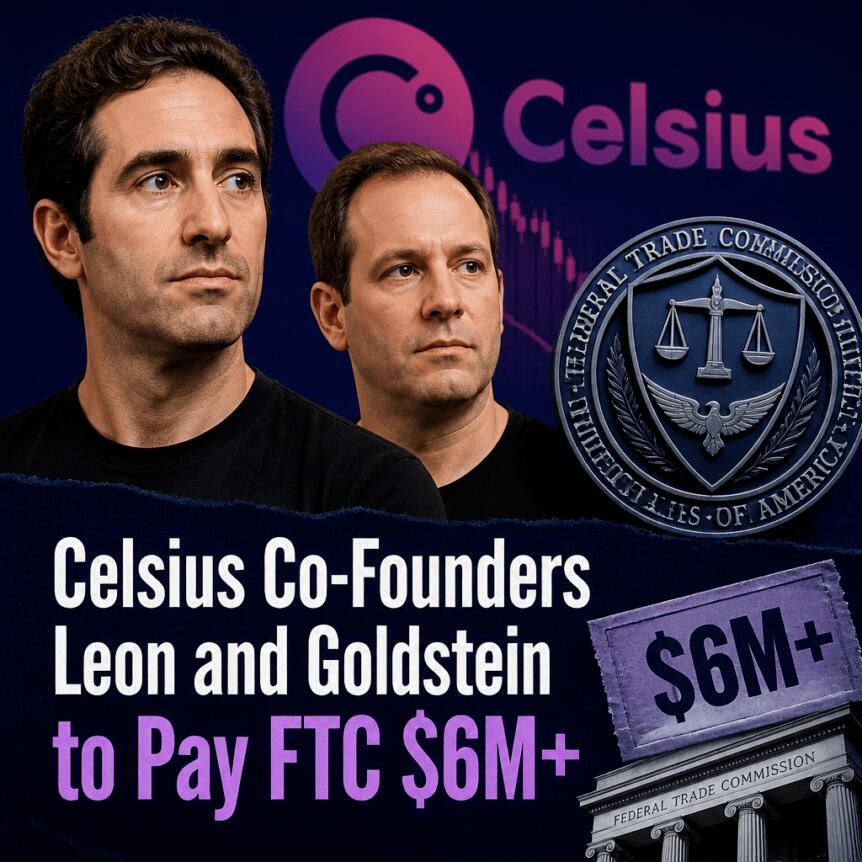
Federal regulators have extended the legal fallout from Celsius’ 2022 collapse by ordering two of the company’s former co-founders to pay more than $6 million to resolve Federal Trade Commission (FTC) allegations that they misrepresented the safety of the crypto lending platform.
On Monday, the FTC announced that Hanoch “Nuke” Goldstein, Celsius’ former chief technology officer, was ordered to pay $2.014 million. Shlomi Daniel Leon, the firm’s former chief strategy officer, was ordered to pay $4.1 million under a separate stipulated order entered on June 29.
Key takeaways
- Goldstein and Leon have been ordered to pay a combined $6.114 million to settle FTC consumer protection allegations tied to Celsius’ failure.
- The orders include marketing and sales bans affecting products or services that could be used to deposit, exchange, invest, or withdraw crypto assets.
- The FTC’s claims focus on alleged misstatements about Celsius’ reserves, insurance coverage, and whether loans were unsecured.
- The settlements build on a separate FTC resolution involving Alex Mashinsky, which already included a $10 million payment and a permanent marketing ban.
- Payments from the co-founders are also set to be credited against the FTC’s consumer-harm judgment tied to the case.
What the FTC says the co-founders got wrong
According to the FTC’s allegations, Celsius made assurances to customers about the platform’s financial safety that were not consistent with the company’s actual position as it moved toward bankruptcy. The regulator said Celsius falsely told customers it maintained sufficient reserves to satisfy withdrawal demands, claimed it had a $750 million insurance policy covering customer deposits, and represented that it did not issue unsecured loans.
The FTC further alleged that these public assurances persisted even shortly before the company’s collapse. As the agency put it in its statement Monday, the promises were allegedly false and “its top executives continued to claim that customers’ deposits were safe days before the company filed for bankruptcy.”
Goldstein and Leon are being held responsible for the misconduct the FTC described in connection with how Celsius marketed its operations during the period leading up to the shutdown.
Court-ordered bans restrict Celsius-related promotion and sales
Beyond the monetary payments, the FTC’s settlement terms also impose restrictions designed to limit future involvement in crypto custody and dealing workflows. The agency said the orders bar Leon from marketing or selling products or services that could be used to deposit, exchange, invest, or withdraw assets.
For Goldstein, the restrictions are similarly broad. The FTC’s statement Monday said Goldstein agreed to a ban on marketing or selling retail products or services that can be used to buy, sell, deposit, withdraw, distribute, or trade cryptocurrency.
“Similarly, Goldstein has agreed to a ban on marketing or selling retail products or services that can be used to buy, sell, deposit, withdraw, distribute or trade cryptocurrency.”
How the payments fit into the wider Celsius settlements
The settlements add another layer to the ongoing enforcement picture surrounding Celsius’ collapse and its impact on customers. The platform, which the settlement narrative places in a much larger consumer-harm context, held $25 billion in assets at its peak and owed $4.7 billion to users when it filed for bankruptcy in July 2022.
The FTC’s co-founder orders also relate directly to an earlier resolution involving Alex Mashinsky. In April, Mashinsky agreed to an FTC settlement that included a permanent ban from promoting asset-related products and a requirement to pay $10 million, alongside a broader, partially suspended $4.72 billion judgment.
In the current cases, the FTC said that the $2.014 million and $4.1 million payments from Goldstein and Leon, respectively, will be credited against the $4.72 billion judgment. That crediting mechanism is intended to prevent double-counting of consumer-harm-related penalties across related FTC outcomes.
Criminal case developments underscore the regulatory focus
While these are FTC consumer protection resolutions, other enforcement tracks have also advanced. Separately, US prosecutors have pursued criminal charges against Mashinsky. The filing timeline described in the source indicates Mashinsky pleaded guilty to commodities and securities fraud charges and was sentenced to 12 years in prison in May 2025.
Prosecutors, as described in the reporting referenced in the source, said he misled Celsius customers about the company’s profitability, investment risks, and the safety of customer funds. That criminal framing aligns with the FTC’s core theory in the co-founder cases: that customers were allegedly given assurances about safety and risk management that did not match reality.
For investors and industry participants, the practical takeaway is that Celsius-related enforcement is not confined to one executive or one courtroom. The FTC’s added restrictions on future marketing and sales of crypto asset-related products suggest regulators are targeting the ability of former insiders to re-enter similar distribution and promotion channels. Readers should watch whether additional Celsius-linked proceedings—civil or criminal—continue to expand the circle of accountability and how courts treat the scope of the marketing bans as the industry adapts to ongoing compliance demands.
https://www.cryptobreaking.com/celsius-co-founders-leon-and-2/?utm_source=blogger%20&utm_medium=social_auto&utm_campaign=Celsius%20Co-Founders%20Leon%20and%20Goldstein%20to%20Pay%20FTC%20$6M+%20
Comments
Post a Comment