
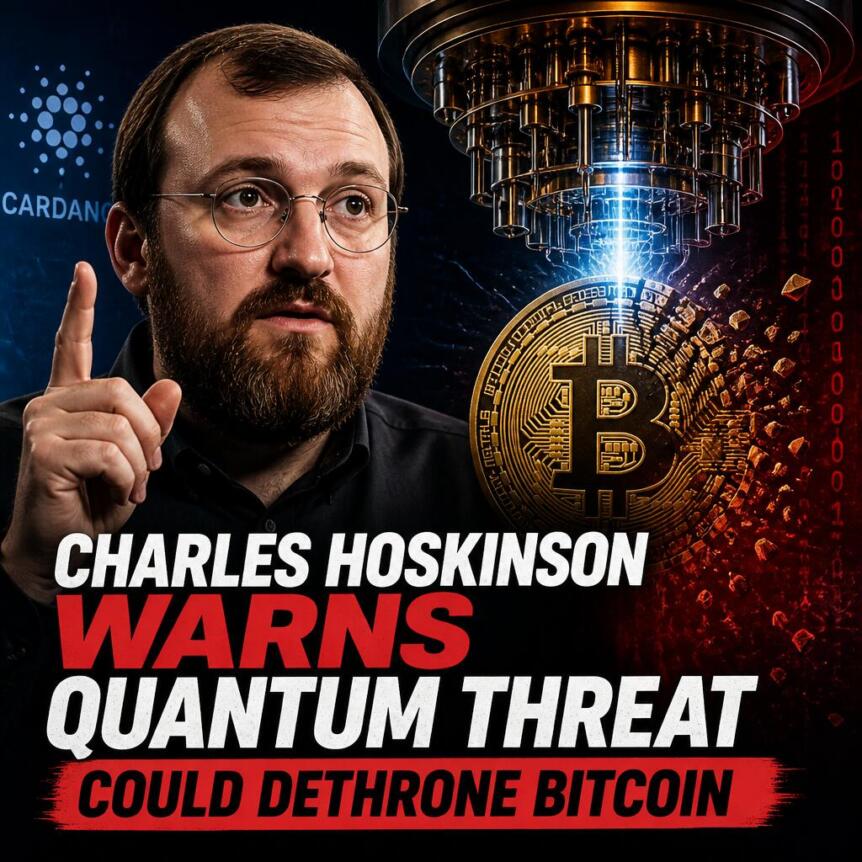
Cardano co-founder Charles Hoskinson has warned Bitcoin could lose its dominance if its governance system and community fail to coordinate a response to the quantum computing threat.
Bitcoin developers are already working on post-quantum solutions, including BIP 361, which proposes moving away from ECDSA and Schnorr signatures after a post-quantum system is selected.
Quantum Threat Could End Bitcoin Dominance
Hoskinson’s warning came during an interview with The Starting Block. The Cardano co-founder described Bitcoin as being “stuck in time” because any changes to the network require consensus across stakeholders including users, miners, node operators, and developers. According to Hoskinson, frustration with Bitcoin’s rigidity and inflexibility was one of the reasons behind the creation of Ethereum. Hoskinson was one of the original co-founders of Ethereum along with Vitalik Buterin. He stated during the interview, “The issue with Bitcoin is it’s frozen in time. It’s very difficult to change anything.”
Bitcoin uses elliptic-curve cryptography to prove the ownership of funds. Quantum computers, in theory, could decipher private keys from the public keys and authorize transactions without the owner’s knowledge or approval. Hoskinson believes the quantum threat could pose a major risk to the flagship cryptocurrency and its $1.3 trillion market capitalization, eventually stripping it of its dominance unless its governance mechanism adapts without impacting the qualities that give it value. “What made Bitcoin so strong is it survived external threats ... including the loss of its founder. Quantum computers are yet another threat ... if Bitcoin's governance is such that it's impossible actually to make meaningful progress, or they compromise the core reason to use Bitcoin, I don't think Bitcoin's going to stay the number one cryptocurrency.”
Cardano Better Equipped for Technical Threats
Hoskinson argued that Cardano’s formal on-chain governance and ability to approve upgrades make it better at responding to threats like the one confronting Bitcoin.
“Cardano is, in many ways, a spiritual successor . It reflects correcting a lot of things that I think that Satoshi couldn’t get around to because of expertise or time but was directionally moving there.”
Cardano moved to full community governance after the Plomin hard fork in January 2025. ADA token holders can vote or delegate their vote to representatives called DReps. A constitutional committee and stake pool operators also participate in key decisions. This system helps Cardano approve hard forks and treasury decisions on-chain. Hoskinson argued that Cardano could use the system to vote on migrating away from quantum-vulnerable infrastructure.
Hoskinson added that Cardano is preparing for its largest upgrade, which would make the network “60-times faster.”
Not a Perfect System
However, Cardano has yet to undertake or complete such a migration because its governance system must evaluate technical designs, approve funding, and organize users, developers, and service providers. Cardano’s governance system has also witnessed several disputes. Cardano delegates recently rejected and challenged several proposals linked to Hoskinson and Input Output, including a proposal to research Leios scaling and quantum-resistant cryptography.
Bitcoin Developers Exploring Post-Quantum Options
Bitcoin’s governance allows developers to propose code. However, users and node operators decide on its implementation. Miners, exchanges, and wallet providers also influence decision-making. While this helps avoid frequent changes, it makes urgent coordination difficult. The community is tracking BIP-361, a proposal that phases out legacy ECDSA and Schnorr signatures to protect the network against the quantum threat. Several other proposals are also under consideration, including ones advocating new address formats, hybrid signatures, and recovery paths.
However, any measure will require wallets, exchanges, custodians, and dormant holders to migrate their funds without splitting the network or creating conflicting ownership rules.
Disclaimer: This article is provided for informational purposes only. It is not offered or intended to be used as legal, tax, investment, financial, or other advice.
https://www.cryptobreaking.com/charles-hoskinson-warns-quantum-threat/?utm_source=blogger%20&utm_medium=social_auto&utm_campaign=Charles%20Hoskinson%20Warns%20Quantum%20Threat%20Could%20Dethrone%20Bitcoin%20
Comments
Post a Comment