
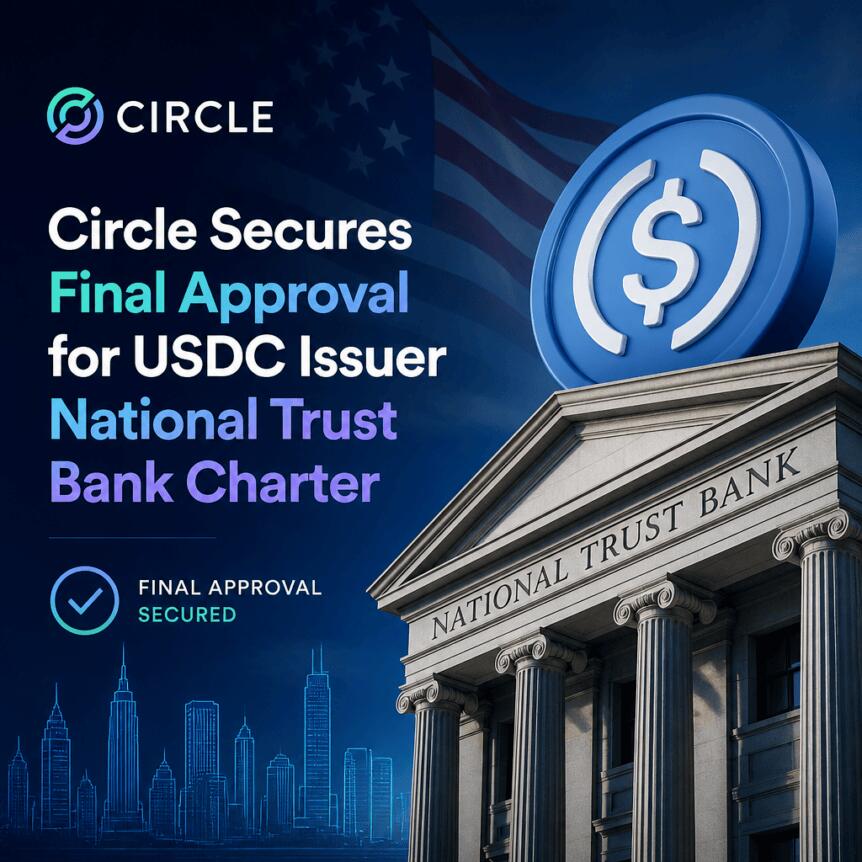
USDC stablecoin issuer Circle has received final approval from the US Office of the Comptroller of the Currency (OCC) to establish First National Digital Currency Bank (FNDCB), a national trust bank that will operate under the name Circle National Trust. The OCC’s decision marks a significant step toward bringing Circle’s custody and trust-related services into a federally regulated banking structure.
Circle said the approval, announced Friday, follows its application for the national trust bank charter in June 2025. Circle CEO Jeremy Allaire called it “a defining step in bringing blockchain technology and digital assets into the core of the US financial system,” according to the company’s press release: https://www.circle.com/pressroom/circle-receives-final-occ-approval-to-establish-national-trust-bank.
Key takeaways
- Circle received final OCC approval to create Circle National Trust, a national trust bank.
- The bank’s initial mandate focuses on fiduciary digital asset custody for Circle and affiliated companies.
- Circle National Trust may later extend services to a limited set of institutional customers if demand grows.
- The structure could, in future, support management of the USDC Reserve under federal oversight, depending on implementation.
From charter application to OCC final approval
Circle’s new bank is the culmination of a charter process that began when the company applied for the national trust bank charter in June 2025, according to Circle’s earlier filing and subsequent updates. In Friday’s announcement, Circle framed the OCC approval as an important regulatory milestone for its broader effort to embed USDC infrastructure within mainstream financial oversight.
While the approval itself is a clear authorization step, the scope of what Circle National Trust can do—at least at launch—remains tightly defined by the bank’s approved business plan. That distinction matters for investors and counterparties because the earliest stage will likely concentrate on internal and affiliate custody needs before widening to external clients.
What Circle National Trust will do at launch
According to Circle’s approved business plan, Circle National Trust will initially offer fiduciary digital asset custody services for Circle and its affiliated companies. This “start limited” approach is common when new regulated entities begin operations, especially when they involve specialized services like digital asset custody.
Circle also indicated it could later expand services to a limited group of institutional customers. That potential expansion includes banks and other financial institutions, such as regulated derivatives firms, if demand develops. In other words, the bank is not positioned as a broad retail custodian from day one; rather, it appears designed to support institutional workflows connected to regulated capital markets.
The structure additionally creates a pathway—if implemented—to manage the USDC Reserve within a trust bank framework, bringing those operations under federal oversight. Circle did not provide further implementation details in the announcement, but the possibility is a key point because USDC’s reserve management is central to stablecoin credibility and operational risk controls.
Circle’s expanding regulatory footprint
Circle’s OCC approval adds another layer to a regulatory build-out that has already included multiple jurisdictions. The company said it was the first firm to receive a BitLicense from the New York Department of Financial Services in 2015. It also stated it became the first global stablecoin issuer to comply with the European Union’s MiCA (Markets in Crypto-Assets) framework in 2024, aligning its operations with a more comprehensive EU stablecoin regime.
Circle has also pointed to approvals in other markets, including the United Kingdom, Singapore, Bermuda, Canada, and Abu Dhabi, as it continues to scale its USDC infrastructure globally.
For market participants, this multi-region regulatory record is relevant because it suggests Circle is pursuing a “compliance-first” model across major financial jurisdictions. The US trust bank approval, in that context, is a move from sector-specific and cross-border oversight toward a deeper integration with US banking supervision.
The company previously worked on expanding how USDC can be minted and used through traditional banking channels; Cointelegraph reported on Standard Chartered and Circle bringing USDC minting onto banking rails, reflecting an ongoing effort to connect stablecoin issuance and distribution to regulated financial infrastructure.
Why the timing and structure could matter for USDC
USDC’s role in crypto markets depends not only on its liquidity, but also on how its infrastructure is supervised and operationalized. A federally regulated trust bank structure can potentially strengthen institutional confidence by formalizing custody-related functions within a banking oversight framework.
At the same time, it’s important to separate the approval from the eventual operational outcomes. Circle National Trust’s initial custody scope is limited to Circle and affiliated companies, and any future handling of the USDC Reserve would depend on later implementation. That means the most immediate impact may be internal—while the broader institutional-facing effects could arrive later if Circle expands its customer base as indicated.
Markets react as Circle shares move higher
Circle Internet Group’s stock (CRCL) rose roughly 16% in pre-market trading on Friday after the announcement, according to Yahoo Finance data, climbing above $73 after closing the previous session at $63: https://finance.yahoo.com/quote/CRCL/.
Stablecoin demand and overall crypto market activity remain key drivers for USDC, and the token’s scale provides additional context. At the time of publication, USDC was described as the second-largest stablecoin by market capitalization at $73.3 billion, according to CoinGecko. CoinGecko data cited in the source indicated its market cap increased 16.7% over the past year, while declining 2.5% year-to-date (as reported in the original article).
Investors and institutional users will likely watch two things next: whether Circle National Trust expands its custody services beyond affiliated entities, and whether Circle moves forward with any plan to bring USDC Reserve management under the bank’s federally supervised structure. Both developments could shape how quickly USDC infrastructure deepens its integration with traditional financial systems.
https://www.cryptobreaking.com/circle-secures-final-approval-for/?utm_source=blogger%20&utm_medium=social_auto&utm_campaign=Circle%20Secures%20Final%20Approval%20for%20USDC%20Issuer%20National%20Trust%20Bank%20Charter%20
Comments
Post a Comment