
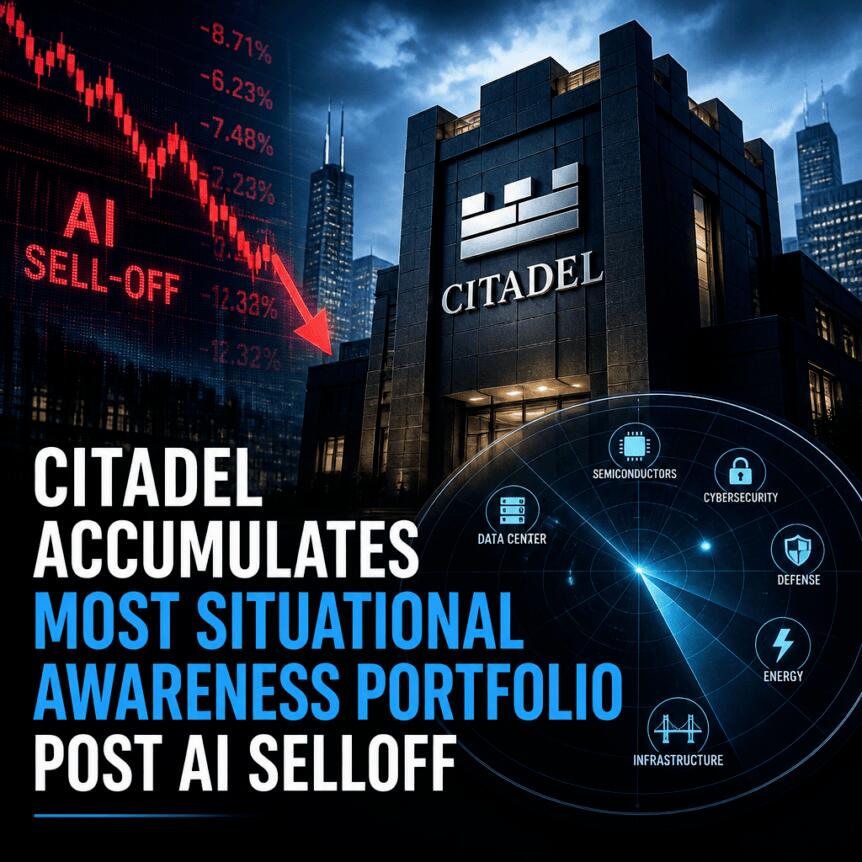
Ken Griffin’s Citadel has reportedly stepped in to buy a large portion of the publicly traded stock portfolio of Situational Awareness, the hedge fund run by former OpenAI researcher Leopold Aschenbrenner. The deal comes after steep losses tied to last month’s broad selloff in AI-linked equities.
According to the Financial Times, Citadel purchased the discounted portfolio after Situational’s performance deteriorated in July’s AI stock rout. Earlier reporting from The Wall Street Journal indicated Situational fell about 67% during July, even as it was still up roughly 80% for the year at the time of a letter sent to investors.
Key takeaways
- Citadel reportedly bought much of Situational Awareness’s publicly traded equity portfolio after major July losses in AI-linked stocks.
- Reports cite liquidity pressure, including the need to handle lender margin calls, though Reuters could not confirm whether formal margin calls were issued before certain share sales.
- SEC filings show Situational held public stakes in AI-adjacent names such as Sandisk, CoreWeave-related exposure, and Bloom Energy as of March 31, alongside a sizable Bitcoin mining share portfolio.
- It remains unclear which exact holdings were included in the Citadel transaction and whether any of the miner positions were retained.
From AI selloff to portfolio sale
The reported acquisition follows a sharp equity drawdown that hit hedge funds concentrated in AI infrastructure and related trades. The Financial Times said Citadel bought the portfolio at a discount after Situational Awareness suffered heavy losses during July’s AI stock market rout.
The sequence of events described by major outlets suggests liquidity became the limiting factor. The Wall Street Journal reported that Situational needed cash to meet margin calls from its lenders. In that account, the fund agreed late Wednesday to sell $3.5 billion of Anthropic shares to a group led by Greenoaks and Sequoia Capital, but then withdrew from the deal after agreeing terms for a Citadel-led portfolio transaction.
Reuters separately reported that Citadel bought most of Situational’s stock holdings after the AI share rout and described details of the leveraged portfolio and share sales. Reuters also stated it could not determine whether formal margin calls had been issued before the Anthropic-related sale discussions. Reuters added that Situational retained about $10 billion in stocks and private investments, including exposure to Anthropic.
What July losses looked like in holdings
Several stocks connected to Situational Awareness’s portfolio reportedly dropped sharply during July. Yahoo Finance data cited in the coverage shows Sandisk down about 44% for the month even after closing Thursday up 26%. CoreWeave was down nearly 26% in July, while Bloom Energy fell around 32%, according to the same dataset.
While those monthly declines underline how concentrated positions can magnify market stress, they also illustrate why a portfolio sale at “discounted” terms can become attractive to a counterparty—particularly when pricing dislocations occur across an entire thematic trade rather than a single company-specific issue.
SEC filings point to AI infrastructure and Bitcoin mining exposure
Situational Awareness’s U.S. Securities and Exchange Commission filing reportedly shows direct share positions in at least three companies—Sandisk, CoreWeave, and Bloom Energy—as of March 31. The SEC document is used to ground the public-equity portion of the story, including what was held before July’s drawdown.
The same filing also showed approximately $1.11 billion in shares of seven Bitcoin (BTC) mining companies, including Iren, Core Scientific, Riot Platforms, and CleanSpark. Cointelegraph previously reported that the strategy involved miner exposure that could benefit from demand for AI and high-performance computing by repurposing power supplies and data center sites.
In this round of reporting, however, the critical open question for investors is scope: it is not clear which specific stocks were included in the Citadel transaction, and it remains uncertain whether Situational retained any of its Bitcoin miner positions after the sale of the public stock portfolio.
Why the trade may signal shifting leverage risk
Across hedge fund industry coverage, the theme in situations like this is rarely the long-term thesis of an investor—it’s how leverage and collateral requirements interact with fast-moving equity markets. The reporting around margin calls and the need for cash suggests the fund’s ability to keep positions through volatility was constrained.
At the same time, the asymmetry between what is publicly visible and what is financially decisive remains. Reuters’ note that it could not confirm whether formal margin calls had been issued before certain transactions highlights the limits of what outsiders can verify in real time—especially when term sheets, lender discussions, and collateral mechanics are involved.
For readers tracking crypto-adjacent strategies, the story also underscores that “AI” and “crypto infrastructure” exposures are increasingly intertwined. Situational’s reported combination of AI-linked equity holdings and Bitcoin miner stock exposure reflects a broader market reality: demand for power, computing, and deployment of infrastructure can connect traditional equity investing, AI narratives, and crypto mining businesses.
Watch items after the reported deal
Investors should watch for further clarity on which holdings Citadel acquired, whether Situational retained any miner positions, and how the fund’s remaining $10 billion of reported stocks and private investments evolve after July’s volatility. Until additional filings or confirmations arrive, the practical takeaway remains straightforward: when leverage meets thematic drawdowns, portfolio exits can happen quickly—even for funds that may still look strong over a longer time horizon.
https://www.cryptobreaking.com/citadel-accumulates-most-situational-awareness/?utm_source=blogger%20&utm_medium=social_auto&utm_campaign=Citadel%20Accumulates%20Most%20Situational%20Awareness%20Portfolio%20Post%20AI%20Selloff%20
Comments
Post a Comment