
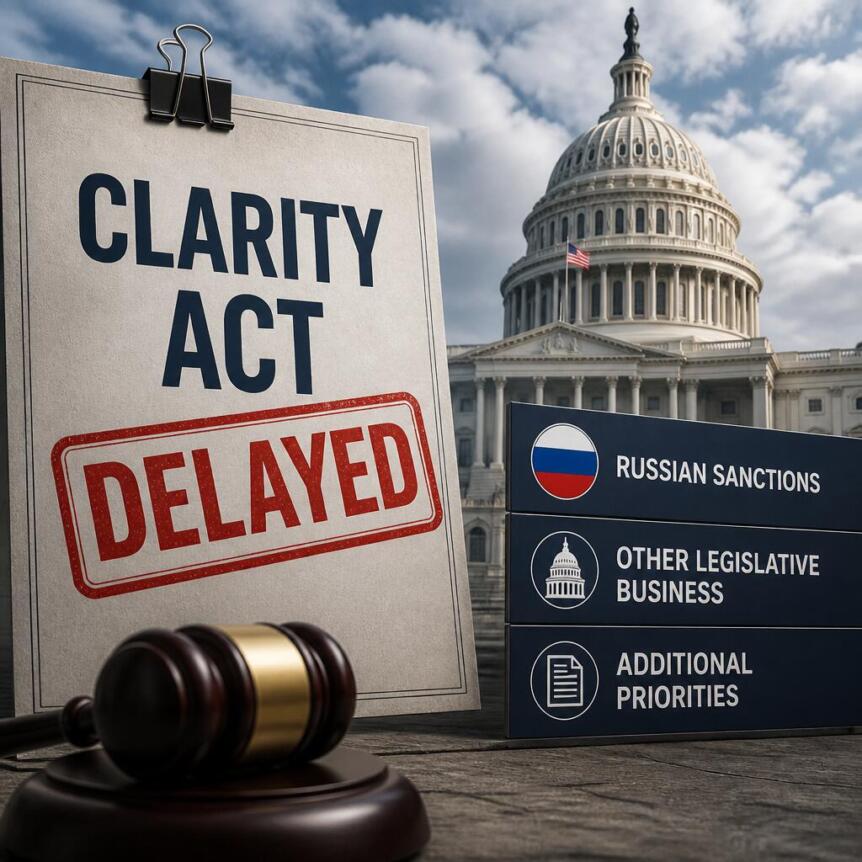
The CLARITY Act is facing another delay as US lawmakers prioritize federal nominations, a Russian sanctions package, and other legislative business ahead of its summer recess.
The development makes it increasingly likely the bill will not be deliberated upon during the ongoing session and will be discussed during the autumn session.
Clarity Act Faces Another Delay
The United States Senate has put the CLARITY Act on the back burner as it debates federal nominations, new sanctions against Russia, and other legislative business. According to a CoinDesk report, the bill is unlikely to be taken up by the Senate before its summer recess on August 8. Journalist Eleanor Terrett revealed that the Senate leadership is discussing deliberations beyond the planned recess if they can garner enough votes to invoke cloture and press ahead with the bill. Additionally, some senators also want a vote on the SAVE America Act and Russia-Iran sanctions.
Terrett stated on X,
“A must-read on the Senate math behind the Clarity Act without the hype. I reported this morning that Senate leadership has discussed potentially keeping members in Washington beyond the scheduled recess if they have the votes to invoke cloture on the motion to proceed.”
Democratic lawmakers remain hopeful of a compromise banning senior government officials, including President Donald Trump, from investing in crypto projects.
A Procedural Delay
However, the delay is not due to Republicans and Democrats failing to agree upon the way forward. Senate Majority Leader John Thune has prioritized discussion on the Russian sanctions package, and Senate rules outline that only one contested bill can be considered at a time. Additional Senate business has also reduced floor time. As a result, lawmakers have found it difficult to discuss the CLARITY Act during the ongoing session.
Meanwhile, SEC Chair Paul Atkins reiterated his belief that the Senate will pass the CLARITY Act. Atkins added that the SEC is ready to create rules to implement the bill once it becomes law. He added that it can also address market issues if Congress delays the bill. However, the SEC Chair stressed the importance of regulatory clarity to “future-proof” crypto in the US.
President Trump Can Reconvene Senate
According to legal analyst MetaLawman, Article II, Section 3 grants President Trump the authority to reconvene the Senate during the August recess, allowing lawmakers to vote on the CLARITY Act and other delayed bills.
“President Trump Has Legal Authority to CANCEL THE SENATE RECESS. The President has the Constitutional authority to call an “extraordinary session” of the Senate to vote on the SAVE AMERICA ACT and the CLARITY ACT.”
However, as things stand, a final Senate vote on the CLARITY Act looks unlikely before next week.
How The Delay Impacts Crypto
The CLARITY Act is a crucial piece of legislation for the cryptocurrency industry. If it fails to advance during the ongoing session, it could face a substantial delay as lawmakers focus on other priorities in upcoming sessions, including election-related legislation. The delay effectively leaves the industry in limbo, with only the GENIUS Act offering some regulatory clarity. For now, the industry will rely on SEC and CFTC oversight while waiting for the bill to pass.
Disclaimer: This article is provided for informational purposes only. It is not offered or intended to be used as legal, tax, investment, financial, or other advice.
https://www.cryptobreaking.com/clarity-act-delayed-again-as/?utm_source=blogger%20&utm_medium=social_auto&utm_campaign=Clarity%20Act%20Delayed%20Again%20As%20US%20Senate%20Prioritizes%20Russian%20Sanctions,%20Other%20Legislative%20Business%20
Comments
Post a Comment