
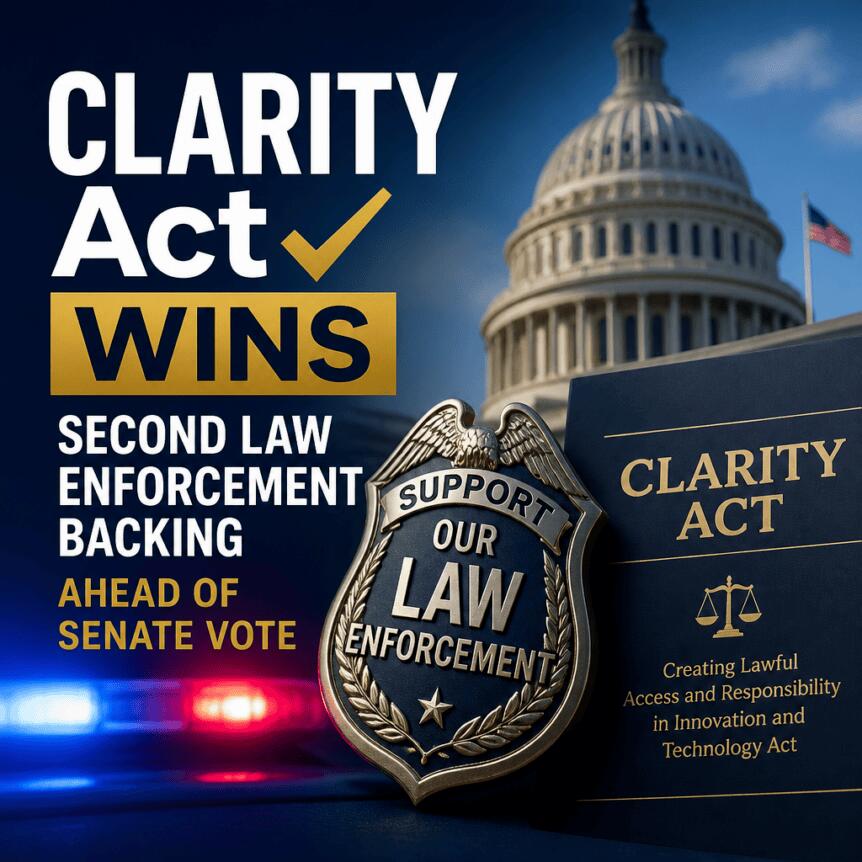
The Digital Asset Market Clarity Act, commonly known as the CLARITY Act, is gaining momentum in the US as a second major law enforcement organization publicly endorses the bill ahead of a critical Senate deadline. The Federal Law Enforcement Officers Association (FLEOA) said it submitted a letter to the Senate Banking Committee supporting the legislation, while urging targeted revisions—particularly around how decentralized finance (DeFi) protections are structured and how accountability is defined.
FLEOA’s July 10 endorsement arrives after earlier backing from the National Organization of Black Law Enforcement Executives (NOBLE) and comes as lawmakers weigh whether the bill can clear Congress before the Senate’s August recess. Industry observers have framed the recess period as a potential make-or-break window for final action this year.
Key takeaways
- FLEOA has endorsed the CLARITY Act in a letter to the Senate Banking Committee, calling it progress toward balancing innovation and public safety.
- The association supports the bill’s consumer-protection goals but wants changes to narrow DeFi-related protections and clarify who is accountable in decentralized systems.
- Law enforcement groups have previously raised concerns that portions of the bill—especially around developer liability—could create overly broad exemptions that hinder investigations.
- The timing is tight, with the Senate’s Aug. 8 recess cited as a key milestone for whether the legislation can pass this year.
Second endorsement—support with conditions
In its statement, FLEOA characterized the current CLARITY Act draft as “meaningful progress” toward establishing a regulatory framework for digital assets while preserving authorities needed to combat crime. The organization said the legislation should maintain existing capabilities related to criminal enforcement, anti-money laundering, counterterrorism financing, sanctions enforcement, and investigative work.
At the same time, FLEOA emphasized that lawmakers should refine specific DeFi provisions. According to FLEOA’s recommendations, the bill’s DeFi protections should be narrowed, clearer accountability should be established for participants within decentralized finance systems, and the legislation should prevent entities from avoiding regulation simply by portraying themselves as decentralized.
FLEOA also asked Congress to adjust the “specific intent” language to make liability easier to establish, and to explicitly confirm that the CLARITY Act does not limit existing federal investigative authority. The request reflects a core tension that has followed the bill through prior negotiations: how to protect legitimate innovation without inadvertently creating gaps that prosecutors and investigators could struggle to navigate.
Crypto Council CEO Ji Kim linked FLEOA’s support to a broader argument that the bill strengthens consumer protection and preserves law enforcement effectiveness, noting the endorsement in a public statement Monday.
Why law enforcement scrutiny has mattered
The fresh FLEOA letter lands on the heels of earlier objections from law enforcement organizations that challenged parts of the CLARITY Act—particularly around developer liability for misuse by users on decentralized platforms.
Earlier reporting highlighted that in June, four law enforcement organizations contacted the White House with concerns centered on Section 604, which aims to protect developers from liability tied to illicit activity conducted by users on decentralized networks. The organizations argued that the language, as written, might function as a broad exemption, potentially complicating investigations into crypto-related crime.
Those concerns prompted attention within the administration. The White House invited law enforcement groups objecting to the bill’s language to a late-June meeting—an indication that the disputes were not merely academic. In July, the Major County Sheriffs of America shifted from opposition to neutrality, reflecting that negotiations and proposed changes were actively shaping positions across law enforcement.
FLEOA’s new letter suggests that—while support for the CLARITY Act is increasing—there remains a category of legal uncertainty that enforcement advocates want addressed before the bill locks in. For investors, traders, and builders, the practical effect is straightforward: the scope of developer protection and the definition of responsibility in DeFi can influence how compliance strategies, product design, and risk management decisions are made.
What the Senate deadline means for prospects
FLEOA’s endorsement also underscores the political urgency surrounding the CLARITY Act. The letter was released less than four weeks before Aug. 8, when the Senate is expected to recess. According to Senator Cynthia Lummis, the window to pass a digital assets bill could be limited this year, warning that failure to enact meaningful legislation could leave rulemaking to other jurisdictions and prolong uncertainty for US market participants.
For the crypto sector, the legislative calendar matters not just for timelines, but for predictability. When a bill is approaching a recess, negotiations often compress: controversial language becomes more difficult to rewrite in depth, and stakeholders may shift their focus toward narrower edits rather than sweeping redesigns.
That dynamic helps explain why the FLEOA letter emphasizes targeted adjustments rather than a fundamental withdrawal of support. The group is signaling that it can back the overall approach—while still pushing for clarifications that could reduce enforcement friction later.
DeFi protections and accountability: the remaining fault line
At the heart of FLEOA’s requests is the question of how the CLARITY Act treats decentralized systems in practice. Supporters of the bill have argued that rules should recognize technological realities and avoid punishing developers for actions they do not control. Enforcement advocates, however, have warned that overly protective language could unintentionally insulate individuals or firms whose conduct resembles regulated activity—even if marketing or structural claims point toward decentralization.
FLEOA’s call to narrow DeFi protections and clarify accountability is therefore not just legal fine-tuning. It goes directly to whether investigators can build cases effectively, and whether compliance obligations remain aligned with operational control and influence.
Equally important is FLEOA’s emphasis on “specific intent” language and an explicit preservation of existing investigative authority. In legislative drafting, intent requirements can determine what must be proven in court. Changes here can shift burdens of proof and affect litigation risk for market participants.
What remains unclear—until lawmakers see the evolving text—is the balance Congress will strike between encouraging responsible development and ensuring that decentralization claims cannot be used as a shield against enforcement. Readers should watch whether forthcoming amendments address the specific points raised by FLEOA and other law enforcement organizations, or whether compromises keep the legislation’s enforcement implications ambiguous.
With the Senate’s August recess approaching, the next steps will likely hinge on how quickly the committee can incorporate these requested revisions into a final bill text—and whether additional groups move toward alignment or raise new objections as the calendar tightens.
https://www.cryptobreaking.com/clarity-act-wins-second-law/?utm_source=blogger%20&utm_medium=social_auto&utm_campaign=CLARITY%20Act%20Wins%20Second%20Law%20Enforcement%20Backing%20Ahead%20of%20Senate%20Vote%20
Comments
Post a Comment