
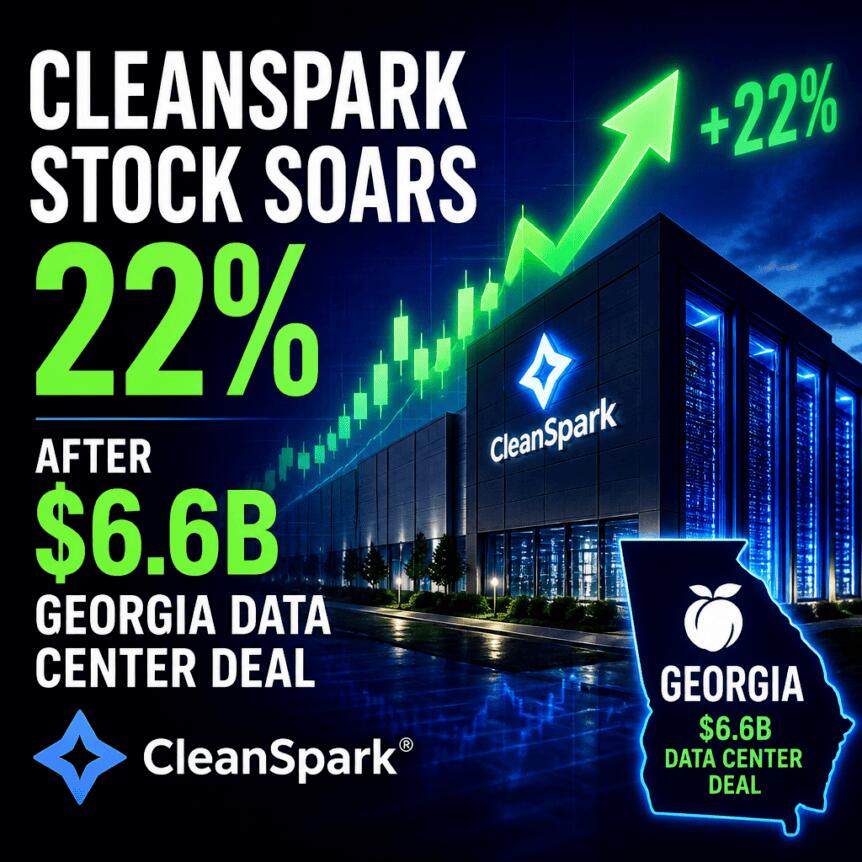
CleanSpark shares jumped sharply on Tuesday after the Bitcoin miner disclosed a long-term deal that ties up large-scale power and real-estate capacity for a new data center in Georgia. The company said it signed a 20-year triple-net lease for a 175-megawatt facility at its Sandersville, Georgia campus—one of the clearest examples yet of miners moving beyond pure block-reward economics and into broader digital infrastructure.
The agreement, CleanSpark said, is expected to generate about $6.6 billion in contracted revenue over the initial 20-year term, with revenue rising to $11.6 billion if the tenant exercises two five-year extension options. The tenant will install computing infrastructure on-site, and phased deliveries are expected to start in the fourth quarter of 2027.
Key takeaways
- CleanSpark announced a 20-year triple-net lease for a 175-megawatt data center at its Sandersville, Georgia campus.
- The company estimates $6.6 billion in contracted revenue over the initial term, potentially increasing to $11.6 billion with two five-year extensions.
- Infrastructure deliveries are expected to begin in Q4 2027, giving the project a multi-year timeline rather than near-term revenue.
- The announcement highlights how miners are responding to post-halving margin pressure by securing longer-duration capacity demand—particularly from AI and high-performance computing.
- CleanSpark is also positioning itself as a continuing Bitcoin holder even as it diversifies into data-center business lines.
A data-center play built around contracted capacity
CleanSpark’s stated objective is to broaden its revenue base while leveraging the industrial footprint it already controls. Under the lease terms, a tenant—described by CleanSpark only as an undisclosed “investment-grade global technology company”—will deploy computing infrastructure at the Sandersville site, with phased delivery starting in the fourth quarter of 2027.
Triple-net lease structures typically place more operating-cost responsibilities on the tenant, which can matter to investors focused on predictability. Even so, the timing underscores a central point for the market: this is not a near-term catalyst designed to instantly offset mining volatility. Instead, it is a long-dated demand commitment that can strengthen CleanSpark’s infrastructure narrative as AI compute requirements drive new buildouts.
Why miners are chasing new revenue after the halving
Miners have been under renewed financial strain since the 2024 Bitcoin halving, when block rewards declined and competitive pressure tightened. CleanSpark’s own recent results reflect how sensitive mining economics remain to Bitcoin price movements and operating margins.
In March, the company reported a fiscal second-quarter net loss of $378 million, with nearly 60% attributed to a drop in Bitcoin’s price. Earlier, in February, CleanSpark also sold a portion of its BTC holdings—an indication that liquidity and balance-sheet flexibility continue to play a role in how miners fund operations and expansion plans.
Still, CleanSpark’s approach appears less aggressive than some peers. Cointelegraph previously reported that publicly traded miners sold roughly 15,000 BTC between October and the end of February, even as the sector struggled with margins and liquidity needs. Against that backdrop, CleanSpark has remained a net accumulator while simultaneously exploring ways to monetize its infrastructure beyond mining.
Equities react as the market prices diversification
Tuesday’s announcement translated into immediate stock momentum. CleanSpark shares reached an intraday high of $15.10 before paring gains during the U.S. lunch hour. At the time of reporting, the stock was up about 11%, while the CoinShares Bitcoin Miners ETF (WGMI) was up less than 1%.
That divergence suggests investors are treating the data-center lease as something more than routine corporate expansion. For equity holders, the appeal is straightforward: contracted infrastructure revenue can, in theory, reduce dependence on the day-to-day volatility of mining economics. It also positions CleanSpark within the broader “digital infrastructure” stack that increasingly benefits from high-performance computing demand.
What’s next for CleanSpark and the infrastructure thesis
Even with the long-term lease in place, mining performance and BTC exposure remain central to how the company is valued. CleanSpark is expected to report fiscal Q3 results on Aug. 6, with analyst consensus calling for a loss of $0.25 per share versus earnings of $0.79 in the year-ago period, according to Yahoo Finance. The company has also missed Wall Street estimates in each of the last three quarters.
Going forward, investors will likely watch whether CleanSpark can convert its infrastructure plans into measurable financial improvements over time—while also continuing to manage the impact of Bitcoin price swings and ongoing pressure on miner margins. The lease provides a longer runway, but the key test will be execution: tenant commitments, delivery milestones expected to begin in Q4 2027, and whether the company’s diversification meaningfully cushions future mining results.
https://www.cryptobreaking.com/cleanspark-stock-soars-22-after/?utm_source=blogger%20&utm_medium=social_auto&utm_campaign=CleanSpark%20Stock%20Soars%2022%%20After%20$6.6B%20Georgia%20Data%20Center%20Deal%20
Comments
Post a Comment