
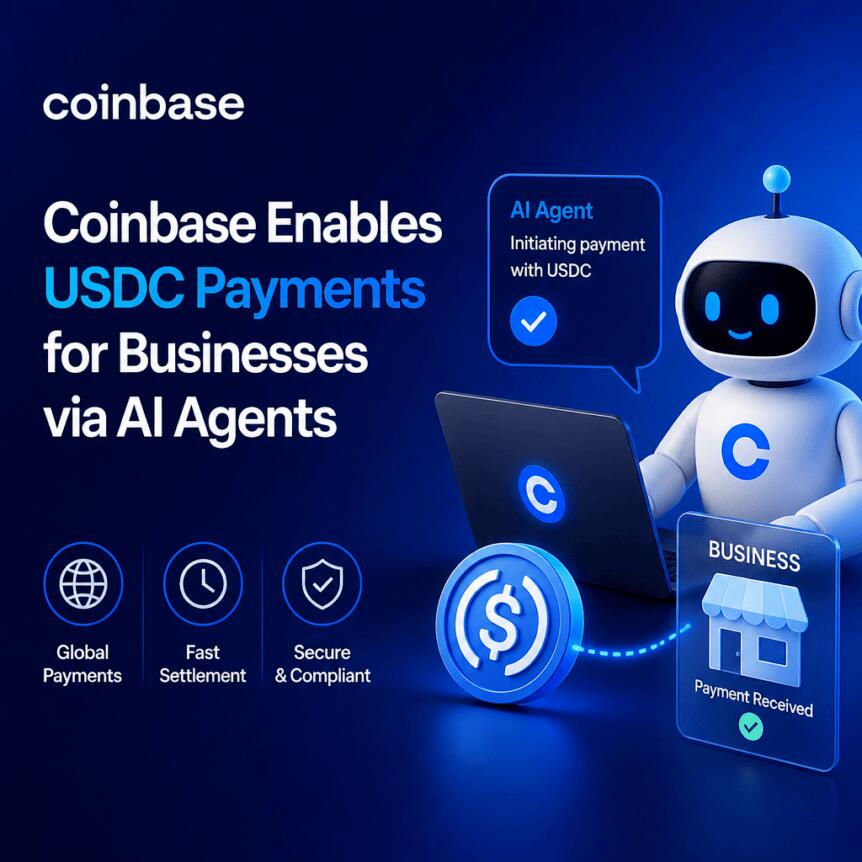
Coinbase is rolling out new infrastructure aimed at “agentic” finance, expanding its business tools so companies can accept stablecoin payments from autonomous AI agents. The move centers on USDC transfers using the x402 payment standard, an HTTP-based approach introduced by Coinbase earlier this year to make stablecoin payments workable for agents, applications, and APIs.
In an announcement posted to X on Thursday, Coinbase said its Business customers will be able to receive USDC payments from AI agents through x402, alongside new AI trading capabilities that allow users to monitor orders, pull live market data, and trigger actions based on predefined conditions.
Key takeaways
- Coinbase Business will support receiving USDC payments from AI agents via the x402 standard.
- x402 was launched in May 2025 to enable stablecoin payment workflows over HTTP for agent and developer use cases.
- The update also includes AI trading tools for order monitoring, live market data access, and condition-based execution.
- Coinbase frames the changes as part of broader infrastructure needed for autonomous agents to manage payments and finance.
- The rollout arrives as exchanges and payment firms increasingly market stablecoins and blockchain payments for AI agent ecosystems.
USDC payments for AI agents through x402
The practical heart of Coinbase’s update is x402, a payment standard designed to connect stablecoin payment flows with common internet protocols. According to Coinbase’s announcement, the company will enable Coinbase Business users to accept USDC payments initiated by AI agents through x402.
Coinbase first introduced x402 in May 2025, positioning it as a way to support stablecoin payments over HTTP for AI agents, software applications, and APIs. By placing USDC payment acceptance behind a developer-friendly standard, Coinbase is effectively lowering the friction for businesses that want to integrate with agent-driven commerce without relying on traditional, human-centric payment workflows.
Beyond payments: AI trading tools and a developer kit
Coinbase’s Thursday post did not limit the announcement to payments alone. The company also previewed AI trading tools intended to give users more automated control over trading operations. Coinbase said users will be able to monitor orders, access live market data, and execute actions when predetermined conditions are met.
For developers, Coinbase additionally described a software development kit (SDK) for building agent-powered applications. That matters because payments and trading are only useful to autonomous systems if they can be integrated reliably into software. An SDK paired with an HTTP-based payment standard suggests Coinbase is aiming to make agent integrations more repeatable for teams building real products—not just demonstrations.
Why Coinbase says the “agentic economy” needs new infrastructure
Coinbase framed the initiative as support for the “agentic economy,” where AI agents can perform tasks such as making payments and managing finances on behalf of users. The company’s argument is that the existing financial internet was designed around a human making choices through interfaces—clicking buttons, confirming actions, and manually initiating steps.
Coinbase also pointed to an adoption signal: it said agent-generated traffic on its Base documentation pages surpassed human traffic for the first time last month. While that doesn’t automatically prove consumer adoption, it does underline a shift in how developers and systems are interacting with technical resources—an important backdrop for tools that are meant to be used programmatically by agents rather than by people.
At the same time, Coinbase acknowledged the gap it’s trying to close: financial infrastructure built on the assumption of human button-clicks leaves businesses, developers, and users without tooling designed for AI agents to act autonomously in payment and finance workflows.
Stablecoins and blockchain payments move closer to agent workflows
The Coinbase announcement lands as the broader industry increasingly treats stablecoins and blockchain-based payments as infrastructure for AI agents. The announcement explicitly points to this trend, noting that stablecoin payments are being marketed for emerging autonomous agent ecosystems.
Earlier coverage from Cointelegraph has highlighted the growing interest from exchanges and payment companies in agent-focused commerce. In particular, Cointelegraph previously reported on an OKX AI marketplace narrative aimed at an “autonomous agent economy,” as well as Crossmint’s initiatives tying agent-driven experiences to card payment rails.
What’s notable in Coinbase’s approach is the emphasis on a standardized, API-friendly payment method. Instead of treating payments as a black-box checkout flow, Coinbase is attempting to make payment acceptance compatible with agent decision-making—especially when agents need to initiate transfers and coordinate actions without a human in the loop.
What to watch next
For businesses considering agent integrations, the next questions are likely to be practical: how widely x402 support is rolled out, what implementation details developers will need to adopt the standard for USDC acceptance, and how Coinbase’s condition-based AI trading tools perform for real workflows. As agent traffic grows, the value of these updates will hinge on reliability and ease of integration for payments and execution beyond documentation and pilots.
https://www.cryptobreaking.com/coinbase-enables-usdc-payments-for/?utm_source=blogger%20&utm_medium=social_auto&utm_campaign=Coinbase%20Enables%20USDC%20Payments%20for%20Businesses%20via%20AI%20Agents%20
Comments
Post a Comment