
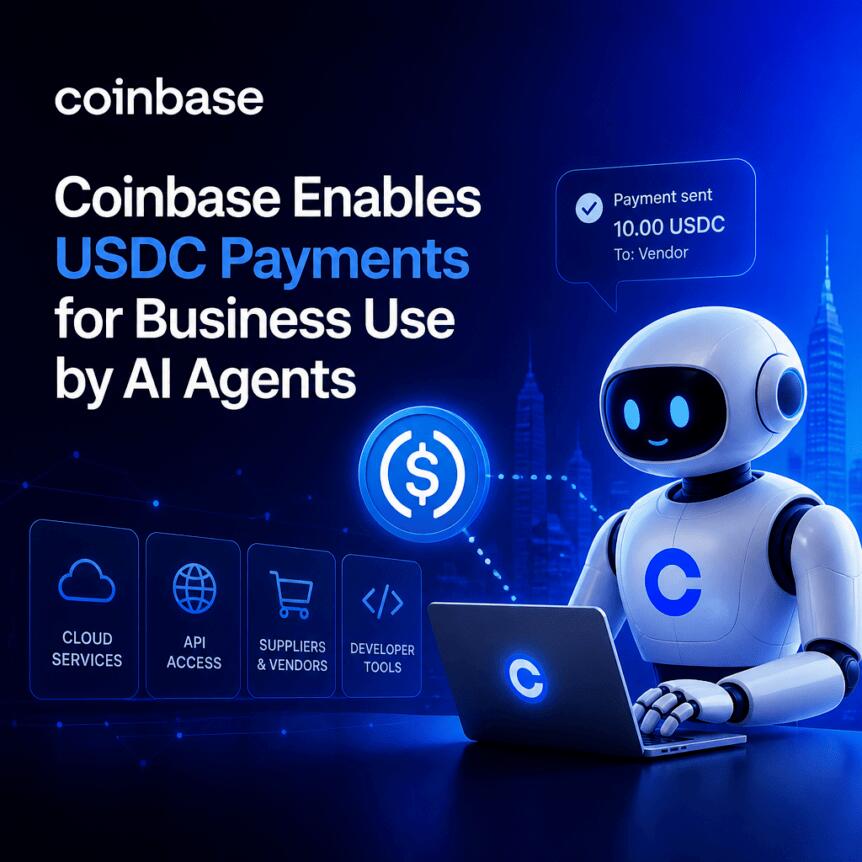
Coinbase is rolling out new tools aimed at what it calls the “agentic economy,” extending its platform so businesses can receive stablecoin payments from autonomous AI agents. In a Thursday update posted on X, the exchange said Coinbase Business customers will be able to accept USDC payments made by AI agents using the x402 payment standard.
The announcement also points to a broader push beyond payments, with Coinbase describing AI-enabled trading functionality for monitoring and condition-based execution, alongside a software development kit (SDK) intended to help developers build agent-driven applications on top of Coinbase’s infrastructure.
Key takeaways
- Coinbase Business will support accepting USDC payments from AI agents via the x402 standard, originally introduced in May 2025 for HTTP-based stablecoin payments.
- Coinbase says it is adding AI trading tools that can pull live market data, monitor orders, and trigger actions based on predefined conditions.
- The company frames the rollout as infrastructure for an “agentic economy,” where AI systems handle payments and financial tasks on users’ behalf.
- Coinbase highlights a mismatch between today’s finance interfaces—built around human-driven actions—and the growing use of autonomous agents in web traffic and developer activity.
USDC payments for AI agents through x402
Coinbase’s latest move focuses on payments. According to the company’s X post, Coinbase Business customers will be able to accept USDC payments originating from AI agents through x402—an interface designed to let stablecoin transfers work over HTTP.
Coinbase previously introduced x402 in May 2025 as a way to make stablecoin payments more compatible with how agents and applications communicate on the internet, including via APIs. The Thursday announcement ties that standard directly to a new business-facing capability: merchants and enterprises can receive stablecoin payments initiated by AI agents, rather than requiring the usual human-in-the-loop flow.
For businesses, the practical significance is that payment execution can become easier to automate. Instead of routing transactions through manual steps, agent software can integrate directly with payment endpoints in a way that aligns with modern web-based communication patterns.
AI trading tools and condition-based execution
Beyond payments, Coinbase also described new AI trading tools. The company says these tools are designed to help users oversee trading activity and respond to market changes using predefined rules.
In its announcement, Coinbase said customers will be able to monitor orders, access live market data, and execute actions based on conditions that users set ahead of time. The details provided in the post position these features as an operational layer for agent-style workflows—where monitoring and decision logic can be packaged into automated routines rather than handled exclusively through manual monitoring.
While the post doesn’t specify which trading venues, asset types, or order types are included, it does clearly emphasize the “agentic” theme: enabling systems that can observe, interpret, and act according to rules.
A developer kit for building agent-powered finance
Coinbase also said it is releasing a software development kit to support the development of agent-powered applications. The SDK is presented as part of the same strategy that includes x402-based payment support and AI trading tooling, suggesting Coinbase wants to provide developers with building blocks that can be used to connect autonomous agents to financial actions.
That matters because many AI-agent use cases depend on reliable integrations—both for receiving funds and for taking actions in response to changing conditions. By bundling payments, market connectivity, and an SDK under one umbrella, Coinbase is attempting to reduce the amount of custom integration work developers typically face when trying to link agent software with crypto rails and trading interfaces.
Why Coinbase is leaning into autonomous agent infrastructure
Coinbase’s messaging places the rollout in the context of how it believes AI agent adoption is accelerating. The company said agent-generated traffic surpassed human traffic on its Base documentation pages for the first time last month, pointing to a shift in how developers and systems are interacting with blockchain-related documentation.
Coinbase also used the argument that the internet’s financial infrastructure was built around a single assumption: “a human clicking the button.” In the company’s view, that design choice has left businesses, developers, and users without tools tailored to AI agents that can initiate payments and execute tasks autonomously.
As stablecoins and blockchain-based payments are increasingly marketed as infrastructure for AI agents, the direction of Coinbase’s rollout fits a broader sector trend. The use case is being targeted by multiple exchanges and payment-focused companies, according to earlier coverage from Cointelegraph about the “autonomous agent economy,” as well as reporting on payment providers exploring AI-agent purchasing and payment flows.
In other words, Coinbase’s change is not just about adding a new payment feature—it’s an attempt to align crypto payment and trading interfaces with how autonomous systems are increasingly expected to operate: with fewer manual steps and more direct API-driven execution.
What to watch next
For users and builders, the key unknowns are how widely x402 support will roll out across Coinbase Business integrations, what the trading AI tools can cover in practice, and how developers will use the SDK to connect agent workflows to payments and execution. As agent adoption increases, the most important test will be whether these interfaces can reliably handle real-world automation at scale without forcing human intervention.
https://www.cryptobreaking.com/coinbase-enables-usdc-payments-for-2/?utm_source=blogger%20&utm_medium=social_auto&utm_campaign=Coinbase%20Enables%20USDC%20Payments%20for%20Business%20Use%20by%20AI%20Agents%20
Comments
Post a Comment