
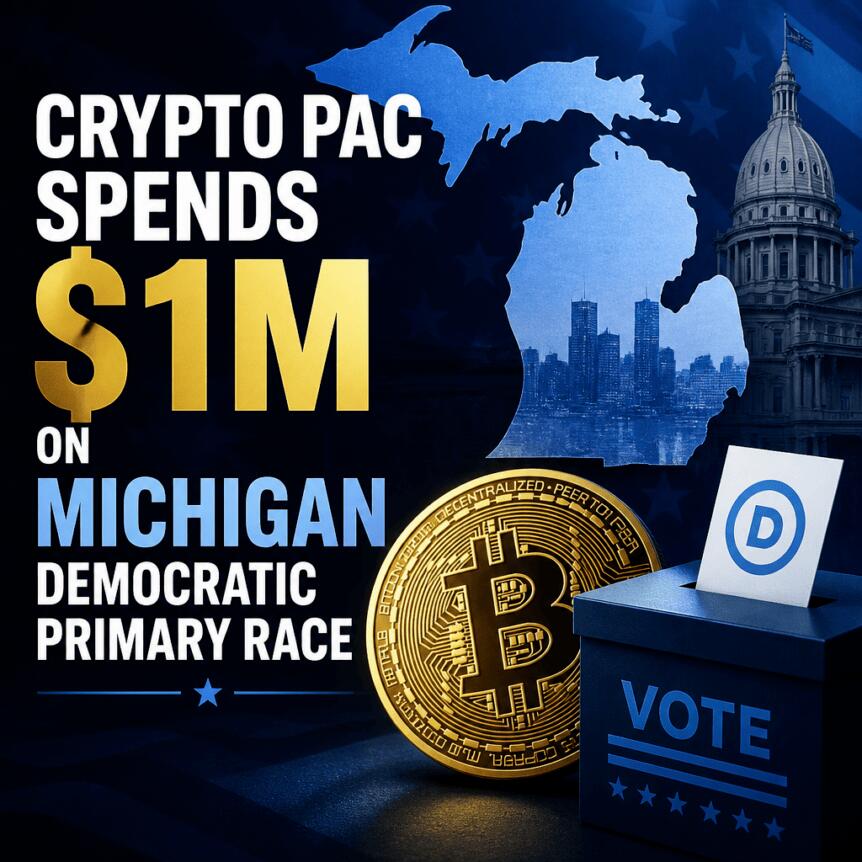
An affiliate of Fairshake—an influential cryptocurrency-aligned political action committee (PAC)—is spending heavily in Michigan ahead of the Aug. 4 Democratic primary for the U.S. House seat in the 13th congressional district. According to filings with the Federal Election Commission (FEC), Protect Progress PAC has reserved roughly $1 million for television and other media aimed at boosting incumbent Democrat Shri Thanedar while attacking his primary challenger, Donavan McKinney.
The campaign effort comes at a critical moment: the primary will decide who moves on to the November general election. The latest spending figures underscore how crypto-aligned political groups are tying financial resources to lawmakers’ voting records and the direction of digital-asset policy in Congress.
Key takeaways
- Protect Progress PAC says it has spent over $986,000 on messaging supporting Shri Thanedar and opposing Donavan McKinney in Michigan’s 13th district primary.
- The expenditures were filed two weeks before Aug. 4, when voters will determine the Democratic nominee for the November general election.
- The Michigan push mirrors Protect Progress’ 2024 spending, when it also backed Thanedar with about $1 million.
- Fairshake affiliates reported a combined $191 million war chest intended to influence key elections, including through multiple PACs.
- Fairshake-aligned spending extends beyond Michigan, with similar activity reported in Arizona and potential spillover into Washington state.
Protect Progress targets the Michigan primary
FEC documentation filed as of Tuesday shows that Protect Progress PAC has spent more than $986,000 on ads. The PAC’s messaging is designed to be pro-incumbent—supporting Democratic congressman Shri Thanedar—and anti-challenger, Donavan McKinney.
The primary is scheduled for Aug. 4. Because the seat’s Democratic nominee will be selected through that vote, the spending suggests the crypto-aligned political operation is focused on shaping outcomes early rather than waiting for the general election.
Why Thanedar and McKinney have become the center of this fight
The spending contrasts with McKinney’s comparatively limited public footprint on digital-assets policy. The article notes that McKinney did not run against Thanedar in 2024 and had not made significant public statements centered on crypto before entering this race. Thanedar, by comparison, has a documented legislative record from his time in Congress.
According to earlier coverage referenced in the report, Thanedar voted in favor of several crypto-related measures during his House tenure, including the CLARITY Act, the GENIUS Act, and the Promoting Innovation in Blockchain Development Act.
At the same time, the challenger’s critique is rooted in campaign finance and campaign spending decisions connected to crypto companies. The report says Thanedar reportedly lost more than $600,000 in the second quarter of 2026 after investing $3.7 million of campaign funds into crypto-related companies.
McKinney also criticized the role of the broader crypto political network in a Tuesday statement tied to the PAC’s spending. In a video posted online, he argued that crypto-aligned groups were “paying” for political leverage and linked that activity to the Trump administration’s record on cryptocurrency and related policy. The statement was presented alongside the PAC spending coverage, reinforcing the narrative that this primary is as much about political access as it is about policy outcomes.
A familiar playbook: repeating the spending pattern from 2024
The Michigan operation is not new. The report notes that Protect Progress spent about $1 million supporting Thanedar in 2024. That year, Thanedar won the Democratic primary with 54.9% of the vote and later captured the general election with 68.6% against Republican and other party challengers.
Re-running a similar level of spending—now in a primary rematch context—suggests Protect Progress and its allies view Thanedar as a key legislative proxy. For investors and political observers, this matters because recurring investment patterns often indicate where crypto-aligned groups expect the policy agenda to move. It also hints at what they may do if a candidate with a less crypto-friendly record attempts to displace an incumbent.
Broader influence strategy: Fairshake affiliates and multiple states
Beyond Michigan, the report describes a larger effort by Fairshake and associated entities. It states that Fairshake and its affiliates reported having $191 million available to influence voters in major elections.
Protect Progress is part of a broader ecosystem of PACs. The report also points to other industry-aligned groups, including:
- Fellowship, described as backed by Cantor Fitzgerald and Anchorage Digital.
- The Blockchain Leadership Fund, described as a hybrid PAC backed by Anchorage and Chainlink Labs.
In Arizona, Protect Progress reportedly spent more than $100,000 on media supporting Representative Greg Stanton’s reelection bid. The report says Stanton voted in favor of CLARITY and GENIUS while in the House and that he won his primary on Tuesday in Arizona’s 4th congressional district with 65% of the vote.
In Washington, the report adds another layer: it says party primaries scheduled for Aug. 4 could be influenced by a Fairshake affiliate. According to the cited FEC filings, the Defend American Jobs PAC spent more than $65,000 on media supporting Amanda McKinney, a Republican running for Washington’s 4th district. The report also references a public statement from the candidate supporting crypto and notes that Representative Dan Newhouse announced in 2025 that he would not seek reelection.
Taken together, the geographic spread suggests a strategy aimed at maintaining momentum across multiple congressional districts—especially where lawmakers have been active on crypto legislation or where challengers are willing to campaign on a pro-crypto agenda.
As Aug. 4 approaches, readers should watch whether similar spending schedules translate into durable primary results, and how the messaging ties specific legislators’ votes and campaign financing decisions to digital-asset policy. The next signals will likely come from additional FEC disclosures and the outcomes of primaries in other states where crypto-aligned PACs have already placed media buys.
https://www.cryptobreaking.com/crypto-pac-spends-1m-on/?utm_source=blogger%20&utm_medium=social_auto&utm_campaign=Crypto%20PAC%20Spends%20$1M%20on%20Michigan%20Democratic%20Primary%20Race%20
Comments
Post a Comment